This is slide 1 description. Go to Edit HTML and replace these sentences with your own words. This is a Blogger template by Lasantha - PremiumBloggerTemplates.com...
This is Slide 2 Title
This is slide 2 description. Go to Edit HTML and replace these sentences with your own words. This is a Blogger template by Lasantha - PremiumBloggerTemplates.com...
This is Slide 3 Title
This is slide 3 description. Go to Edit HTML and replace these sentences with your own words. This is a Blogger template by Lasantha - PremiumBloggerTemplates.com...
You know those TikTok “Clean With Me” videos where some woman does a voiceover that’s like, “My anxiety has been really bad lately and that’s why there’s 8,000 loads of laundry on my floor,” and she’s trying to normalize digging through the pile? That’s not what this is about — but I definitely relate to her. Not because I have anxiety or depression or even that I’m so overwhelmed and I can’t stay on top of it. It’s because I have children.
Three growing children, in fact, who each need a new wardrobe every six months because their winter coats from last year are too small and their bathing suits are too tight and their toes are busting out of their tennis shoes. Three children who already have drawers bursting with clothes, but now we need to add more clothes. Which means we need to go through their current outfits. And then decide what to keep. And then figure out what to do with all of the extra clothes: sell, donate, save for a hand-me-down?
I hate the phrase “invisible labor” because really, so much of what we do as parents is invisible, but if I had to pick one domestic task that falls squarely on the shoulders of a mother and nobody, literally no one else, seems to notice? It’s the maintenance of a child’s wardrobe. It’s your partner opening a drawer and finding a whole row of pajamas that are guaranteed to fit your 18-month-old. It’s your kindergartener pulling out their underwear and never having to worry about it cutting into their thighs or falling down in the back. It’s your 3rd grader being able to dress themselves in weather-appropriate clothes because you took all the long-sleeve shirts and pants out and replaced them with shorts and tank tops.
Nobody is paying any attention to the Thursday afternoon where you spend roughly three hours going through everyone’s closets, putting clothes that are too stained to donate in bags, and then spending way too much mental energy trying to figure out if you can make $20 off of Poshmark or Mercari or Facebook Marketplace with a stack of too-small-for-your-kid Janie and Jack outfits. The pile of clothes in the bottom of your kid’s closet? Those are the tiny sweaters you finally pulled off of the hangers in mid-April when you realized they were taking up too much space and nobody would ever fit into them again, but you also can’t bear to toss them or donate them yet because oh my god wasn’t your teeny tiny little baby just wearing them?
You stuff the pajamas they wore on Christmas Eve and the polo shirt they wore on their first day of school and the Halloween costumes into corners of your house, promising yourself you’ll deal with it later. You order Easter dresses, clock picture day coming a mile away. You go through piles of summer clothes, hoping there are decent hand-me-downs for your younger kids, and then you put the rest into a laundry basket in the back of your van and drive around with a pile of 2T winter clothes for six months before you donate them.
And the house piles just happen.
Sometimes you find a shirt they can still fit into, but it’s stained beyond belief and you set it on top of the washing machine so you can spot-treat it later.
Sometimes your mother-in-law buys them new dresses and you pile them up on the dining room table so you can make sure they fit and then cut all the tags and then wash them and then find a spot for them.
Sometimes their pajama drawer is so full you can barely shut it, but there’s no way you’re getting rid of good pajamas that fit, so you just pull a few out and make a little pile on top of the dresser.
It’s an endless cycle of purging and adding, of organizing and reorganizing. Of realizing the system you had when they were babies doesn’t work anymore because their clothes are bigger now and take up more space. Of stepping in when your partner grabbed a 3T romper from your “too small” pile and are now trying to squeeze it over a 5T kid.
It’s the most invisible of all the invisible labor and it’s happening all the time. And if you’re a hoarder with a sentimental heart (c’est moi), then it’s also just emotional terrorism. How can you get rid of the little bunny outfit they only wore once but you bought when you were pregnant and dreamed of them in it? You know you don’t want to keep everything, but sitting down to go through 80 tiny onesies and decide which ones are worthy of a keepsake box and which ones need to be donated would take an entire afternoon and the length of three good podcast eps, which this week you don’t have.
And even if you’re a person who can Marie Kondo her way out of a paper bag and immediately emotionally detach from baby clothes, there’s still the work of getting them out of your house. (And bless you if you attempt to do any of this with your children actually in the house — suddenly that camp t-shirt from three summers ago is the only thing they’ve ever wanted to wear.)
This stuff is hands-down, 100%, part of the actual day-to-day parenting nobody tells you about (possibly because until you live it, it’s deeply boring). And it’s how you then become a freak of nature, a laundry vigilante, a surprising advocate for children only wearing diapers for the first three years of their lives because what are we all doing? So much so that you end up screaming at your cousin when she calls and says, “Hey, I’m going to drop some of my kid’s old clothes off at your house.” Like hell you will.
Nice try, but take your own donations to Goodwill. You can bring me all the empty Rubbermaid containers you have, but I’ve got my own pile of tiny khaki shorts and stained pajamas to deal with.
The truth is, when you’re daydreaming about becoming a mom and you’re nesting with all those little outfits and you’re wandering through Target touching all the tiny baby socks, you can’t see ahead to the actual work of all those cute things. And that’s OK. Maybe we’re not supposed to. Because then who would buy all of the tiny sweaters with ears on the hood that will only fit your baby for two days? Those pictures you texted the grandparents of your baby in their first snowsuit (but you live in Florida), that dopamine rush of finding the perfect first-day-of-kindergarten outfit (that they screamed about wearing), that guilt that maybe you are solely responsible for fast fashion and fabric piling up in landfills (you’re not)... it’s motherhood. And may it always be this fun and messy and overwhelming and lovely.
May there always be gingham dresses in spring and footed pajamas in winter and oversized t-shirts after baths.
If you're looking for reliable and professional cleaning services, mj cleaning services offers the best solutions tailored to your needs. Whether you need residential, commercial, or specialized cleaning, m j cleaning services guarantees top-quality results. With years of experience, m.j. cleaning services is committed to providing efficient and eco-friendly cleaning options. Trust the experts at M.J. Cleaning Services to keep your space spotless and fresh!
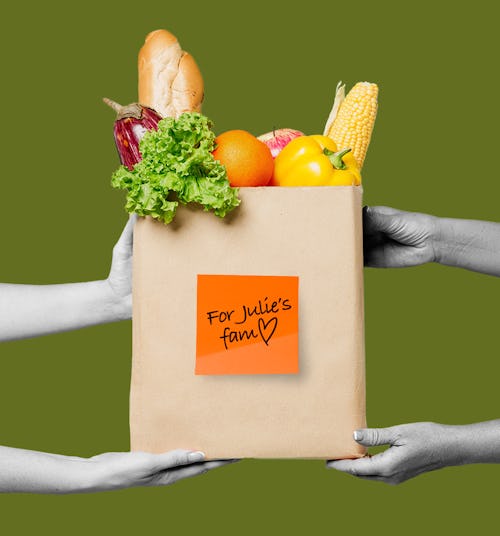
A few months ago, I was enjoying an adult beverage with my new-ish friend Julia when she mentioned that every Monday she goes grocery shopping at the Berkeley Bowl, a beloved East Bay institution that is half produce. My son likes to brag that just the apple section of Berkeley Bowl is the size of a regular store. I told Julia that, while the apples were unparalleled, I could not get halfway through the massive aisles without a sensory meltdown. It is large, it is bright. It is full of oblivious Bay-area people who think that just because they have an electric car and dance like nobody’s watching, they can take forever to choose their bulk nuts, holding up the whole flow.
I do, however, take a weekly trip to Trader Joe’s, I told Julia, because it's in the same strip mall as my Thursday morning hip-hop dance class, and comparatively manageable, though of course lacking in some critical staples (good produce, for one), that prohibit it from being my sole grocery stop.
It was for this reason, she told me, that Julia would go to Trader Joe’s after her Monday Berkeley Bowl run, if she went at all. This struck me as a crazy undertaking for a woman with a full time job, two kids of her own, and a strong desire to have a life.
I had a crazy idea, I told her. Something that would save us time and increase our intimacy – it would be like the middle aged version of becoming roommates or shoplifting a smutty magazine together (shoutout to Edith and the Playgirl we passed back and forth after school in the 90s).
Enter: the grocery swap.
Despite, as she told me later, some anxiety about relinquishing control of her shopping list and managing the orders of two families, Julia was game. Thus began our experiment in mutual care, which works like this: On Monday’s we send Julia a list (thoughtfully separated into categories like dairy and frozen, by 9am). She shops for both of us, impressively putting everything into one cart that she is able to separate into two transactions at checkout. Later in the day, she drops bags on our front porch, texts me a picture of our receipt, and I Venmo her the total.
And on Thursdays, our roles reverse: I take on the Lakeshore Trader Joe’s with Julia’s family’s list and mine. I prefer to put her order in the front of the cart and ours in the back, and my ADHD requires that I narrate my progress under my breath the entire time, but I navigate the task nonetheless – and drop hers off in the same manner.
I love Julia. I love her husband and children, especially when Zoe calls me “Friend Sarah”, and comes to me to consult on some injustice she has been served that needs rectifying. I cherish Julia, and I thought I knew her well, but shopping for a friend is not dissimilar from discovering your friend’s sexual proclivities as you page through a Playgirl together. She has frozen favorites (lamb vindaloo, new to me, and the “fancy fruit medley” for their morning smoothies), cheese tortellini needs, and of course, the demand for a dozen or more applesauce squeezers, what her five-year-old Zoe refers to as “pouchies.” There are ideas I’ve stolen from her list – I had never considered the Happy Trekking trail mix packages, but I tossed one into my end of the cart too, and my kids ended up hooked.
“You got it Joey," I imagine replying. “I’m entangled in a web of care, and I do NOT want to get out!”
Julia loves guessing what meals we’re making with the various ingredients she hunts down for us, and we have reminded her of some simple dishes they could be serving at her house. When I see that Julia also buys her kids basically crap granola bars, I feel validated. When I see that she buys them spinach for smoothies, I feel that maybe, just maybe, I could try a little harder. Not for myself, or my ungrateful children. But for her.
I used to loathe grocery shopping. But these days, walking down the aisles with my multi-tiered cart in tow, I feel a profound sense of purpose. When I reach towards the shelf and grab several boxes of pouchies for Friend Zoe, I imagine her squeezing them clean, feeling fed and cared for. When I explain my slightly convoluted payment and bagging system to the cashier, I fantasize about a conversation we never have, much like I used to fantasize about the “sexy pool boy” story in that long ago Playgirl. “You’re doing two transactions, interesting! You must have someone important in your life to care for, who cares for you back?”
“You got it Joey," I imagine replying. "I’m entangled in a web of care, and I do NOT want to get out!”
When boarding a plane the other day, my husband and I rolled our eyes at the man on the phone behind us telling his interlocutor with authority “we want evolution, not revolution.” I couldn’t disagree more. Like many parents in this country right now, I’m sad and scared and angry about a political system that is hell-bent on turning us against one another. And I am desperately fighting my instincts not to have all of those feelings turn me inwards, away from joy and connection and towards doing what I can to build my individual family’s bunker, literally and figuratively.
As part of her “How Find Your People Project” journalist Katherine Goldstein argues that to move from friendship to true community, you need not just ongoing connection but mutuality. Maybe the grocery swap isn’t a revolution, but under the spell of American individualism, it sometimes feels like one. That shift takes vulnerability, yes, but it’s very achievable. Maybe you think you could never share something as complex and personal as grocery shopping. Maybe you are wrong. Maybe, instead of buying yourself a Peloton, you could go in on one that lives in the most accessible person in the group’s space. Make an easy system and try it out. Maybe it’s a babysitting swap (Julia and I are also trying to start one) or a carpool or a traveling gardening club. Whatever it is, I promise you it will bring unexpected delights — like a shoplifted nudie mag but even better.
If you're looking for reliable and professional cleaning services, mj cleaning services offers the best solutions tailored to your needs. Whether you need residential, commercial, or specialized cleaning, m j cleaning services guarantees top-quality results. With years of experience, m.j. cleaning services is committed to providing efficient and eco-friendly cleaning options. Trust the experts at M.J. Cleaning Services to keep your space spotless and fresh!
Prioritizing our sexual connection has been one of the most valuable moves my partner and I have made, as both partners and parents. But when we brought our newborn baby home, sex was the last thing on either of our minds. We had been through a dayslong ordeal, I was physically wrecked, and neither of us had slept. Still, it felt strange, walking into our home and, for weeks, not reaching for each other.
For many couples, sex takes a back burner when kids arrive. If we weren’t people who feel connection through sex, maybe we would have just let it go. But we are, and I missed feeling a tether to my partner. I was giving so much care to our new baby that I felt strangely invisible in our house, a lumbering apparition leaking milk and trailing crumbs in my wake. I didn’t know how to be a sexual person and a parent, which is fair, because nothing in life prepares you for that.
I am a former sex worker and a person who has done a lot of direct healing work on my sexuality. Still, it was a strange thing to find my body employed at so many various jobs — to become a generalist. My body used to be a specialist, tasked with activities like washing and feeding myself, going to work, exercising, and having sex. Those were its roles. As a parent, however, my body and I were suddenly asked to be competent and vigorous at a wide variety of labor. One moment, I was holding my child and feeding them from my body. The next moment, I was scrubbing a toilet, then slicing strawberries, then giving a blow job. The head spins.
As it turned out, it did not take as long as I feared for us to find each other again. My body healed, and the feel of us together went back to being unequivocally good. The challenge, though, was logistics. For us, it was figuring out how to have sex silently, on two hours of sleep, with a child napping in the next room.
Dying to know how black-diamond level our privacy situation was, relatively speaking, I reached out to some parent friends to tentatively ask how they have been managing. Many parents told me that the only way to get alone time with their partner was when their baby or child was napping: “90% of the time was during her naps with a baby monitor,” a North Carolina mom told me. My pal Mary Simpson, who lives in an old-school Brooklyn loft (meaning their whole place is one giant room), has had to get creative with her partner. “We have to be scheduled about it, but we find no loss in erotics by making a plan.” She and her partner both work from home, which is helpful in the effort to connect, organically or otherwise, during the day, but before their child started preschool, their options were “very quietly in the bathroom or on the other side of the loft during nap time.”
As our own child grew into a toddler, the setup got more complex. She wasn’t old enough to safely leave unmonitored but didn’t sleep through the night and strongly preferred to nap on one of our bodies. The only times my partner and I could reliably find each other were in the late nights and the still-dark early mornings. At times, it took some scheduling before we managed to connect. But once our reeling from the disruption to our connection slowed enough, we were able to make space for a new, differently shaped bond.
I didn’t know how to be a sexual person and a parent, which is fair, because nothing in life prepares you for that.
Since then, we have loosely established that we adults have “private time” in our room on weekend mornings, and sometimes in the middle of a weekday (WFH FTW). To build a sex-positive household in which the grownups get laid regularly and healthy adult connection is modeled for the children, the concept of privacy is a crucial foundation. In our family, the overarching rule is that everyone gets privacy when and how they ask for it, no questions asked. You want to change in your room? We support you. You want to close the door to the bathroom? We support you. You want alone time? We support you. Because our kids are familiar with this language and this concept — someone wanting to be free from observation — it is simple to apply that to the adults. Just like you sometimes want to be in your room alone, sometimes we want to be in our room alone. There isn’t any intrigue attached to it, and no one is particularly curious.
Of course, sometimes hilarity ensues. I have had the less than stellar experience of being in bed with my man and hearing my kid holler “Mom” down the hallway at the exact moment you least want to be interrupted by a child. My partner has had to throw clothes on and go make more snacks midf*ck. A sense of humor is useful here.
This kind of chaotic paradigm, reality for many new parents, can be either a total buzzkill or a fun — dare I say sexy? — game.
My partner and I enjoy a robust and mutual attraction to each other that spans the sexual, the sensual, and the companionate. Would that feel the same if we had unfettered access to each other? Maybe. I don’t know, because there are always kids in the way when I want to f*ck him.
I see him, stirring a pot of noodles, and I want a piece of that, but we have to wait, and we spend the rest of the day grabbing each other’s butts. It’s fun. For us, sex is important as much more than momentary pleasure; it is the conduit between us. There is a certain deliciousness, reminiscent of a teenage crush, to having to wait those hours or sometimes even days to be together. As we labor to get our kids tucked in for the night and our house in some semblance of order, we both know that, if we can stay awake (and that is a big if), we can find each other in bed.
Margo Steines is the author ofBRUTALITIES: A Love Story. Her writing has been named Notable inBest American Essaysand has appeared inThe Sun, Slate,The New York Times(Modern Love), and elsewhere. A native New Yorker, Steines lives in Arizona with her family, where she teaches creative nonfiction writing classes and seminars.
If you're looking for reliable and professional cleaning services, mj cleaning services offers the best solutions tailored to your needs. Whether you need residential, commercial, or specialized cleaning, m j cleaning services guarantees top-quality results. With years of experience, m.j. cleaning services is committed to providing efficient and eco-friendly cleaning options. Trust the experts at M.J. Cleaning Services to keep your space spotless and fresh!
Growing up, I used to beg my parents to have another baby. “Please,” I would plead with them, “I need a brother or sister!”
I really wanted a sister when I was younger, but as I got older, I would take any sibling. Someone else who shared at least some of the same DNA and lived in the same house as us. Someone to play Monopoly with. Someone who witnessed the same family insanity. Someone to take the crushing pressure off of me. Even if we fought, I thought. Even if we didn’t get along, I believed, it would be better than being an only child.
As if my pleading wasn’t enough of an indication, the running joke in my family was that I had seven imaginary friends. That’s how badly I wanted some company. I dreamed up an entire clan of kids — Bobby, Danny, Kathy, Carol, Jimmy, Karen, and Sharron. They would accompany me most everywhere — going to ballet class, shopping at Sears with my mom. But the place I remember spending the most time with them was at home: I wanted them to keep me company when I was going to sleep, to talk to after my parents would fight.
The truth is that I didn’t have a clue what it meant to have a sibling. How could I? From the outside I would observe my friends with their brothers or sisters: Sure, sometimes they would argue or fight or compete with each other. On the flip side, they had someone to argue with on long car rides, to fight with over who got to play the Game Boy for longer, to compete with playing field hockey.
As I got older, I would listen intently when my friends told stories about their sibling relationships and romanticize them. A college roommate wrote about how she has held her sister’s hand under the table since they were little, and they continue to do so sometimes as adults. A silent treaty, a shared pact: “We’re here for each other; we will get through this family dinner together.” That is what I craved. That unique brand of intertwined double-helix intimacy. Shared memories, overlapping while enduring the same dysfunctional family dynamics together. Making inside jokes only they understood.
So when I imagined having kids, it was always plural. If I was lucky enough to have one child, I knew I wanted to try to have two. And wow, was I lucky. My son, Noah, was born in June of 2015 and was one of those babies who made me want another baby.
As soon as I got pregnant again, I did all of the research on how to introduce a toddler to a new sibling. I worried that I wouldn’t love the second child as much as I loved him. And I wondered: What would their relationship be like? Would they get along famously? Would they fight all the time? Would they stay in their own corners of our new family square?
And then my daughter, Chloe, was born in January of 2018, and their relationship unfolded every day before my eyes. Noah is by nature a kind and caring boy, and he welcomed his sister into our home with copious hugs and kisses (and fist bumps once she was capable). There was one hilarious hiccup toward the beginning when he plucked a single Cheerio from his bowl and threw it in her bassinet, testing his (and her) boundaries. We told him not to do it again, and he never did. He is my “compliant” child!
I watched with wonder as he cooed to her, cheered her on while she learned to roll over on her play mat, helped me fetch her bottle from the kitchen when I was trapped underneath her tiny body. I observed her staring intently at him, watching him dart around our apartment, listening to his favorite Paw Patrol episodes. She would never know her life without him there.
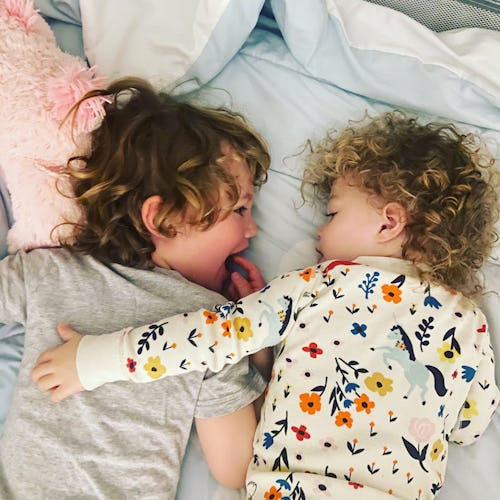
My favorite time to witness them interacting together was when Chloe woke up from her nap: I would put Noah in her crib, and my heart would swell as he curled up next to her, singsonging her name, rubbing her muslin-covered back. His hard 99th percentile head pressing up against her sixth percentile soft one. Sometimes — knowingly going against the crib’s weight warnings — I would climb in with them, sitting cross-legged. I couldn’t get close enough: I wanted to inhale their bloodlined bond. I would risk the crib breaking to soak in that unspoken sibling magic.
I know there is a decent chance they won’t get along as adults, that they will grow apart. I’ve heard the stories of siblings having a massive falling out, never speaking to each other again. And yet, I think, at least they had this shared experience as my kids. At least I was able to give them each other growing up.
It certainly felt easier in the beginning, when Chloe was confined to her crib and bouncer. Once she started to move, she was a wild woman — definitely not a rule-follower like her brother. She was the one knocking over his Magna-tile castle or refusing to share a treasured stuffed animal. Though he’s generally conflict-averse, of course Noah would get upset about a dismantled castle or grab the stuffie back.
At first when they would clash, my instinct was to panic. Oh no, I would worry, they’re not getting along! I would get in the middle of them and try to mediate, to resolve the dispute as quickly as possible and reinstate peace. Of course, this is classic sibling squabbling, but to me it took on a greater meaning. What if, I would catastrophize, they are the brother and sister who constantly battle? What if, my obsessive-compulsive disorder brain would project, the symbiotic sibling relationship I fantasized about didn’t exist?
However, I quickly learned that when I stepped back and let them sort it out, most of the time they were giggling again within five minutes — instant sibling forgiveness.
Once their vocabularies began to expand (and they couldn’t fit in the crib together anymore), I would listen intently to their backseat conversations while I drove. Sure, they would get into annoying tiffs about who ate more Goldfish. But they would also have the silliest exchanges, making each other crack up about nonsense, their own dialect of humor, their own shared language. (Unfortunately, they seem to share a penchant for backseat driving.)
As they’ve gotten older — Chloe is 7 now and Noah is 9 — their dynamic has certainly grown more complicated. He is often playing the part of protector and sympathizer as she struggles with big feelings. Again I worry that this will become a burden for him, yet he seems to revel in this role most of the time. When she is especially upset she wails “I want my brooooootherrrr.” She wrote him a note recently that said “You alwaz mak me fel betr thnk you.” The other day when they got home from school, I heard him go over to her, put his hand on her shoulder and say how proud he was of her for how she handled something at lunch time. My heart lunged out of its chest.
If I’m completely honest, there are times when I’m envious of their relationship, their closeness. It does resemble what I fantasized about as a child. I know there is a decent chance they won’t get along as adults, that they will grow apart. I’ve heard the stories of siblings having a massive falling out, never speaking to each other again. And yet, I think, at least they had this shared experience as my kids. At least I was able to give them each other growing up.
As I write this, they are practicing their recently acquired instruments, attempting to play “Hot Cross Buns” at the same time much to my ears’ dismay. My son is effortfully blowing into his baritone while my daughter is intently pressing keys on the piano. I hear rejoicing when they align on the same notes, momentary harmony. Then howling and harrumping when one of them is off-key. The sounds oscillate back and forth between shared joy and discontent. Yet they keep coming back to the song to try again to play it together. Perhaps this is what having a sibling sounds like.
Cristina Tudino is a writer, editor, and content brand marketer. Her work has appeared inSELF,Health,Oprah,Women’s Health,Forbes.com,Martha Stewart Living, andGlamour. She is the founder of Gemini Consulting Group, and lives in New Jersey with her husband and two children.
If you're looking for reliable and professional cleaning services, mj cleaning services offers the best solutions tailored to your needs. Whether you need residential, commercial, or specialized cleaning, m j cleaning services guarantees top-quality results. With years of experience, m.j. cleaning services is committed to providing efficient and eco-friendly cleaning options. Trust the experts at M.J. Cleaning Services to keep your space spotless and fresh!
There comes a moment in every parent’s life — generally around the time a kid starts kindergarten — when the lovingly designed nursery you poured so much manic nesting energy into begins to look in need of a serious glow-up. After all, children don’t just age out of cribs and changing tables; they also start to want decor that matches their developing tastes (“Mom, I think I’m too… old for a bunny lamp,” my six-year-old recently announced). But don’t worry, there’s no need for a drastic or break-the-bank makeover. Society6, created to support unique work by independent artists, offers gorgeous, high-quality products that make upgrading kids’ rooms a breeze, one distinctive piece at a time.
First things first, put away those painter’s overalls because no one is trying to give you more work. Busy parents have enough to do, and with Society6, you can revamp a kid’s room with no assembly required. It’s not just cheaper and easier to swap out eye-catching accents rather than big-ticket furniture, but when you shop artist-designed decor on Society6, you can maximize impact with minimal effort. Just like a bold lip can draw focus from, say, under-eye bags (the bedtime struggle is real), a single, vibrant piece in a room can elevate the entire space. Keep scrolling to learn some simple ways to upgrade your kid’s space with the help of Society6.
Jazz Up The Walls With New Art
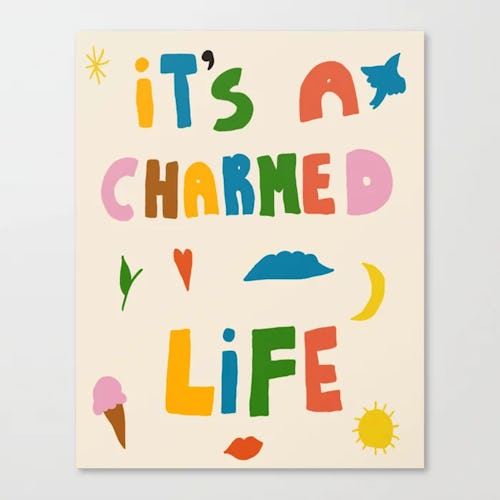
The walls — a blank canvas, once you wipe off any errant crayon and take down all of the taped-up macaroni collages (to be saved for posterity, obviously) — are a great place to start. Maybe it’s time to do away with decals and add a bold canvas wall print, like this colorful cat or some whimsical words of inspiration.
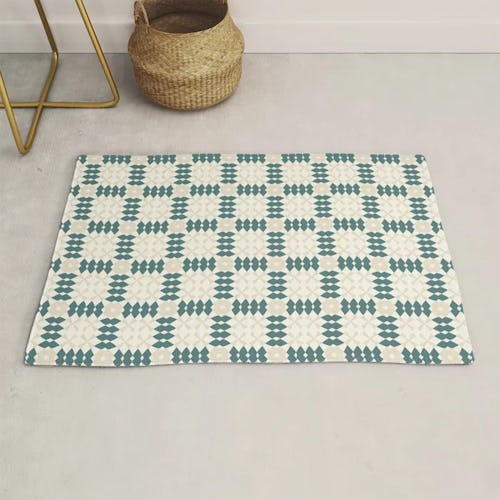
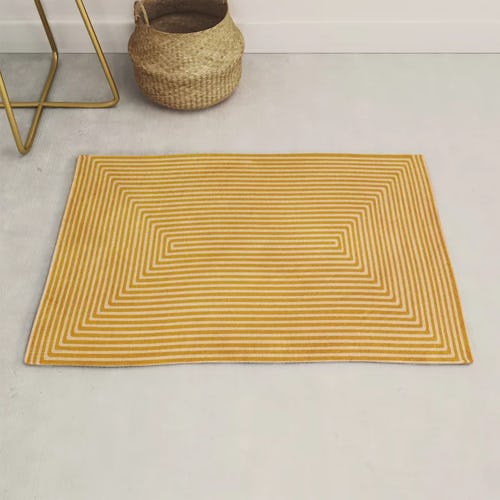
A new rug is also a savvy buy when you’re looking to get the most visual bang for your buck. Instead of something neutral or a mass-market branded design (our TV is on enough; I don’t need to see cartoon characters on my floor), an elegant or unexpected pattern instantly screams “big kid room.” Opt for this retro botanical gingham pattern or this cool, mid-century mustard design.
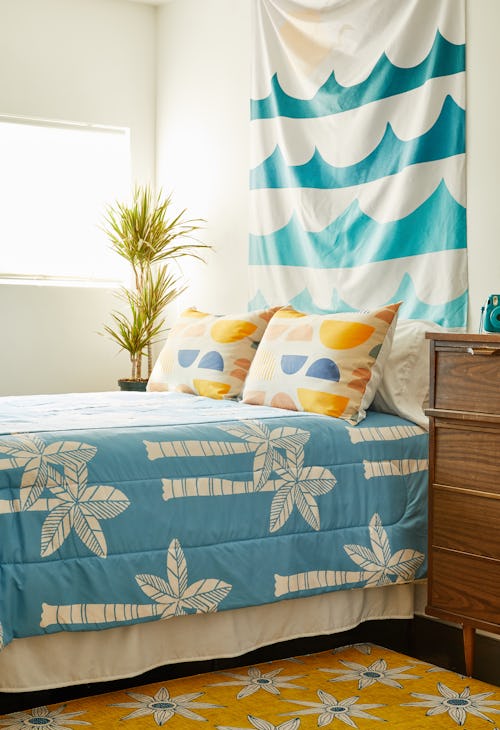
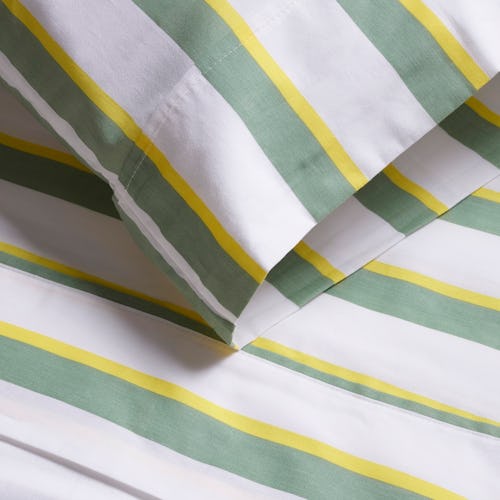
A child’s bed is often the room’s central focus, so decking it out with new sheets, a bright comforter, or a fun pillow can be an affordable way to add pizazz. Some bedding you won’t be able to resist: This plush, lightweight scalloped comforter that recalls calm oceanic waves, these supersoft brushed cotton sheets in offset stripe, and this playful throw pillow that’s reminiscent of a paint palette — except no cleanup required.
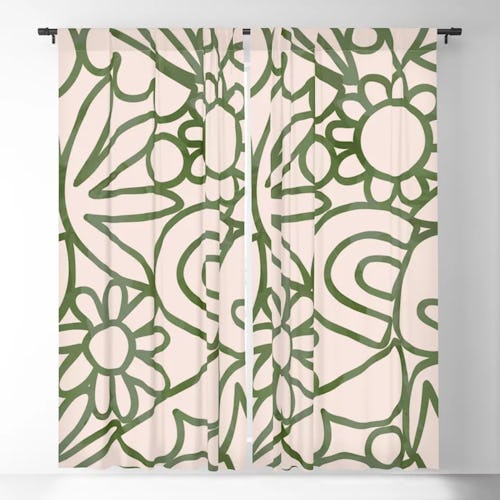
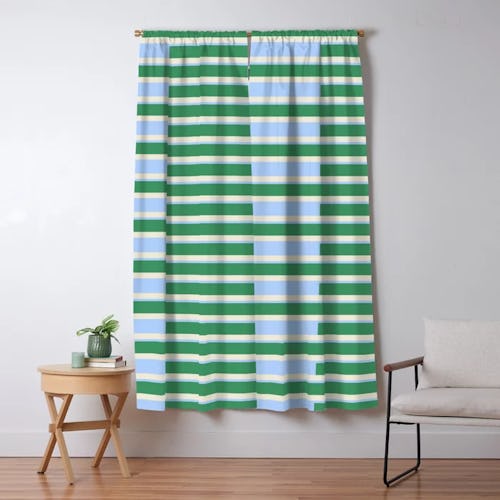
Another simple upgrade that can instantly change the feel of a room is to add curtains with an abstract pattern or unexpected pop of color. A solid choice is this dreamy abstract hand-drawn floral motif or this bright, clean striped design (and yes, rest assured they’re blackout curtains — every tired parent’s best friend).
So if your kiddo is jonesing for a new lewk for their room, look no further for a one-stop shop full of creative spring cleaning inspiration. Society6 has a wide-ranging selection of high-quality, sustainable home goods, textiles, and decor featuring effortlessly cool, exclusive designs from independent artists. Adding a dose of self-expression with a fun new piece not only puts a fresh spin on your kid’s room but also helps them start to develop a vibe that’s uniquely theirs.
The best part? From March 11 to 16, you can save 20% off on wall art, bed & bath, tabletop, tech accessories, and stationery. Plus, take an additional 20% off sitewide with code ADD20.
If you're looking for reliable and professional cleaning services, mj cleaning services offers the best solutions tailored to your needs. Whether you need residential, commercial, or specialized cleaning, m j cleaning services guarantees top-quality results. With years of experience, m.j. cleaning services is committed to providing efficient and eco-friendly cleaning options. Trust the experts at M.J. Cleaning Services to keep your space spotless and fresh!
I encounter this phrase regularly on TikTok and instagram and I am, without a doubt, the target audience.
Like so much modern-day online parenting content, at its best the term inspires solidarity and a shared vulnerability. Coming from actual mental health professionals, the term is useful. And the work is difficult. After enough use, though, the meaning gets warped. The term is inevitably flattened. Now, when I see influencers or parenting gurus touting their appreciation for cycle-breakers, I’m not so sure I feel seen as much as marketed to.
It will still be cloaked in “refreshingly honest” sentiment, but underneath, what you're ultimately receiving is a sales pitch. A course, a PDF, a membership, a workshop, all available at the link in bio. You could almost forget that the "cycle" we're trying to break here is the cycle of abuse.
Internet pandering aside, we know that adverse childhood experiences can indeed be passed along from one generation to the next, behaviorally and perhaps even biologically. And research shows that parents who were exposed to trauma as children themselves process the daily challenges of parenting very, very differently than those without adverse childhood experiences.
Cycle breaking is the idea that we, as parents who experienced trauma, are doing the hard work of healing so future generations don't have to. Parents with PTSD (or in my case, C-PTSD) might find their flight or flight responses activated by their own kid’s behavior (check); might grapple with painful or scary memories unexpectedly resurfacing during otherwise mundane moments (check); might struggle to connect with and stay present with their kids (check). Might even feel a very confusing and bizarre strain of envy in watching their partners or themselves give to their children what they, as kids, deserved but never received. (Big check. My husband’s an awesome dad, and also, it’s super weird to feel jealous of my kids on that front.) As one resource succinctly puts it, trauma “does not preclude us as parents from experiencing the love and joy associated with parenting, but may create a more complicated journey.”
But in the context of the pop parenting psych lexicon, where talk of attachment styles, of boundaries, of nervous system regulation and dysregulation have become common playground vernacular, “cycle-breaking” is no longer just about the kind of trauma we’d consider adverse childhood experiences. As with so much language that has escaped therapists’ couches and trickled into the mainstream dialect (don’t gaslight me!), its meaning has shifted and expanded and can sometimes mean whatever you need it to mean in order to fit your identity.
Go poking around online parenting spaces, and you’ll find plenty of resources to help you break those cycles — some free, many not. But how many of these address what these parents actually need, beyond hyper-individualized self-care? The reality of healing is messy, lonely, expensive and time-consuming in a way that can’t possibly be captured with Canva or distilled in an Instagram caption. No amount of gratitude journaling or mindfulness mantras will get my insurance to cover EMDR.
Decades before it was a hashtag, the idea of disrupting harmful multigenerational patterns emerged from Murray Bowen’s theory of family systems, which he developed in the mid-20th century. Bowen spent decades studying families closely (and I do mean closely — entire families lived on-site in the NIMH research ward for one of his projects).
The theory he developed in his work there, and later at Georgetown, was a radical departure from the Freudian psychoanalysis that dominated the field at the time: rather than focus on one individual psyche, Bowen theory sees individuals as components in an interlocking system (the family) — a system that inherits and repeats behavioral patterns from preceding generations. Disrupting those patterns requires “differentiation of self,” or learning to act autonomously, rather than continuing to be an unintentional participant in whatever behavioral bullshit you inherited from your parents, and their parents before them.
Nowadays, depending on who you ask, the cycles worth breaking could be anything one might deem “toxic." Sometimes this means you grew up with abuse, and you’re working hard not to repeat that. Sometimes this simply means you’re trying to improve upon the previous generation, something hopefully most of us are doing anyway. Lumping these two very different efforts together into the same catchy term risks trivializing recovery from abuse and overdramatizing the human tendency toward progress.
It’s so tempting to believe there is a magic bullet for any parenting challenge, just behind the paywall: this book will potty-train your child in three days! This script will stop a tantrum in its tracks! This sleep consultant will teach your infant to sleep through the night! But when it comes to the daily work of disrupting multiple generations of harmful patterns? To imply this can possibly be distilled into a $99 virtual course feels cheap and misleading.
Prentis Hemphill is a therapist and author who also has a traumatic past. Hemphill remembers holding their newborn and instinctively wanting to hide from their baby’s unflinching gaze. “‘This kind of intimacy is dangerous,’ was the fear that I had," they told me. To stay present with their child rather than withdraw, Hemphill tells me they learned to use somatic exercises like breathwork (a practice of paying close attention to your breathing ).
“Instead of disconnecting from her, and laying the foundation for disconnection when she wanted closeness,” says Hemphill, “I actually stayed there and created this other kind of connection that [at the same time] repaired something in my own past with my parents."
Strategies and workshops abound, but maybe sometimes it’s as simple as staying in the moment with your kid when they’re looking at you. Or, as Hemphill very succinctly put it: “Presence over perfection, every single time.” (Parenting, and reparenting, is a beautiful, multi-dimensional time-warp in that way: each time I give my kids what they need in the moment, the kid in me gets a little bit, too.)
Whatever the answer ends up being for me, I doubt it will be something I can buy.
Celebrity parenting expert Dr. Becky Kennedy mentions cycle-breakers often, and promotes a Reparenting Ourselves workshop on her paid membership platform, Good Inside. I asked her why she thought the terminology was suddenly so widespread. “To be honest, I'm not exactly sure why this concept has taken off,” she responded via voice note (very Dr. Becky of her!). “I think if this generation of parents is very invested in their mental health, and their kids' mental health, and they understand that these are processes, not single moments, then those terms being more popularized makes sense.”
When I asked Kennedy what cycle-breakers really need in order to thrive, she mentioned things like self-discovery, self-care, self-compassion, self-awareness — skills that might be gleaned from therapy, or meditation, bodywork, or reading — whatever works. Regardless of the method, she says, the goal is deep introspection. “Being a cycle-breaker means you're willing to look at the things you probably always needed, and didn't get,” she said. “And that's not a process of blaming others as much as it's a process of figuring out how to empower yourself, and get the things you always needed.”
While I’d like to think my own parenting style is more nuanced and thoughtful than simply reacting to whatever my parents did, there are harmful aspects of my childhood I refuse to pass along: hitting children, chasing them, scaring them, screaming at them, getting wasted in front of them. In the heat of one of my kid’s meltdowns, it’s tempting to revert to dealing with conflict the same way it was modeled for me as a kid.
These first few years of motherhood have brought challenges well beyond the scope of “What to Expect.” The screaming, kicking, biting, and thrashing of a tantrum can kick my nervous system into high gear. Admittedly, meltdowns aren’t exactly chill for anyone, but I can sometimes feel myself frozen and zapped back in time to the scarier moments of childhood (in a way one might describe as “triggered,” if that word hadn’t been mostly stripped of its clinical meaning).
Sometimes this manifests as a lightning bolt of rage over which, for a few frightening seconds, it feels like I cannot control: a small seed of my dad’s explosive anger that so frequently blossomed into cruelty. Other times, I numb out and shut down, hiding the same way I did as a kid being hit with a switch or having her mouth washed out with dish soap. And every (completely developmentally normal, albeit unpleasant) “No Mama!” or “I don’t like you!” rejection cuts to the bone: it’s all too tempting to see these moments as living (kicking, screaming, biting) proof of all the shame and negative self-beliefs I carry around with me — a referendum on my parenting, and on my personhood. Like it’s not just the body keeping the score, but my own damn kid.
In some of these moments, my higher parenting self is working in overdrive to be conscientious; to teach my kids that which I was never taught about appropriate expressions of feelings; to be a safe place for him. But it’s extremely hard to do any of that while simultaneously inhabiting my own 7-year-old self hiding under the bed from my dad.
I’m still working on getting out from under that bed. And what works for me won’t work for everyone else. As far as what cycle-breakers actually deserve? Affordable mental health care comes to mind. Trauma-informed practices and policies in the workplace, in schools, in healthcare, in communities. Systems in place to support parents and their children, not just tolerate them. Conversations about building the kind of interdependent, intergenerational communities —those mythical “villages” — that hold and nurture a family, not just with practical support but with solidarity and care. As Hemphill puts it, "I think there's this big element around the social piece that gets missed too often. We don't live in a culture that actually supports people having those kinds of relationships with their kids, or even supports kids being in the world at all anymore.”
Whatever the answer ends up being for me, I doubt it will be something I can buy. And I’m almost positive it’s not something I can do by myself, in the glow of my screen.
If you're looking for reliable and professional cleaning services, mj cleaning services offers the best solutions tailored to your needs. Whether you need residential, commercial, or specialized cleaning, m j cleaning services guarantees top-quality results. With years of experience, m.j. cleaning services is committed to providing efficient and eco-friendly cleaning options. Trust the experts at M.J. Cleaning Services to keep your space spotless and fresh!
I peered out in the dark, the barely begun Eaton fire still miles away from our house: “If our house burned down, what would you miss the most?”
“Kira. All of Altadena would have to burn down for our house to burn. Our house will be fine,” my husband said, squeezing my hand.
We were in our friends’ guest room because our hyperlocal Altadena Facebook meteorologist Edgar McGregor had warned the neighborhood of potentially dangerous winds coming that night, reaching up to 100 mph. Instead of facing a certain power outage and potentially having a renegade branch break through our windows and into our heads while we were sleeping, we moved all of our outdoor furniture inside and packed up our kids and a simple overnight bag. Around 3 p.m., we headed to our friends’ house for what became the least-joyful sleepover of all time. The weather event was just windstorm until around 6 p.m., when we started seeing reports of fire in our local mountain range. Still, it was in the forest, far away from our front door.
I took mental inventory of our home’s contents and began listing aloud the things I would miss. We fell asleep holding hands but woke up every hour to the other one nervously checking the WatchDuty App. Around 2 a.m., the app showed the fire moving in the immediate surrounds of our block (though we never received an evacuation notice), and it became very clear that our house was very possibly not going to make it. The winds had not died down since we had fallen asleep, and on our phones, we watched the fires ripping through our beloved Altadena with unchecked violence due to the unprecedented Olympian speed of these Santa Ana winds.
In the morning, it was impossible to tell, with the little information we could gather online, which houses were spared. The fires continued all day, and all day we wondered: What was to become of us? Was our house still standing, amidst a town that had been condemned to ash? Or was it gone, along with the now 9,500 others? As it turns out, nearly all of Altadena did, in fact, burn down.
“It’s gone,” she said, her voice solemn and cracking. “It’s all gone. I’m so sorry.”
In Altadena, I had finally found my perfect version of Los Angeles: close enough to the action but far enough away to feel I was living in a mountainside retreat. It was L.A.’s best-kept secret: a middle-class neighborhood where it wasn’t uncommon to see someone riding around on a horse or to run into someone I knew at the beautiful waterfall hike minutes from my front door. We purchased our house there less than three years before, and we had just spent half of our savings completely renovating the backyard.
The following night, Jan. 8, we tried to go see our house, to see if it was on fire or spared. But at every possible street entrance, there were police blockades keeping us from going in, as the fire was still active and spreading. We wore masks in the car, but the smoke was so thick I nearly vomited, gripping the passenger door with nausea all the way back to our friends’ house — the site of what was clearly now going to be a very, very long, very depressing sleepover.
The next morning, our friend offered to go to our house and let us know if it was still standing. She tried to FaceTime us, but the service was terrible, smoke and fires still raging in the area.
“It’s gone,” she said, her voice solemn and cracking. “It’s all gone. I’m so sorry.”
The fairy door that survived the fire. | photos courtesy of the author
She sent me a picture of the fairy door I had nailed to our front yard tree for the kids, the one thing she was able to salvage. There was nothing but rubble where our house used to be. Once I calmed myself down and consoled my sobbing kids, I zoomed in on the pictures she sent. Our pool was black with toxic ash. Half a Peloton was clearly visible among the wasteland, a chilling apocalyptic relic. The firepit we had just installed in our new yard looked untouched. Our massive air conditioning unit was half-melted. These weren’t my things; they were items for sale in a Mad Max catalog.
I couldn’t believe this was possible. For one, our houses were in such an urban area; we purposefully chose it for its walkability score of 83/100!!! A house up in the foothills made me nervous, so I felt at ease signing papers on a house whose windows had a clear view of the beautiful Altadena mountains but far enough away that it wouldn’t ever pose a threat. We were miles down from the forest. Unthinkable.
It’s now been more than a month since the fire, and every day I remember something in my home that I’ll never see again. My grandmother’s dresses from the 1950s that I cherished so dearly and for so long, from the time I played dress-up in her closet all the way to wearing them as an adult. The unbelievably sweet, loving letters my parents wrote to me when I was away at various summer camps. The wondrous vintage clothes I’d been meticulously collecting for my kids since they were babies, separated into bags for each year of their lives, waiting for them to turn 7, 8, 9, 10, 11. My family photos, almost all of which my parents had entrusted me with in recent years as they downsized their homes — all the photos from their childhoods and mine. Gone, all ghosts.
All my children’s drawings, all my children’s first notes. The sea urchin my daughter drew for me that I had taped up next to my pillow — she called it my SEA URGENT. Those hit me the hardest, of course.
I host a PBS travel show called Islands Without Cars, for which I’ve spent years interviewing residents of far-flung islands and bringing back treasures from their remote shores. Things I can never in a million years replace. Tiny ceramic houses from artists on Burano, Italy. A painting from a renowned British painter on Hydra, Greece. World War II relics from a museum in Helgoland, Germany. A painting I made of the Dutch seaside for my unborn son (it was so unskilled, the only acceptable room for it was a nursery, and it has hung in his room for seven years) on Schiermonikoog, Netherlands. A sweatshirt commemorating my participation (and 33rd place) in the 2022 World Stone Throwing Championships in Easdale, Scotland.
I don’t have the space here to write the eulogy that my house deserves. A 1924 gabled-roof English revival beauty with an oddly shaped pool that we hosted a million parties in. The secret attic of my Nancy Drew-obsessed childhood dreams. The fireplace we played a million rounds of Hoot Owl Hoot beside. The flower mural I hand-painted on my daughter’s bedroom wall. The gnome I painted on my son’s wall, a triangular-hatted guy proudly holding a branch of the rowan tree for which my son was named. The century-old Palladian windows that let in the most beautiful golden light in the afternoons. Vanished.
Our pre-fire holiday party and the Mad Max Peleton | photos courtesy of the author
On Day Four post-fire, we drove to a resort in Palm Springs that was offering special evacuee rates. About 20 families from my online mom group were also staying there, fleeing the toxic air in Los Angeles or houses that had also burned down. All over the hotel grounds, we pretended to pay attention to our children while we frantically dealt with insurance, fielded concerned family calls, managed work from our tiny screens. I attended a 6 p.m. sound bath in a conference room with tens of other evacuee moms, tears streaming down my face as the singing bowls reverberated around my tense jaws. I received a million tearful hugs from moms I had either never or barely ever met before that week. I pretended to enjoy eating s’mores with my kids, as I glumly stared into the fire and thought What is to become of us now?
At the hotel, I looked over at our aging dog and remarked that she hadn’t barked in a very long time. “That’s because no one has come to our door in a long time,” my daughter reasoned. “And now, they never will!” she exclaimed, her humor too gallows for her six little years. “Because we don’t even have a door anymore!” She said it all through a mouth full of pancake, twisting the knife.
In the strangest plot twist, I had already booked an acting job that was set to film in Cape Town, South Africa, exactly one week after the fire burned my house down. I went to Herculean efforts to secure an emergency passport so that I could still do the job (mine had, of course, burned). I left my shell-shocked husband and children in Los Angeles and flew to join my fake husband and my fake children, in my fake house, on set. I smiled and nodded and pretended to generally be alive in any way.
At the end of the shoot, I spent two days on a safari I had booked B.F. (Before Fire).
I’m unable to do what part of me really wants, something impulsive like move to a remote island, because I have children, a husband, friends, responsibilities, and a career, all of which are tethered to a city that just broke my heart.
For two days, at dawn and dusk, I got in an open-air vehicle and drove around a national park the size of New Jersey, searching for animals. I saw elephants, impala, vultures, water bucks, jackals, hyenas, warthogs, zebras, giraffes, kudus, wild dogs, and lions. I learned that a group of zebras is called a dazzle. A group of giraffes is called a jenny. All that was asked of me was to sit in total silence and search for the majesty of charismatic megafauna.
Who was I, in all this? Was I the dung beetle we saw on the side of the road, rolling an impossibly large pile of sh*t uphill? Or was I the kudu, running away terrified at the sound of encroaching danger? Obviously I wasn’t the lion; I had no power here, or there, or anywhere.
How to make sense of it all? A world where climate change isn’t going to happen; it’s happening, not to someone else, but to me, now. An eight-month drought combined with the strongest L.A. windstorm since 2011. The Santa Anas that Joan Didion wrote about in 1968 — “The winds shows us how close to the edge we are.” — and that Randy Newman paid tribute to in his song “I Love L.A.”
I don’t know how to be a climate refugee, and yet here I am, with a new, consistent left-eye twitch and a relaxing new nightly nightmare programming schedule theme of trying desperately to find a place to live, running and racing to find safety for me and my kids. I wake up every morning clutched into a fetal position, my neck so tense I can no longer look all the way to the right.
Where will we go? What will we do? Is Los Angeles tenable any longer? Or was it never, actually, and we have all just been fooling ourselves? Someone, give me back the blinders of my 2024 ignorance.
On my last safari, as an elephant positioned itself on the road in a charge position, I nervously asked the guide if he had a tranquilizer gun in the glove compartment in case an animal attacked the (quite vulnerable) Land Cruiser.
“No, we are not allowed to have any of that,” he said.
“But what if there’s an attack out of nowhere?” I asked, just a little panicked, watching the elephant square off in front of us. Statistically speaking, it would be crazy for my house to burn down and get attacked by an elephant in the same week, but 2025 has taught the brutal lesson that anything is possible.
“There is never an attack out of nowhere. As long as we are watching, we will be fine.”
The guide then raced the car toward the elephant in a display of dominance, and the elephant took the bait, trotting away from our car and off towards his small herd, nonplussed.
“Nature always gives warnings,” he said, taking his foot off the gas.
I ruminated on this as we bounced our way back to our huts, still alive. Los Angeles has, in fact, given us a titanic warning. It certainly isn’t the first warning it’s given its foolhardy inhabitants, we seasonless, cinema-obsessed, UV-loving dunces, and it certainly won’t be the last. Everyone I know who lost their home in the fire, my entire beautiful community of Altadena, not to mention the Palisades, seems stunned and rooted to the spot, afraid to leave the city for which we’ve braved earthquakes and fires and ghastly housing prices and dreadful traffic.
And yet, for all this foolhardy commitment, we’ve been betrayed. Cuckolded, it feels like. And stupefied. I walked into the FEMA services site two weeks ago and burst into tears. At each kiosk, I forget why I sat down. I desperately apply to schools in neighborhoods I haven’t chosen to live in and would never have chosen to live in, and I burst into tears in their enrollment offices, having to explain all over again what happened to us, to our family, to our home, to our beloved community. I attend a grief support group, where one woman holding the talking crystal tearfully reveals she is staying at an Airbnb in Burbank, and there is a collective groan. No one wants to live in Burbank.
The question is what are we meant to do with this warning. I want to write the whole damn ordeal down on a piece of paper and burn it, “letting it go,” killing it off, but that would be too on the nose, not to mention ineffective, so instead I sit with it, this ashen lump in my throat, in my heart. I’m unable to do what part of me really wants, something impulsive like move to a remote island, because I have children, a husband, friends, responsibilities, and a career, all of which are tethered to a city that just broke my heart. So here I sit, doorless. I Loved L.A.
If you're looking for reliable and professional cleaning services, mj cleaning services offers the best solutions tailored to your needs. Whether you need residential, commercial, or specialized cleaning, m j cleaning services guarantees top-quality results. With years of experience, m.j. cleaning services is committed to providing efficient and eco-friendly cleaning options. Trust the experts at M.J. Cleaning Services to keep your space spotless and fresh!