Redirecting you to our exclusive offer…

If you are not redirected automatically, click here.

Thanks for visiting! Your offer will open shortly.

  • This is Slide 1 Title

    This is slide 1 description. Go to Edit HTML and replace these sentences with your own words. This is a Blogger template by Lasantha - PremiumBloggerTemplates.com...

  • This is Slide 2 Title

    This is slide 2 description. Go to Edit HTML and replace these sentences with your own words. This is a Blogger template by Lasantha - PremiumBloggerTemplates.com...

  • This is Slide 3 Title

    This is slide 3 description. Go to Edit HTML and replace these sentences with your own words. This is a Blogger template by Lasantha - PremiumBloggerTemplates.com...

Showing posts with label articles. Show all posts

Thursday, May 15, 2025

My Powerful, Impossible Wish For My Baby To Look Just Like Me

FOTOGRAFIA INC./E+/Getty Images

I’ve always been proud my hands look just like my mother’s, even though we’ve had a strained relationship for most of my life. That’s because my mother’s hands look like her mother’s hands, and I never had a chance to meet my grandmother Ruth, although I was named after her. Somehow knowing my hands connected me to my matrilineal line gave me a feeling of belonging.

When my husband and I decided to use donor eggs to have a baby, resemblance was one of my first questions. Would my child’s hands look like mine? Or would his or her appearance belong to another family I’d never met?

At the time my husband, Rob, and I were choosing a donor, whether our child would resemble me was one of my biggest worries. Not just our hands, but the rest of us, too.

After all, we are living in a time when ancestry and genetic connection seem more important than ever — with more than 15 million people around the world spitting in a tube to send their DNA to 23andMe as of October 2024. Meanwhile, our Instagram feeds are filled with moms and daughters in matching pajamas, and there’s been a continued fascination with twins and doppelgangers. I’d seen friends with new babies post photos on social media and watched as their followers oohed and aahed about how their children looked exactly like them. I’d even done it, once telling a friend her newborn was a replica of her. Her husband turned to me and said, “DNA, it’s a powerful thing,” and I shook my head and thought to myself: “Yes. Yes, it is.”

Of course when we began pursuing egg donation, I understood, and made peace with, the fact that I’d be carrying a fetus made from my husband’s sperm and a stranger’s egg inside my body for nine months. It seemed vital, though impossible, to know whether our resulting baby’s face would forever remind me of another woman. And in turn of what I thought of then as my own failure.

The more I immersed myself in the world of donor eggs, the more I realized I wasn’t alone. In Facebook groups I frequented, other donor-egg recipients clung to the field of epigenetics and the idea that our DNA can be modified by the environment. Epigenetics gave them hope that even though they didn’t share DNA with their offspring, maybe they could still look like them. For better or worse, I’d spoken to a few geneticists and knew enough to understand this was highly unlikely and not really how epigenetics worked. But I also felt the longing behind their desire, the yearning for proof there was no wedge between them and their child.

Illogical or not, resemblance seemed to be one of the primary emotional concerns of donor-egg recipients. From the outside, it’s easy to wonder why. What is it about family resemblance that is so persistent and powerful — even when we know resemblance has nothing to do with love?

We understand plenty of families adopt children who look nothing like them and still feel bonded with them. And even those who have kids who are genetically related to them don’t always look alike. In fact, when I told our fertility doctor I was worried about how important resemblance was in this whole process, he reminded me kids often come out looking more like distant cousins or even great-grandparents than their biological mother or father. And yet, the desire to see ourselves in our children lingers.

What is it about family resemblance that is so persistent and powerful — even when we know resemblance has nothing to do with love?

While I was pregnant, I kept thinking about a factoid I’d found in my research: A study out of Cambridge University revealed women who used donor eggs didn’t bond as easily with their babies. The 85 women in this particular study didn’t smile as much at their child or respond as quickly — and because of that, the child was less likely to involve its mother by holding out or waving toys. There it was, my biggest fear — that I wouldn’t feel as attached to our baby because we didn’t share a genetic connection — cemented in the research.

I made a note in my journal: “Make sure to smile at our baby.”

When I think about that study now, I think about its flaws. How much of the mothers’ lack of attachment to their children was connected to the fact they didn’t look alike? Maybe the stress and anxiety of parenting had gotten to them? And who’s to say whether those 85 mothers would have smiled at their babies more if they were genetically related? Maybe these ones were just nervous because they had researchers watching them from behind a two-way mirror?

And what did these early interactions predict about the future? A relationship is long, isn’t it? Just because these mothers didn’t smile at their children then, did that mean they never would?

Nonetheless, when I read the study at the time, I figured there was no way to tell whether I’d be a mother who smiled at my kid or not. I decided to be hypervigilant to cover all my bases. In my mind that meant my baby and I should look alike, and I figured the best chance of that was to find a donor who resembled me.

Each clinic has its own rules about how aspiring parents can access donor databases. For privacy reasons, some clinics don’t allow clients to see any photos of the donors at all. Others allow only baby pictures. Because of the Wild West nature of this still-stigmatized industry, matchmaking agencies have cropped up as intermediaries, offering to help prospective individuals and couples locate the “perfect” donor who will produce the golden egg.

As more and more women have decided to use donor eggs, the demand for eggs of different ethnicities, nationalities, and even religious backgrounds has blossomed, and clinics have found themselves in the awkward position of needing to “recruit” women from high-demand groups, offering them larger incentives to donate their eggs.

Of course, there are lots of reasons why someone might want a donor egg from someone of the same ethnicity as them, but resemblance is certainly one of them. Some egg banks offer AI-powered facial feature analysis to help identify donor matches who most resemble the would-be mother. When my husband and I were searching for an egg donor, that wasn’t an option for us at our clinic. In my desperation for something to control in that chaotic moment, I might have wanted to upload a photo of myself into the system. I might have believed that if we found a donor whose facial features looked like mine, it would mean magically our genetics would be that much more similar too.

I know now that resemblance is about so much more than whether your facial symmetry can be detected by an algorithm. And creating a family is about so much more than genetics.

Instead, a funny thing happened. We picked a donor, as someone in one of my donor-egg recipient groups suggested, who I’d “want to have a coffee with.” Another way of saying it is she seemed familiar to me. After flipping through photos of her as a baby, a toddler, and an adult, I told myself she looked like she could be my cousin. Not that I look like my actual cousins. But in theory she could have been my cousin.

Six years later, we have a 4-and-a-half-year-old daughter, and you know what? People who don’t know us exclaim “She looks just like you!” when we enter a room or walk down the street together. Just as often, though, strangers and even those who know us say “She looks just like her dad!” We’ve been told she also resembles a cousin and an aunt on her dad’s side. All the competing messages make me realize one thing: Everyone sees what they want to see.

I know I’m in our daughter’s facial expressions and in the intonations in her voice. When she looks into my eyes and says “Mom, we look like twins,” I know objectively that’s not true, but I take her to mean she feels so close to me — and I to her — that it almost feels like we’re the exact same person.

I know now that resemblance is about so much more than whether your facial symmetry can be detected by an algorithm. And creating a family is about so much more than genetics. Despite what we’re told in rom-coms and greeting cards, love isn’t automatic or even guaranteed. It doesn’t happen all at once either, but over minutes and hours and months and years. Love is a process of commitment, a practice — smiling at my baby is mothering. Mothering is also holding her as she cries. Mothering has nothing to do with looking like her, which of course I’d always known, but as I grasped for certainty during the chaotic time when I wasn’t sure if I’d ever have a baby, resemblance seemed like something tangible I could hold onto. Over time, through the act of caretaking, my love for my daughter has become so overwhelming that I can’t imagine having ever not loved her. Her hands don’t look like mine. And yet, there’s no question in my mind that she belongs to me, and I to her.

Ruthie Ackerman’s debut memoir, The Mother Code, is out now from Random House.


If you're looking for reliable and professional cleaning services, mj cleaning services offers the best solutions tailored to your needs. Whether you need residential, commercial, or specialized cleaning, m j cleaning services guarantees top-quality results. With years of experience, m.j. cleaning services is committed to providing efficient and eco-friendly cleaning options. Trust the experts at M.J. Cleaning Services to keep your space spotless and fresh!

Tuesday, May 13, 2025

Tariffs On Essential Baby Gear Are ‘A Slap In The Face’ To New Parents

Emma Chao/Romper; Getty

Martha, who is 31, married her high school sweetheart last summer and is expecting her first baby. Martha’s doing what many moms do in their first trimester: announcing to friends and family, feeling queasy, and shopping for cute baby outfits to make it better. That, and she has spent the last few weeks researching which car seat, stroller, crib, and other big ticket items she wants and ordering them ASAP before tariffs send their prices skyrocketing.

Martha says she and her husband had been “pretty opposed” to buying anything for the baby early; they plan to move somewhere larger in a few months, so better to wait. But Martha checked anyway, and noticed the stroller and car seat combo she wanted was out of stock everywhere — likely because she wasn’t the only new parent panic-buying baby gear ahead of the tariffs. She snagged it when it came back in stock in one color. It has already increased in price between $50 and $100, depending on the retailer, she says.

For Martha, the tariffs have added yet another layer of financial stress to an already fraught situation. “Having a baby was already the big financial thing of our year,” she says. “All of our bills are increasing. Both of our student loan payments have gone way up because they canceled income-driven repayment plans. It just feels like everything's going up and nothing is compensating for that." Martha says the privilege she has is not lost on her — she and her husband can afford to buy this stuff ahead of time, or even after the tariffs kick in. She knows they will be OK. "But I also know that other people won't be," she says. "And that's really hard."

Expectant parents and families with young children have been frantically stocking up on gear since Feb. 1, when President Trump’s economically disastrous tariffs were imposed via executive order, then ratcheted up to comical heights in a tit-for-tat with China. Of course, the vast majority of baby gear, like car seats, strollers, and cribs are manufactured there. On May 12, the U.S. and China announced a temporary agreement to reduce tariffs for 90 days, bringing the upcharge on baby gear from 145% to down to 30%. The administration has been careful to specify that this is merely a temporary pause and does not signal a reversal of Trump’s universal tariffs.

Many popular baby gear brands have already announced price hikes coming before the end of May, including UPPAbaby, Munchkin, and Nuna, Axios reports. Parents have also flocked to Reddit to report price differences as they occur, like a $100 jump on a Chicco travel system. UPPAbaby travel systems will reportedly increase anywhere from $150 to $300 dollars, depending on the model.

“What we're seeing right now is an average price increase of around $100 to $150 per gear item — talking things like car seats, strollers, and high chairs. Some are higher than that,” says Jamie Grayson, a dual-certified child passenger safety technician and speaker on car seat safety. “What's going to be terrible about it, you have lower cost brands — like Baby Trend, for example — that already operate on small margins so that their products can be a lower price point and more accessible to people. To maintain any kind of margin, they're really going to have to hike these prices up significantly.” He worries less about families who were buying a $900 travel system that now retails for $1,200 than he does those who rely on affordability to access something like a car seat at all.

Tariffs have added yet another layer of financial stress to an already fraught situation.

Naturally, the price tags attached to new items are leading many parents to shop secondhand. There has been a huge uptick in traffic to resale websites like Good Buy Gear, according to Kristin Langenfeld, CEO and co-founder of the platform, as parents try to stock up on necessities. The widely used shower registry site Babylist also added an “open to secondhand” feature so parents-to-be can indicate which items they’re open to receiving used.

It's easy to predict how much more expensive secondhand items may become as a result of Trump’s tariffs, too. Langenfeld explains that prior to the signing of his executive order, her website’s pricing algorithm would slowly drop the price of an item the longer it sat unsold. For the first time in her business’s history, the same algorithm is slowly adjusting the prices up, accounting for the amount of interest in the items and how quickly they’ve been selling — just one tangible example of the rapid increase in demand, and therefore price, for used baby gear. And, of course, when parents set their own prices on platforms like Facebook Marketplace and OfferUp, it’s their car seat or crib manufacturers’ new, inflated prices they’ll use as a reference point.

Langenfeld has heard from many major baby brands that they are increasing their prices not just to account for the increase in tariffs, but as a way to keep their products in stock. “Every one of our partners has increased prices more so to try to slow down the sales of their items while they wait to see what happens,” she tells me.

And so I ask her the bigger question that's been on my mind: if manufacturers are worried about stock, does that mean we have the makings of an essential baby gear shortage on our hands? “Oh, 100%,” she says. “If there is a shortage, then we're going to have to get more of the inventory that's sitting in our basements and garages and get it back into circulation. We're going to have to use this stuff that's already here. We just need to help parents know how to get those items safely.”

When it comes to car seats, many safety experts will say you should never purchase one secondhand. Car seats are no longer considered safe if they’ve ever been involved in a collision. While you can check the expiration date on one you’re interested in buying, you have to be able to trust the person you’re buying it from that it has no crash history.

If you do need to shop secondhand for a car seat, Grayson echoes Langenfeld's concerns and says to avoid swap sales, third-party sellers on Amazon, and Facebook Marketplace — Meta historically has not policed for recalled or dangerous products. Instead, he recommends browsing a site like Good Buy Gear that follows an expert-backed inspection process on all its used car seats, and requires resellers to sign documents attesting their seat has never been involved in an accident.

“These products are not going to be accessible in terms of prices, and that's going to be a really big problem.”

Grayson also worries that parents who are trying to do the best they can will resort to unsafe alternatives, like counterfeit car seats.

“There are counterfeit, unregulated Doonas that are sold on TikTok Shop,” Grayson says. “They are hundreds of dollars cheaper than a Doona that is properly crash-tested. These counterfeit Doonas have been around for years, but now we see them just saturating the online market." Grayson says that a regular crash test is still very intense to watch, but “[the seat is] still doing its job. If you look at a counterfeit Doona crash test, the entire seat shatters into pieces.” (To avoid accidentally purchasing a counterfeit car seat, purchase seats directly from the manufacturer, Grayson says.)

When doing car seat education in underprivileged communities, Grayson sees many parents who stretch the use of their products, like using a bucket car seat for their child long after they’ve outgrown the height and weight limits. “I think a lot of people think, ‘Oh, they're just being stupid and not reading manuals.’ No. They're trying to do the best with the situation they're in and get more lifespan out of that car seat. Even if it was ‘just a $60 car seat,’ $60 is a lot of money to a lot of people.”

All systemic issues have unique, often compounded effects on minority communities. When I ask Grayson if this will be the case when it comes to tariffs hiking up the prices of baby gear, he doesn’t hesitate: “I think it's going to be really bad.”

“We already know specifically if we're looking at car seat education, that minority and underserved communities are the ones who are already not getting this information,” he says. “Now you stack the fact that these products are not going to be accessible in terms of prices, that's going to be a really big problem. The other side of this coin is that a lot of the car seat check events that we do, we basically will give free car seats out to families in need. They show up, they go through a little bit of training with us, we give them a seat, teach them how to use it, all of that. I'm very worried now that brands that historically have been beyond generous [in giving] seats to these programs, I’m worried there may be a cutting-back moment with that, which could be devastating for people.”

On April 1, Democrats in the House of Representatives called on the Trump administration to “exempt essential child care products from President Trump’s reckless tariff wars.” The letter highlighted that families spend roughly $20,000 on their baby’s first year of life alone, and that the tariffs “leave parents with fewer affordable options to keep their babies safe.” It also points out that the first Trump administration provided exemptions from tariffs in 2018 for essentials like high chairs and car seats, something House Democrats and the Juvenile Products Manufacturers Association (JPMA) are advocating for again. In an Oval Office meeting on May 7, President Trump told reporters he was considering exemptions for baby gear, but was hesitant to overcomplicate his universal tariffs. “I want to make it nice and simple,” he said.

The fact that these exemptions were not reinstated is “wildly unethical and wrong,” Grayson says, considering the fact that it’s illegal to even drive your baby home (or anywhere else) after birth without a car seat. “The one single baby item you legally have to have is a car seat. And the fact that now it's going to be $100, $200 more expensive is absolutely outrageous.”

Shopping secondhand can be a great way to get what you need at a more affordable price point. That said, experts say there are a few precautions you should take to ensure the used products you buy are safe:

  • Search for the product on cpsc.gov/recalls, a U.S. Consumer Product Safety Commission (CPSC) database, to ensure the product is not recalled. You can also search SaferProducts.gov to check for incident reports, which identifies potentially dangerous products that may not have been recalled yet.
  • Find the model number on the product and search for the owner’s manual online, then read the safety recommendations for it. This will ensure it fits your child properly and you know how to use it safely.
  • Only buy cribs or high chairs manufactured in the past 10 years. It has been required for cribs to have their manufacture date printed on them since 2011, so be wary if you don’t see one. And if the crib, play yard, or bassinet comes with a mattress, make sure they’re designed to be used together, and that it fights tightly inside.
  • Only purchase products you can see in person — check that they feel structurally sound and include all parts and hardware. If you’re going to check out a stroller, swing, or something similar, watch a YouTube video about all its features so you know how to properly test the product in person.
  • If a crib is too expensive, know that bassinets, play yards, mini cribs, and bedside sleepers may be cheaper options, while still being considered safe sleep spaces by the CPSC. Do not settle for a swing, inclined sleeper, nursing pillow, or other unsafe sleep setup.
  • Once your purchase is complete, visit the manufacturer’s website and register the product to you. This allows them to notify you directly if there is a recall on your product.

Sources: Jamie Grayson, dual-certified child passenger safety technician; Gabe Knight, senior safety policy analyst for Consumer Reports; and Nancy Cowles, executive director of Kids In Danger.


If you're looking for reliable and professional cleaning services, mj cleaning services offers the best solutions tailored to your needs. Whether you need residential, commercial, or specialized cleaning, m j cleaning services guarantees top-quality results. With years of experience, m.j. cleaning services is committed to providing efficient and eco-friendly cleaning options. Trust the experts at M.J. Cleaning Services to keep your space spotless and fresh!
Friday, May 9, 2025

Stylist Lily Chapman's TK Routine

For TikTok stylist, brand founder and new mom Lily Chapman, it’s all funny business. “Whether I am building my brand or playing with my daughter, I make joy the center of everything I do,” Chapman tells me over Zoom. The travel guru and influencer with an audience of nearly 1 million on the app has become a fashion-forward content creator for the DIY-obsessed and moms — sharing a mix of thrifting content, design projects, BTS of parenting and now, running her first-ever clothing brand: Elizabeth Bay Limited.

“I had no idea how people started brands. I got into content creation because I made a dress and people liked it, and everything since then has been me figuring it out as I go,” Chapman says, referring to the wild ride on social media since her homemade street-style dress in Paris was featured in Vogue. Since then, Chapman’s passion for global travel and high-low vintage fashion, inspired her to launch a curated collection of cheeky graphic tees, and vintage finds from women-owned shops and artists.

The 26-year-old’s relatable GRWM-style stories and raw parenting perspective has caught the attention of her community just as much as her eccentric outfit picks, with the common thread being self-expression in all areas of her life. “I've never really had motherhood without business ownership and vice versa. My entrepreneurial endeavors before having Ruby were always focused on myself. As soon as I got pregnant, it became clear to me that I want to build something bigger and set an example as someone who follows their dreams.”

Ahead, Lily Chapman takes us through her expert travel hacks, time management routine and her favorite “special soap” for new moms.

Romper: How has travel changed for you since having Ruby?

Lily Chapman: Travel has been at the center of my life for years, and I knew I didn’t want to give that up when I had [my daughter]. I was always someone that was just winging it when it came to planning trips, and with a child that is just not an option. I'm packing so much food with me; I'm bringing breast pumps; I’m making sure that I have the right kind of outlet to plug them into. I'm bringing a sound machine, a bassinet, the special soap that she uses. So it definitely forced me to stretch some muscles that I hadn't used before, particularly in the preparation.

We still love to keep exploring new places, new hotels — in fact, that is what inspired our next collection. There's so many little elements that make hotels special, whether it's the room key, the Do Not Disturb sign, what they serve for breakfast, how they decorate. It's a unique lens to look at the world of travel through, especially as a mom.

R: What Is This “Special Soap”?

LC: The Dark Cherry scent from Tubby Todd is her go-to for soap and lotion. I wear Santal 33 and she smells better than me.

R: Your social media aesthetic and brand have a very fun, lighthearted energy. How do you prioritize joy when feeling overwhelmed?

LC: The way that I curate my own sense of joy really comes back to leaning on what was fun for me in my adolescence, and reconnecting with my inner child. I loved theater, I loved dramatics and I loved fashion — so creating a day-to-day that for me is fun is how I’m able to sustain that joy. I have fun with my daughter even when it's a lot of work. Sometimes having fun is throwing off the entire schedule and doing a worse job at something than you'd hoped, but if you prioritize that for yourself, you're going to remember those moments way more than the picturesque days.

R: Speaking of fun: we have to talk about your viral Junk Journal. What is it, and do we all need one?

LC: So junk journals are a modern, creative way of memorializing ephemera. And for those who don't know, ephemera is just typically printed or written items that were meant to be thrown away, but the kind of thing that you find yourself holding on to. For example: train tickets, plane tickets, receipts from a café that you really love or someone's business card when you liked meeting them. Rather than keeping those things and shoving them all in a drawer, the junk journal is a way to take those ideas and build a permanent place for them to live where you can reference them in a really joyful and beautiful and esthetic way. So it's kind of like your mom's scrapbooks from the 80s, but with a modern twist.

R: What is a mantra you live by?

LC: Let people be wrong about you. When I think about my daughter, I don't want her to spend a second of her time in this world devoting mind space to people who are committed to misunderstanding — and same for me.


If you're looking for reliable and professional cleaning services, mj cleaning services offers the best solutions tailored to your needs. Whether you need residential, commercial, or specialized cleaning, m j cleaning services guarantees top-quality results. With years of experience, m.j. cleaning services is committed to providing efficient and eco-friendly cleaning options. Trust the experts at M.J. Cleaning Services to keep your space spotless and fresh!

Monday, May 5, 2025

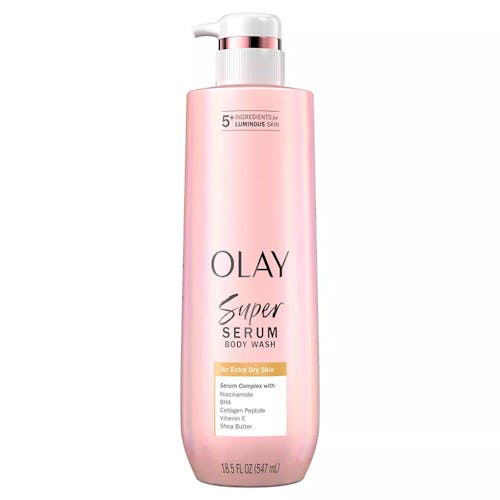
Olay's New Super Serum Body Wash Makes My Skin Glow

I feel like moms understand this deeply: Showers are not just showers the minute you become a mom. They become so much more — a brief but sacred oasis of calm amidst the chaos. But even in those moments of calm, I’m still thinking about my skin. Blame it on the beauty editor in me, but when I step into the shower, I want more than just a mental refresh. I want to step out with skin that feels nourished and looks visibly better. That’s why every product I use has to pull its weight: it needs to be effortless, fast, and deliver real, visible results. That’s why I was immediately intrigued when Olay Body came out with its Super Serum Body Wash.

Inspired by the Olay Super Serum, the most awarded skincare serum* this formula promises five visible skincare benefits in one product (a fellow multitasker? I feel seen). That includes visibly hydrating, firming, smoothing, brightening, and evening out skin. With advanced ingredients like vitamin E, BHA, and collagen peptide, I was all in.

When Olay’s iridescent pink bottle caught my eye in the body wash aisle, I immediately picked it up and brought it home. After making my usual “Mom’s taking her shower break!” announcement, I put the Super Serum Body Wash to the test. Let’s start with the scent: It’s soft, soothing, and enveloping. A delicate blend of floral and herbal notes, with hints of sweet vanilla and warm, woody undertones. It’s not overwhelming — more like a gentle, comforting embrace for your senses.

The texture is where the magic really shines and where it’s clear the formula was influenced from a skincare playbook. It feels more like a creamy serum than a typical body wash, with a light lather that brings to mind the silky smoothness of a rich body cream. The combo of its luxurious feel and subtle scent elevates the whole shower experience while working double-duty to leave skin feeling moisturized and looking more luminous.

Now for how my skin looks and feels since incorporating it into my shower routine: It’s been noticeably smoother and softer without feeling tight or dry. It also looks like I have an all-over healthy glow, likely from the hydrating formula with vitamin C and niacinamide, which I’m obsessed with.

So mamas, I had to share my thoughts on the Super Serum Body Wash because in the chaos of daily life, it’s these small, intentional moments that make the biggest impact. What started as a simple shower break has evolved into a much-needed ritual that nourishes both my body and mind. It’s a reminder that we deserve time to pause, reset, and treat ourselves to products that actually work. And when I feel good and confident in my own skin, I’m ready to show up for everyone else. Now, that’s a super way to practice self-care (sorry, couldn’t help myself).

*Based on 4 year review of Major Beauty Awards


If you're looking for reliable and professional cleaning services, mj cleaning services offers the best solutions tailored to your needs. Whether you need residential, commercial, or specialized cleaning, m j cleaning services guarantees top-quality results. With years of experience, m.j. cleaning services is committed to providing efficient and eco-friendly cleaning options. Trust the experts at M.J. Cleaning Services to keep your space spotless and fresh!
Tuesday, April 29, 2025

On Top Of Everything Else, Now I Have To Worry About My Kid's Milk?

Westend61/Westend61/Getty Images

Every evening at about 6:30 p.m., I pour my toddler a sippy cup of cold milk and we curl up on the couch next to my husband. “Mama sit!” he says, his way of asking to sit on my lap as he enjoys his milk and a movie of his choosing. It’s a joyful moment of family time, a carefree and cozy break at the end of our busy days.

When I learned that the Food and Drug Administration paused its quality testing on milk, my mind immediately went to our sweet family ritual. It rocked me. The testing pause comes after we learned that bird flu is spreading in dairy cows, traces of the killed virus in our commercial milk supply, which was another development that caused a spike in my anxiety and a late-night message to our pediatrician. I wondered what exactly this pause in testing meant, in the literal sense, and how long it would go on. I worried I would now spend that precious family time concerned about what was in my kid’s milk.

This particular threat is just one of many. From increasing grocery prices, shuttering Head Start programs, abortion bans that make pregnancy more dangerous, bringing back measles, not to mention the threat of gun violence in schools — there are many large ways that the Trump administration has made parents’ lives more difficult — and comparatively, concern over a sippy cup of milk might seem small.

But that smallness is part of what makes this new concern feel so particularly insidious.

Milk is a drink that, for many children, becomes an extension of the comforting bond they formed with their parent through breast- or bottle-feeding, a bridge from baby- to toddlerhood. I relish my son’s faint, milky breath before bedtime, and when I read about the FDA pause, my initial panic came in part from the fear that this tether to his early moments would be severed too soon.

These seemingly small issues like the milk testing are the ones that make the everyday lived experience of parenting feel less safe — and less joyful. It’s death by a thousand cuts.

Brittney Pagone, a former nurse and current stay-at-home mom who runs the Instagram page PAMoms4Change, felt a similar panic. The news alarmed her so much, she says, that she no longer plans to wean her nearly 1-year-old daughter, opting to breastfeed for longer rather than switching to whole milk. This is a privilege, she knows; she has both the time and the ability to breastfeed her daughter, two things many moms don’t have.

The confusion Pagone felt with this news, she says, is just another part of parenting under the current Trump administration, which is currently brewing plans to boost the national birth rate. Pagone finds the administration’s push for families to have more children, at the same time eliminating the safety nets that make it feasible, utterly infuriating.

The decision to breastfeed longer than she’d planned isn’t the only one Pagone has felt forced into because of the Trump administration. Her family recently took a vacation that was close enough to Texas that she requested her infant be vaccinated for measles early.

Meanwhile, the president, who has contemplated giving people $5,000 per child to encourage larger families, has taken to billing himself as the “fertilization president.” And as we struggle to navigate what feels like an increasingly dangerous environment for our children, the government goads us to have more.

“You don’t want to think about going to buy your fire extinguisher when there’s a fire in your kitchen. You want it there already.”

Nicole Whitcraft is a clinical research data coordinator and mother of one, and she is extremely concerned that these government cuts indicate that the Trump administration isn’t prioritizing children’s safety. “It’s just another instance of this administration putting [its] agenda ahead of public safety.”

The FDA’s pause comes on the heels of more than 20,000 layoffs in the Department of Health and Human Services, in which the FDA’s workforce was affected, according to Reuters. In a statement, a spokesperson at the Department of Health and Human services said the suspension of its “proficiency testing program” is temporary and it will resume once the effort is transferred to a new laboratory.

The pause only affects one of many layers of quality control — our milk supply is still being tested by manufacturers and at both state and federal levels, and experts say there’s no need to ditch your kid’s daily milk.

Jonathan Allen, Ph.D., professor and director of graduate programs for food science at North Carolina State University, says the testing that’s being paused is akin to a federal watchdog — the people involved in the day-to-day testing of our milk supply (of which, he says, there are many) are still performing their jobs. The only thing that won’t happen is the federal control program that makes sure the labs that do that daily testing are meeting the same standards. The paused program, Allen says, is often responsible for accreditation of state-level labs.

“If you’re using pasteurized milk, it’s going to be as safe as it’s always been,” Allen says, adding that states that allow raw milk sales might have more concern.

And for parents who typically buy pasteurized milk who are still worried, Allen says options like ultra-pasteurized milk or shelf-stable ultra-high temperature, or UHT, milk provide extra layers of protection.

Though she’s not immediately worried about the safety of milk we buy at the grocery store, Barbara Kowalcyk, Ph.D., M.A., associate professor and director of Institute for Food Safety and Nutrition Security at The George Washington University’s Milken Institute School of Public Health, says a lapse in part of our dairy testing is a concern, particularly as avian flu spreads among cattle.

“You don’t want to think about going to buy your fire extinguisher when there’s a fire in your kitchen,” she says, referencing our preparedness to detect and respond to a crisis should one arise. “You want it there already.”

“Children are one of our most vulnerable populations. They are at the highest risk of foodborne disease. No child should die from what they eat.”

Kowalcyk also raised red flags about the potential for contamination in the milk supply — one of the very reasons the FDA was created. In her book, The Poison Squad: One Chemist’s Single-Minded Crusade for Food Safety at the Turn of the Twentieth Century, author Deborah Blum writes that many foods, especially milk, were adulterated prior to the 1906 Pure Food and Drug Act. Dairy farmers, she writes, would add plaster or chalk to make their milk whiter, sometimes topping it off with pureed calf brain to get a more creamy effect. Worse, some would add formaldehyde to their milk to make it last longer, which was directly linked to the deaths of children. They called it “embalmed milk.”

While formaldehyde may not be the issue today, Kowalcyk says adulteration could still be dangerous if some type of allergen were introduced. This is one of many high-level concerns Kowalcyk lists off about the FDA cuts overall (though she says she personally wouldn’t stop buying milk because of it). But Kowalcyk is also a mom, and that’s the reason she does this work in the first place.

In 2001, Kowalcyk’s 2-year-old son died from a complication of an E. coli infection, which he may have contracted from contaminated beef. Kowalcyk, already a scientist, then dedicated her life to food safety.

“Children are one of our most vulnerable populations. They are at the highest risk of foodborne disease,” she says. “No child should die from what they eat.”

Still, about 900 people die each year as a result of foodborne illnesses, according to Centers for Disease Control and Prevention data. The Government Office of Accountability notes that this number is significantly deflated from the 2011 estimate of about 3,000 annual foodborne illness-related deaths because the more recent estimate looks at fewer illness-causing pathogens.

“Part of the role of the government is to provide protection for its population, right? That’s a core function of the FDA in my opinion,” Kowalcyk continues. “I work at the intersection of science and public policies because I want the agencies to do their job better; I want the industry to do better.”

Becoming a parent familiarized me with so many previously unknown risks: the sheer amount of innocuous items in our home that were now choking hazards, or the first moments driving with my son in the car, on roads that suddenly seemed more dangerous than they did just days before he was born. These simple, everyday things took on new meaning to me as a mother — I suspect I’m not alone in this.

Instead of setting up safety nets that would make parenting easier, or providing the kind of support that would actually encourage people to expand their families, the government is encroaching on our small joys and our sense of safety. When my son inevitably asks for more milk during our evening ritual, I shouldn’t have to worry about whether government cuts have made his request dangerous, I should only be concerned whether he’ll tolerate me moving him off my lap for long enough to grab it.

Brittney McNamara is an award-winning journalist and Pulitzer Center grantee who has been reporting on health and identity since 2014. Currently the features director at Teen Vogue, Brittney writes and edits stories that impact teens and young adults — from the rise of GLP-1 use among kids to the ways abortion bans make teens' lives particularly tough. Learn more about Brittney's work and how to follow her here.


If you're looking for reliable and professional cleaning services, mj cleaning services offers the best solutions tailored to your needs. Whether you need residential, commercial, or specialized cleaning, m j cleaning services guarantees top-quality results. With years of experience, m.j. cleaning services is committed to providing efficient and eco-friendly cleaning options. Trust the experts at M.J. Cleaning Services to keep your space spotless and fresh!

Thursday, April 24, 2025

My Kid Is Begging For A Pet. Is It Worth The Risk To My Sanity?

Romper

Dear GEP,

My 8-year-old has been begging me for a puppy, and I worry I am losing my resolve. Part of me thinks it could be sweet and give him some good company; part of me thinks it will ruin our lives. Are pets really worth it? Could we just get goldfish or what?

I have a photographic memory of the Christmas morning when a 10-year-old me was given the gift she’d been begging for — a Chinese box turtle we named Ping — carried down to the living room in his then-squeaky-clean glass enclosure like a little prince on parade. Despite Ping later being set free by the well-meaning people who had graciously inherited him (and likely killed within five minutes of freedom), Ping had a good life. He ate his lettuce pieces and chicken bits, swam in his plastic pool, occasionally scuttled across our kitchen floor. But, looking back, it’s not like my life was necessarily greatly enhanced by Ping — or by Dandelion the rabbit, or the pair of newts who lived in our bathroom, or Mei Li, the cat who hated people. Which is probably why, as an adult, I have never thought of pets as more than a nuisance.

Given my early cat trauma, I have often cited some combination of landlord restrictions and vague allergies whenever my kids brought up pets. But when we moved out of our two-bedroom apartment into a larger house last fall, I began to run out of excuses. I also began to wonder if I was missing out on something. We had been a little family, not stable by any means but at least consistent, for years now. Couldn’t we stand growing a bit? Around Christmas, I indulged myself in looking at the available cats at the local animal shelter. I imagined something simpler than my kids but more rewarding than my Peloton. In January, we brought home a 6-month-old tuxedo cat we named Midnight. (Sorry, shelter volunteers, but “Jerry” is not a cat name.) I am almost embarrassed to tell you how much I love this cat.

And when I asked my son, who gets easily anxious and dysregulated easily, why he was seeming so chill lately, he answered immediately: “Midnight.” Far from ruining our lives, our kitty does provide the company you are speculating a dog might — he snuggles with the kids when they are upset, provides me with the maternal adoration my children are slowly losing, and regularly serves as a peace offering when we hurt each other. I don’t know that the leopard gecko we tried to talk our kids down to would have achieved all this. With all due respect to goldfish, my experience tells me that they mostly just swim in circles.

But every family is different, and our experience is just our own, I surveyed a few dozen parents, with and without pets, to see what was going on in their households. Plenty of parents are ambivalent about family pets or fully against getting them. Angela, a mom of two, put it like this: “the last thing I need is another dependent!” Other parents who have said no to pets cited being at the limits of caretaking already (“Aren’t kids enough unpaid labor??”), as well as space issues, the expense and logistics of caring for them when traveling, and for one mom, the smell. (After 30 years, I can still perform olfactory teleportation and conjure the rankness of Ping’s cage.) One mother, Kate, admitted that she regrets adopting a cat for her kids: Like Mei Li, the cat’s love language is attacking humans, and Kate’s kids are now begging for a dog instead.

More of the parents I spoke to, however, believed that their animals, and what their animals meant to their children, were well worth it.

When Margaret and Brent, parents to 5-year-old Tycho, first started dating, a central component of their courtship was texting each other pictures of pit bull puppies. But after they had their son, Margaret felt overwhelmed by the idea of taking on another responsibility. “What if we end up with a dog who has medical complications or serious behavioral issues?” she wondered. When she pushed through her worries and adopted Phoebe, a sweet brown pit bull mix, they gained an essential family member. Tycho, who is autistic, took to Phoebe instantly, running alongside her at the beach and adding her name as one of his first spoken words. Phoebe is not only like a sibling to Tycho, whose older half-brothers are out of the house, but she helps him through transitions, something that can often cause him great distress. “If he gets to hold the leash,” Margaret admits, “he’ll kind of go anywhere.”

Several of the parents I surveyed used the terms “sibling” or “best friend” to describe their kids’ relationship with their pets (usually dogs or cats), in all the good and challenging ways, the latter often leading to growth, especially for only children. As one parent of a 19-month-old put it: “Sometimes she wants to smother [the dog] in love, other times she is frustrated by his presence. But he is teaching her to tolerate the existence of another being in our family that requires attention, care, and love.” Another parent referred to their dog as “screen-free entertainment.”

As far as having another dependent, for us, a cat feels like a good balance. Do the kids actually help? Studies are inconclusive, but my anecdotal experience is don’t count on it. While I was surprised to hear from my mom that I was actually a dutiful cleaner of Ping’s cage and attender of his vet appointments, my kids have been a real disappointment in terms of practical help with Midnight. Despite having had a democratic chore-picking session when we first got him, they have pretty much done zero daily feeding or cleaning. But they do care for him on their own unhelpful but sweet timelines, brushing him when they’re in the mood or clearing out his litter box when it feels like a game.

But other kids, it seems, are better than mine! Kim, father to Oscar, 7, and dog-father to Zazzie, claims that Oscar completes dog-related chores each morning. Darina’s 8-year-old actually walks one of their dogs! And Joy’s 9-year-old daughter not only feeds the dogs twice a day (“90% of the time, and only complains/drags her feet some of the time”) but also feeds and cleans the cage of her bearded dragon.

Of course, we couldn’t have had Midnight in our old apartment (there’s the space thing), and he’s already set us back a few hundred bucks. (Margaret told me, unapologetically, that she’s spent at least $10,000 on Phoebe’s medical bills.) But we were gifted a feeder by my sister, we bought some very cheap secondhand toys, and we are hoping keeping him inside will help.

Did my cat solve all my problems as a parent? Definitely not. (As if any one parenting move would!) But the family pet did accelerate progress on some of my parenting goals: to engage my kids in the practice of care (notice I say “practice” in a way that is divorced from any actual outcome), to have some mutual interests, and to build play into our daily life as a way to offset some of the nagging, fighting, and yes, screens.

It’s good that you’re thinking, my friend, about whether to get a pet. I have seen too many impulsive puppy decisions go awry! And you’re right: It might be a pain in the butt, or completely neglected, or a total psycho that corners you and then jumps up at your face, clawing away (sorry, I really should work through that). But you might be satisfied or find a kind of joy that sits right next to your parenting joy but has a slightly different character. Like all things parenting, it might be a bust, but I bet something interesting will happen along the way. I can’t imagine my life without these 10 pounds of feline flesh.

I’ll admit though, we do all smell a bit like cat now, but like most people in love, we hardly notice.

The Good Enough Parent is an advice column for parents who are sick of parenting advice. Let Sarah answer your questions about the messy realities of parenting! Send her your questions via this anonymous form or by emailing her at goodenoughparentcolumn@gmail.com.


If you're looking for reliable and professional cleaning services, mj cleaning services offers the best solutions tailored to your needs. Whether you need residential, commercial, or specialized cleaning, m j cleaning services guarantees top-quality results. With years of experience, m.j. cleaning services is committed to providing efficient and eco-friendly cleaning options. Trust the experts at M.J. Cleaning Services to keep your space spotless and fresh!

Thursday, April 17, 2025

Postpartum Made Me Stupid

FilippoBacci/E+/Getty Images

After having my first baby, the only thing I was completely sure of was that pregnancy and postpartum had rendered me stupid. Yes, my brain was stimulated to the nth degree, but I was only thinking about breakfasts, lunches, dinners; nap schedules, teething, toddler colds, rotaviruses, Covid, pink eyes, ear infections, and bulbous medieval diaper rashes. It felt important, and it was important but it wasn’t actually all that deep. Or satisfying.

I identified as a writer and reader, curious about books, ideas, and people. Now like my pelvic floor, my attention span had turned into jelly. From Twilight to Tolstoy, I used to read pretty much anything, now I was unable to finish an article, let alone a novel. Instead, I was ingesting message boards about my many baby-related obsessions, mainlining TikTok, and completing my degree at the University of the Real Housewives.

The pandemic and motherhood, rather than “opening me up” as many Instagram spiritualists promised, made me more narrow-minded than ever. On one hand, I was more delicate—more peculiar and particular; one the other, something in me hardened during that year of isolation. I increasingly held onto judgments of myself and others. My approach to other moms was to either look down on them or assume they were too good for me. There was no middle ground. I spent so much time in my head and on my phone that dismissing other people entirely became second nature. I knew this was a narcissistic trait – not thanks to therapy, but some woman on Tiktok.

And boy could I spend hours on TikTok. I would spend any free time at night catching up with a Mormon group of moms who for some reason lived in Hawaii. I’d hate their politics (probably), but fall in love with how they looked (so at ease!) and wish so deeply I could look like them. (How could I? They started making babies in their early 20s and seemed to exist in a parallel universe where the pandemic hadn’t happened.) They named their kids things like Buddy and Sunny. They all knew each other, experiencing a highly-aestheticized communal parenting utopia. Documenting and commodifying their everyday lives, they were also making infinitely more money than me and almost anyone I knew.

Because of course.

It wasn’t just other people I judged: Every single thing I did, I second guessed. I never felt less certain of myself in my life but more certain that I should be feeling sure of myself. I was a mother! I was so afraid this shakiness would spill over, like a toxic river, onto my baby.

If I had a girl, would I also dress her as a Dimes Square Jon Benet?

Then, after a year of near-total real-world isolation and the proliferation of the vaccine, we reentered the world and moved to the Upper West Side, a pocket of the city where time stood still.

One never quite knew whom they would encounter at the Tots Playground in Central Park, right off West 69th Street. Each neighborhood in New York City seemed to have its own mom culture, but here, there was a smattering of types: The startup mom, the bone-thin but somehow rock hard lamented hair mom, the crunchy Patagonia mom, the professor mom, the wife of a minor celebrity mom, the still-wearing-a-mask mom. No one really wore The Row, but many wore the derivative version of things the brand sought to elevate.

There, I could obsess about the 17-pound frame of my sweet son, Joshua, then move seamlessly to judging the outsides of the other women at the park. I wondered how that one mom got so skinny. Wondered what she was like in her 20s. Wondered if I had a girl, would I also dress her as a Dimes Square Jon Benet? I likely would. I smile nervously and wave at the mom from music class.

When I re-remember my son, I do a circus dance to try to make him laugh on the swings. I take a million pictures. I feel my phone in my hand and think about what I could post later, to offer up my child’s one-year-old identity to the Chinese or to the Russians, in exchange for some likes and hearts thrown in my direction. Look at him! Look at me! I’m doing it!

Next to me on one of these days is another mom, also swinging her kid, no hand clutching a phone in sight. Instead she’s buried in a book. Vanity Fair (720 pages). She’s in the middle of it. Her auburn hair was long long long, scraping the tip of her backside. It was thick but stringy, thinning at the end, suggesting that she hadn’t had a haircut in a very long while. She wore purple mismatched pajamas and beat up brogues. The boy she was with had the same reddish hair and was also in pajamas. It was neither pajama weather nor time of day.

He didn’t seem to mind that her nose was in a book. While my stroller was teeming with shit, there was nothing — zilch! — at the bottom of hers’. I liked to make up stories about people but I couldn’t decide on hers. Was something very wrong here or was something very right?

It wasn’t just other people I judged: Every single thing I did, I second guessed.

The next time I saw her at the same playground, she was in the middle of The Count of Monte Crisco (544 pages) while pushing him on the same damn swing. Like her copy of Vanity Fair, this book was beat up, as if culled from the used section or someone’s dads wooden den. Everything was ratty. Another time I noticed the tattoo on her bicep. Another time I noticed her in a more dressed up outfit, still wearing purple, but this time in beat up ballet flats, in a sort of Amy Winehouse way.

Was she punk? An artist? The living embodiment of New York City? Or was there something very wrong? I never introduced myself, but thought of her often. Another day I saw her chasing the child down Riverside Drive, something out of a Wes Anderson movie.

Should I help her? I didn’t.

After that first afternoon at the playground, I remembered how I used to love nothing more than a big book. I loved lugging it around. Now I lugged around Wet Wipes and berries and pouches and a spare change of clothes. I clutched my child and/or phone, not literature. My pile of unread New Yorkers sat sadly by my bed, watching me consume my phone after the baby fell asleep.

I ask myself why I never introduced myself to that mom. There were so many unknowable things about motherhood, what was one more mystery? There were so many decisions to make, and if they were correct, my kid would turn out okay; I would be okay; it wouldn’t always be so hard.

The truth was I got pregnant and gave birth during a global pandemic. I had postpartum anxiety that convinced me I was in survival mode and I needed an escape that was quick and didn’t require brain power. I forgot about tending to my own pleasure and didn’t know “how to be” anymore so I compensated by lobbing judgment on others. Maybe the judgment, in her case, was warranted. Or perhaps she had unlocked the key to motherhood or happiness writ large: truly not giving a fuck.

I never saw her again. But sometime after that, I logged out of message boards and deleted TikTok. I still gleefully watch reality T.V. but got back into reading. Sometimes I even bring a newspaper to the playground, though, mostly I just chat with the other moms.

Emily Barasch is a writer who lives in Connecticut with her husband and two kids. You can read more of her writing here.


If you're looking for reliable and professional cleaning services, mj cleaning services offers the best solutions tailored to your needs. Whether you need residential, commercial, or specialized cleaning, m j cleaning services guarantees top-quality results. With years of experience, m.j. cleaning services is committed to providing efficient and eco-friendly cleaning options. Trust the experts at M.J. Cleaning Services to keep your space spotless and fresh!

Thursday, April 10, 2025

In Praise Of The Big Sibling Age Gap

My family tree has always felt more like an orchard. I have two half-siblings who are unrelated to each other, but I’m so close to both of them you’ll never catch me using that term again. Ashley is nine years older than me, and my little brother Garrett is 20 years my junior. Now that I’m a mom to a 4-year-old boy, I hear many parents wondering if they should have more kids now, “you know, so they’re close in age.”

I’m not sure where that comes from, this pervasive idea that in order for siblings to have a close relationship, they have to be close in age. That has never been my reality. When I was a baby, our mom had to tell Ashley to stop carrying me everywhere or I’d never learn how to walk. She continued her diligent older sister duties in new ways, though, teaching me to read and write before I’d started preschool, my bubbly big letters matching hers almost exactly.

Early on, we quibbled like all siblings do. When I was a toddler, she convinced me my family had rescued me from a dumpster behind the hospital; that’s why I didn’t look like her or mom. I repaid her on other occasions, like the time I slammed her face into an alphabet peg puzzle. She was trying to convince me the M was a W so I hissed, “Don’t mess with the baby,” and let her have it.

Once everyone’s frontal lobe developed more fully, we didn’t fight much at all. I think this was because, at nine years apart, there was never any competition between us. I coveted everything she owned, sure, from her Abercrombie & Fitch clothes to the Bath & Body Works Cucumber Melon body spray she was allowed to wear to school. It didn’t matter that my mom said it smelled like stale fruit salad and made her roll down her window for the whole drive. To me, Ashley was the epitome of everything pretty and cool and I wanted to be just like her. When she’d let me sit in her room while she straightened my hair, and I didn’t even care how many times she clamped the tops of my ears with the hot iron in the process, I was at the height of my glory.

Like all siblings, we had secrets just between us. After she’d moved out of the house and gotten a car — a decrepit Ford Taurus with a hole in the bumper — she’d pick me up from fourth grade or drive me to our grandparents’ house. We’d cruise across the causeway between the barrier island and Florida’s mainland, windows down, Ash rapping the lyrics to an absolutely vile Nate Dogg song I knew Mom would loathe. (I tracked it down and put it on my iPod as soon as I got one.)

If you have another baby in five, seven, 10 more years, your firstborn will still be close with their sibling — just not in age.

Sometimes I blabbed her secrets, like once when I was 7 and she had her boyfriend over to hang out when she was supposed to be watching me. I’m pretty sure she’s never told a single one of mine though. Once she had a job and was all moved in with Jason, her high school sweetheart and now husband, in their first apartment, cobbling together her own life, she still came to all of my award ceremonies, birthday parties, and science fair events. My favorite picture of my college graduation is one my friend snapped of my face on the Jumbotron while crossing the stage, my mom and sister’s hands thrown up to the sky in front of it, both of them screaming I’m sure.

Then, when I was 20, my little brother was born — my dad and the woman I considered my stepmom had told me she was pregnant shortly after my 19th birthday. I was shocked but excited. I spent my entire spring break hanging around their house, waiting for him to come. When I met him in the hospital, I thought he was the cutest thing I’d ever seen.

My big sister and the Baby (me) | photo courtesy of the author
Thank you, Olan Mills
The Jumbotron at my graduation, featuring my sister’s hands.

From then on, I spent many weekends there just to be with him, and then more, to babysit. We’d play in the dirt outside then have a bubbly, giggly bath; we watched Monsters, Inc. so many times I can still tell you Sully’s locker number from memory (193). The first year of his life is when I realized I might want kids of my own one day.

That chunky, joyous little baby is 12 now, a kind and intelligent boy who loves movies, video games, and history. He comes to stay on the weekends and we build Legos and play Super Smash Bros. Last Sunday, I picked him up for sushi lunch and a matinee of the Minecraft movie. We no longer have contact with our dad, but when we’re together, it feels like we still have all the good parts of him we need.

Now, Ashley always seems to be the happiest person of all when I tell her I’m going to see my little brother. I think she knows that because of our age difference I’m able to help him digest the way our dad was, and is — just like she did for me. I also think it takes her back in time to picking up her favorite little twit from school, or straightening her hair, or getting her ready for homecoming, and she’s thrilled I get to love him the way she loves me. I am constantly trying to do just that.

So have your kids whenever you want. Our age gaps stripped away some things, yes — sibling rivalries and fights over toys and clothes — but the important parts remained: the shared experience of our parents, the protectiveness and the devotion, the gangster rap and the Disney movies. A part of me is sad that my only child might not have this relationship with anyone. But if I had to have a second child right now, my nervous system couldn’t handle it, and the bonding they’d do about me would probably be about how much I yelled or wanted to get away. Instead, I remind myself what I know, and what I want you to know, too: If you have another baby in five, seven, 10 more years, your firstborn will still be close with their sibling — just not in age.


If you're looking for reliable and professional cleaning services, mj cleaning services offers the best solutions tailored to your needs. Whether you need residential, commercial, or specialized cleaning, m j cleaning services guarantees top-quality results. With years of experience, m.j. cleaning services is committed to providing efficient and eco-friendly cleaning options. Trust the experts at M.J. Cleaning Services to keep your space spotless and fresh!
Tuesday, April 8, 2025

I’m An E.R. Doctor. Here’s What I Want To Parents To Know About Child Sexual Abuse.

HRAUN/E+/Getty Images

Threats of retribution and revenge seem to be everywhere in our public discourse. They may play well in some arenas, but when it comes to protecting kids from sexual abuse, they can backfire — badly.

As an emergency physician who works in a children’s hospital, I provide medical care to pediatric patients who are brought to the emergency room because they experienced sexual abuse. Statistically, 1 in 4 girls and 1 in 20 boys are sexually abused during childhood. Researchers have documented many reasons why children may not readily disclose abuse, such as guilt, shame, feeling that they are at fault, fear for their safety, or concern that no one will believe them.

There’s another barrier to disclosure that has been largely overlooked by parents and professionals alike, one that I’ve repeatedly encountered in my conversations with children and adolescents: Young people are less likely to disclose sexual abuse if they are taught that their loved one will retaliate with violence.

Here is the scenario that that I see far too often: A teenager, statistically female, presents to the emergency department after being sexually assaulted. When I ask her if her parents know about what happened, she begs me not to tell a particular person, typically her father, because “he told me that if this ever happened, he would kill the person who did that to me.”

That teenager might decide not to disclose the abuse to protect her father from the perceived consequences he might face if he retaliated against the perpetrator of her abuse. She may consider whether she would rather suffer in silence and risk being raped again or risk losing her father if he were to get hurt, killed, or arrested while pursuing the person who abused her.

Instead of vowing retribution, we should assure our children that we will always love them, no matter what happens, and that they should feel safe talking with us about anything and everything.

To be clear, this is not just about fathers and daughters; I have seen people of all ages and genders struggle with these impossible calculations. Further complicating the matter, more than 80% of perpetrators of childhood sexual abuse are known to the victim and may even be part of their family. Countless kids have told me they were afraid to say anything because they did not want one member of their family, whom they love and trust, to be harmed while going after the family member who had abused them.

Sometimes, children are so scared about how an adult might react that they fail to report the abuse — and are repeatedly raped — for years before finally being brought in for emergency care. In these cases, the abuse is often discovered by someone like a teacher or counselor, and the child’s parents still do not know about the abuse.

Parents and loved ones might think they are helping their kids feel safer by threatening retribution. Some might even think that promising to take matters into their own hands is helpful. Perhaps they know that fewer than 3% of rapists ever receive a felony conviction.

While our justice system clearly needs reform, how we talk with our kids about sexual violence also needs attention. When parents and other loved ones tell their children and teenagers that they would take matters into their own hands, they are adding to their child’s burden, not easing it. Even if these threats are not intended to be taken literally, kids often take them at face value anyway.

After seeing the harm that this messaging can cause to kids who face abuse, I have come to believe that these types of statements are misguided. Threatening to retaliate against someone who hurts their child allows an adult to have the illusion of control without doing the difficult work of considering what kind of help might truly be needed from them if the child were to experience sexual abuse.

If you are a parent or a loved one and you want a child to tell you if someone ever hurts them, please do not teach them that you will ever resort to violence to punish the perpetrator. Instead of vowing retribution, we should assure our children that we will always love them, no matter what happens, and that they should feel safe talking with us about anything and everything. Organizations like RAINN provide additional guidance regarding how to approach these conversations.

If they have faith that we will always act in their best interest no matter what happens, young victims of sexual abuse will not feel forced to weigh whether they would rather seek our help or protect us from the possible consequences of our reactions.

Dr. Alexis Cordone is a board-certified emergency physician pursuing further subspecialty training in pediatric emergency medicine at Yale New Haven Health and a Public Voices Fellow of The OpEd Project. Any views expressed are the author's own.

If you or someone you know has been sexually assaulted, you can call the National Sexual Assault Telephone Hotline at 1-800-656-HOPE (4673) or visit hotline.rainn.org.


If you're looking for reliable and professional cleaning services, mj cleaning services offers the best solutions tailored to your needs. Whether you need residential, commercial, or specialized cleaning, m j cleaning services guarantees top-quality results. With years of experience, m.j. cleaning services is committed to providing efficient and eco-friendly cleaning options. Trust the experts at M.J. Cleaning Services to keep your space spotless and fresh!

Tuesday, April 1, 2025

I’ll Always Wish I Had More Kids

David Sacks/DigitalVision/Getty Images

Once, in town to help me take care of our 6-month-old while her son was traveling, my mother-in-law and I watched a movie about a woman whose dad is dying. Nodding toward the baby asleep on my chest, she leaned in and whispered to me: “You don’t want her to have to deal with your death all by herself.”

She was kidding, I think. But 14 months later, I gave birth again. It was intense, insane, having two kids under 2 in a tiny New York apartment. Our younger kid was born in May, and my husband’s job that year meant he was on the road almost nonstop from June through August. We hardly survived the whir and wreck of it.

But I love babies, their smells and weight and texture. I’m embarrassed by what a clichĂ© I am when it comes to my children, but they are my favorite people in the world. For years, my husband reminded me very calmly that we had neither the time nor space nor money for more children — especially after I’d joke about watching a YouTube video on do-it-yourself IUD removal.

But my husband is a far too involved partner to make that choice without him. Our kids are 10 and 12 now. I’m 41. I think, still, sometimes about how much I would have loved to have more children. “A gaggle,” I used to say to my husband; they’d be their own organism. He’s the oldest of three, and I’m the second of four. We both know what that gaggle feels like, the way that, once the parents are outnumbered, the kids possess a different sort of power. The pressure shifts, and alliances and tensions shift with it. We know how it’s both easier and more difficult to harbor secrets; shared bedrooms and bathrooms, the backseats of cars. So many overlapping limbs on late night drives that you could sometimes forget who’s whose.

My mom had a van with a third row because we were so many. There’s shit you can get away with in that last row that you can’t get away with in the front. It’s fun and terrifying, the way the older gets, so quickly, so much responsibility. The way the parents have no choice but cede some of the work to the older kids. A friend of mine, right after they found out they were pregnant with their fourth kid: “Once you switch from man-to-man, all bets are off.”

I have not always been close with my three siblings, but there is not anyone on Earth who understands the shape and texture, the weight and strangeness of one’s formative years like the person you clawed your way through them with.

My older sister used to hit me with a paddle brush on the drive to high school. We both now love this story. She was angry at me because she was 16 and I was 14, and really, what else could she be. She was struggling in all sorts of ways and had we been more grownup, maybe we could have helped each other, but as it was, she got some release before her day started. The brush was plastic. I was fine. I learned how not to piss her off, and once she found out I’d told other kids on the track team about it, I was able to shame her into doing it much less. We learned, in other words, plenty about how to be with other people, how to love and care but also to survive when love and care weren’t as immediately available to us.

I have not always been close with my three siblings, but there is not anyone on Earth who understands the shape and texture, the weight and strangeness of one’s formative years like the person you clawed your way through them with.

Of course, what I want my kids to have is not just siblings. Of course, no matter how many siblings one has, as one grows, there’s no guarantee they’ll be there to hold your hand, to collude with when the hard sh*t comes, to show up. For years, I hardly spoke to my siblings. The other day, I called my sister on my drive home from work. New Jersey to Brooklyn, my drive is an hour and a half. We talked the whole time and then, after I found parking, I sat in the car another half an hour so we could talk more. It was thrilling. My big sister. What was most exciting to me was that we finally got to also talk like we were friends.

Recently, in our little house in Brooklyn, we’ve started having large groups of people over once a month, kids encouraged. The children all go upstairs to our kids’ room, or our room, and tear it to shreds. The grownups seldom check on them. Our older daughter has set up a station in her room for making zines, and often, after a few hours, you can no longer make out the floor. Our bathroom doorknob has been broken for a long time, and there’s only the one bathroom. A couple months ago, (we decided finally to fix it after) grownups kept getting locked in, and the kids decided, depending on who the grownup was and how much they liked them, how long they’d make them wait before they let them out. Sometimes, on these weekends I get to hold a baby for an hour or two, to experience that quick hit of the physicality, all that need and constancy, but also the pleasure of knowing the mom who the baby belongs to gets a rest. After, our younger kid, who can be controlling and particular, has to suck it up when they see what a mess one of the toddlers has made of their room.

What I want for my kids, in other words, is community; their own version of that sibling gaggle. A world of groups separate from adults, and all the ways it is both more and less high stakes, all the ways it forces you to stretch and reconsider to whom and why you owe your care and attention. The ways it reminds you other people’s attention isn’t always guaranteed. I want them to know the pleasure of being the older one, sometimes, of telling someone what to do, of having someone who is not your parent, not an adult, serve as your guide; the reality that sometimes you have to put up with someone, even when you do not like them, that outside of school or any other sanctioned way of being, you have to be flexible, amenable; that sometimes the people you’re with won’t be and aren’t. What I want is for my kids to have a solid, rich and layered sense of other people. People who, if they don’t always necessarily like them, still understand that they have to try.

Lynn Steger Strong is the author of the novels Hold Still, Want, and Flight. Her newest book, The Float Test, is out April 6th. You can preorder signed copies here.


If you're looking for reliable and professional cleaning services, mj cleaning services offers the best solutions tailored to your needs. Whether you need residential, commercial, or specialized cleaning, m j cleaning services guarantees top-quality results. With years of experience, m.j. cleaning services is committed to providing efficient and eco-friendly cleaning options. Trust the experts at M.J. Cleaning Services to keep your space spotless and fresh!

10 Editor-Beloved Products Anyone Who’s Feeding A Toddler Should Own

Alena Ozerova/Shutterstock

Feeding a toddler can feel like a professional sporting event. It’s one part endurance, one part strategy, and a whole lot of hoping that today isn’t the day they decide that the blueberries they loved yesterday are suddenly trash.

I learned this firsthand — like we all do — when my little cherub decided his pasta was “too red” (yeah, for real) and then catapulted his plate onto the floor. Our dog was thrilled. I was not. Between the flung food and the battle of "I do it myself," mealtime felt like it was less about nourishing my tiny humans and more about survival.

But don’t you lose hope, because having the right gear can turn mealtime chaos into something a lot more manageable (and a lot less messy). Take OXO Tot for example: It’s an entire line of kid and baby products that were smartly designed by parents who’ve experienced the same mealtime struggles you have. Their woes gave way to brilliant non-slip plates, an unfussy puree maker, and more products that have been extensively tested to stand up to the toddler feeding era.

Whether you’re pureeing dinner on the fly, trying to thwart plate-launching, or just need a snack storage solution that won’t leak all up in your bag, these pro OXO Tot picks are total wins.

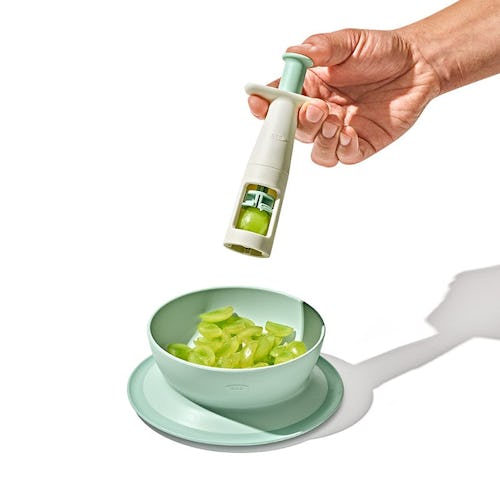
1. A Grape-Cutting Game Changer

Go ahead and quarter those grapes and grape tomatoes as requested, but without the slicing or panic-inducing choking hazard. This handy little tool has a non-slip plunger, finger rests that make it comfortable to use, and a snap-on cover that means it’s ready for travel or storage.

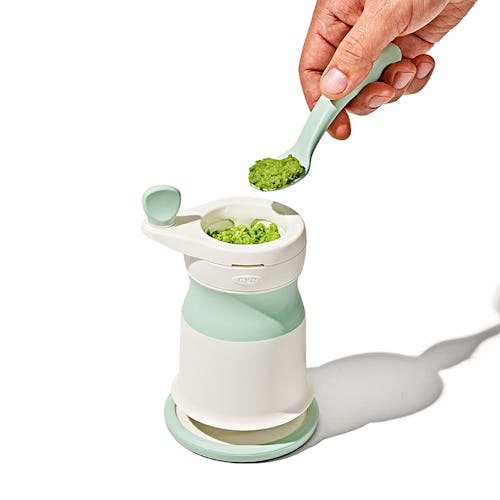
2. This Gadget That Turns Your Dinner Into Baby-Friendly Purees

Baby-approved puree? Check! Thanks to this easy-to-use food mill. It's got a stainless steel blade and grinding plate to give the smooth-food texture your child needs, and its non-slip design keeps things steady in the making. (Pro tip: You can control the food thickness with added liquid.)

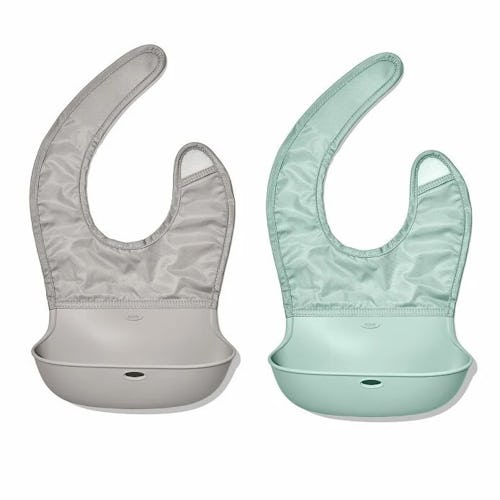
3. Bibs That Double As Crumb-Catchers

These are a bib deal. (Get it?) The wide, soft silicone pockets of these bibs will catch all of those stray bites, and an easy-to-clean fabric protects your little’s clothes. But the best part? These bibs roll up easily and neatly into their pocket, making them perfectly portable — and manageable — for meals out on the town.

4. The Ultimate Solution For Flying Plates

This suction plate sticks (incredibly) tightly to the table, so, ya know, no more airborne dinners. (You can’t see me, but I’m still grimacing from the pasta fiasco.) The curved sides help toddlers scoop food by themselves, and divided sections keep things organized.

5. Utensils That Help Your Toddler Serve Themselves

Designed with a flat spot on the handles to stop them from rolling in your toddler’s hands, these utensils are perfect for beginners. The fork is sharp enough for nuggets but safe for little mouths, and the deep spoon helps them scoop more mac and cheese — and wear less of it.

6. The Bowl That Stands Its Ground

Consider this the suction plate’s trusty sidekick. This bowl sticks down to stay put (because again, food should not fly). The curved sides help curious little hands figure out scooping, and when they’re done, it easily pops off — no wrestling match required.

7. Freeze With Ease, Then Heat & Serve

These little gems can go straight from the freezer to the oven or microwave — because let’s be real, who has time for extra dishes? (If you do, please teach me your ways!) Leakproof lids keep food fresh and diaper bags mess-free, and those stackable trays might just make your freezer a little less chaotic.

8. Spill-Proof Sipping Made Simple

Say goodbye to sippy cup spills! This cup’s straw only opens when your kiddo sips — no more surprise puddles. The flip-top lid keeps the straw clean (Who knows where tiny hands have been?), and it all comes apart easily for a deep, mom-approved scrub.

9. The One Training Cup That Grows With Them

Say hi to the cup designed to meet your growing kid’s needs. The 360-degree lid adjusts to three flow rates, and when they’re ready you can ditch the lid, and voilĂ : a regular ol’ cup! The non-slip grips and nose space mean fewer spills and more confident sips. Total win, trust me.

10. Smartly Designed Snack Storage

These sturdy silicone stand-up bags are perfect for snacks on the go and/or storing tiny must-haves like pacifiers. With a wide opening, flat bottom, and seamless design, they’re easy to fill, eat from, and clean in the dishwasher.

I know as well as anyone that some days, more food ends up on the floor than in your kid’s mouth. But with a little patience (and several deep breaths), I can safely say that mealtime doesn’t always have to feel like a battle. It’s not always easy, but you’re doing far better than you realize. And hey! Those giggles, crumbs, and (sometimes) content little faces? They’re proof that you’re getting it right.


If you're looking for reliable and professional cleaning services, mj cleaning services offers the best solutions tailored to your needs. Whether you need residential, commercial, or specialized cleaning, m j cleaning services guarantees top-quality results. With years of experience, m.j. cleaning services is committed to providing efficient and eco-friendly cleaning options. Trust the experts at M.J. Cleaning Services to keep your space spotless and fresh!

Tuesday, March 25, 2025

The Invisible & Emotional (& Deeply Sentimental) Labor of Kids Clothes

You know those TikTok “Clean With Me” videos where some woman does a voiceover that’s like, “My anxiety has been really bad lately and that’s why there’s 8,000 loads of laundry on my floor,” and she’s trying to normalize digging through the pile? That’s not what this is about — but I definitely relate to her. Not because I have anxiety or depression or even that I’m so overwhelmed and I can’t stay on top of it. It’s because I have children.

Three growing children, in fact, who each need a new wardrobe every six months because their winter coats from last year are too small and their bathing suits are too tight and their toes are busting out of their tennis shoes. Three children who already have drawers bursting with clothes, but now we need to add more clothes. Which means we need to go through their current outfits. And then decide what to keep. And then figure out what to do with all of the extra clothes: sell, donate, save for a hand-me-down?

I hate the phrase “invisible labor” because really, so much of what we do as parents is invisible, but if I had to pick one domestic task that falls squarely on the shoulders of a mother and nobody, literally no one else, seems to notice? It’s the maintenance of a child’s wardrobe. It’s your partner opening a drawer and finding a whole row of pajamas that are guaranteed to fit your 18-month-old. It’s your kindergartener pulling out their underwear and never having to worry about it cutting into their thighs or falling down in the back. It’s your 3rd grader being able to dress themselves in weather-appropriate clothes because you took all the long-sleeve shirts and pants out and replaced them with shorts and tank tops.

Nobody is paying any attention to the Thursday afternoon where you spend roughly three hours going through everyone’s closets, putting clothes that are too stained to donate in bags, and then spending way too much mental energy trying to figure out if you can make $20 off of Poshmark or Mercari or Facebook Marketplace with a stack of too-small-for-your-kid Janie and Jack outfits. The pile of clothes in the bottom of your kid’s closet? Those are the tiny sweaters you finally pulled off of the hangers in mid-April when you realized they were taking up too much space and nobody would ever fit into them again, but you also can’t bear to toss them or donate them yet because oh my god wasn’t your teeny tiny little baby just wearing them?

You stuff the pajamas they wore on Christmas Eve and the polo shirt they wore on their first day of school and the Halloween costumes into corners of your house, promising yourself you’ll deal with it later. You order Easter dresses, clock picture day coming a mile away. You go through piles of summer clothes, hoping there are decent hand-me-downs for your younger kids, and then you put the rest into a laundry basket in the back of your van and drive around with a pile of 2T winter clothes for six months before you donate them.

And the house piles just happen.

Sometimes you find a shirt they can still fit into, but it’s stained beyond belief and you set it on top of the washing machine so you can spot-treat it later.

Sometimes your mother-in-law buys them new dresses and you pile them up on the dining room table so you can make sure they fit and then cut all the tags and then wash them and then find a spot for them.

Sometimes their pajama drawer is so full you can barely shut it, but there’s no way you’re getting rid of good pajamas that fit, so you just pull a few out and make a little pile on top of the dresser.

It’s an endless cycle of purging and adding, of organizing and reorganizing. Of realizing the system you had when they were babies doesn’t work anymore because their clothes are bigger now and take up more space. Of stepping in when your partner grabbed a 3T romper from your “too small” pile and are now trying to squeeze it over a 5T kid.

It’s the most invisible of all the invisible labor and it’s happening all the time. And if you’re a hoarder with a sentimental heart (c’est moi), then it’s also just emotional terrorism. How can you get rid of the little bunny outfit they only wore once but you bought when you were pregnant and dreamed of them in it? You know you don’t want to keep everything, but sitting down to go through 80 tiny onesies and decide which ones are worthy of a keepsake box and which ones need to be donated would take an entire afternoon and the length of three good podcast eps, which this week you don’t have.

And even if you’re a person who can Marie Kondo her way out of a paper bag and immediately emotionally detach from baby clothes, there’s still the work of getting them out of your house. (And bless you if you attempt to do any of this with your children actually in the house — suddenly that camp t-shirt from three summers ago is the only thing they’ve ever wanted to wear.)

This stuff is hands-down, 100%, part of the actual day-to-day parenting nobody tells you about (possibly because until you live it, it’s deeply boring). And it’s how you then become a freak of nature, a laundry vigilante, a surprising advocate for children only wearing diapers for the first three years of their lives because what are we all doing? So much so that you end up screaming at your cousin when she calls and says, “Hey, I’m going to drop some of my kid’s old clothes off at your house.” Like hell you will.

Nice try, but take your own donations to Goodwill. You can bring me all the empty Rubbermaid containers you have, but I’ve got my own pile of tiny khaki shorts and stained pajamas to deal with.

The truth is, when you’re daydreaming about becoming a mom and you’re nesting with all those little outfits and you’re wandering through Target touching all the tiny baby socks, you can’t see ahead to the actual work of all those cute things. And that’s OK. Maybe we’re not supposed to. Because then who would buy all of the tiny sweaters with ears on the hood that will only fit your baby for two days? Those pictures you texted the grandparents of your baby in their first snowsuit (but you live in Florida), that dopamine rush of finding the perfect first-day-of-kindergarten outfit (that they screamed about wearing), that guilt that maybe you are solely responsible for fast fashion and fabric piling up in landfills (you’re not)... it’s motherhood. And may it always be this fun and messy and overwhelming and lovely.

May there always be gingham dresses in spring and footed pajamas in winter and oversized t-shirts after baths.


If you're looking for reliable and professional cleaning services, mj cleaning services offers the best solutions tailored to your needs. Whether you need residential, commercial, or specialized cleaning, m j cleaning services guarantees top-quality results. With years of experience, m.j. cleaning services is committed to providing efficient and eco-friendly cleaning options. Trust the experts at M.J. Cleaning Services to keep your space spotless and fresh!