Redirecting you to our exclusive offer…

If you are not redirected automatically, click here.

Thanks for visiting! Your offer will open shortly.

  • This is Slide 1 Title

    This is slide 1 description. Go to Edit HTML and replace these sentences with your own words. This is a Blogger template by Lasantha - PremiumBloggerTemplates.com...

  • This is Slide 2 Title

    This is slide 2 description. Go to Edit HTML and replace these sentences with your own words. This is a Blogger template by Lasantha - PremiumBloggerTemplates.com...

  • This is Slide 3 Title

    This is slide 3 description. Go to Edit HTML and replace these sentences with your own words. This is a Blogger template by Lasantha - PremiumBloggerTemplates.com...

Thursday, January 27, 2022

What To Know About Postpartum Headaches From Causes To Medications


After having a baby, you expect to feel all kinds of aches and pains as your body recovers, but how do you know what’s normal and what should warrant a call to your doctor? Postpartum headaches are one of those symptoms that could mean nothing or could be a sign that something bigger is going on, so it’s important to monitor when they are occurring as well as their intensity. There are a handful of reasons you may be experiencing postpartum headaches, and they range from something as simple as dehydration to rare diagnoses.

Causes Of Postpartum Headaches

The first clue for what is causing your postpartum headache is typically when you’re experiencing it — whether it’s immediately following delivery or in the days and weeks following your baby’s birth. “For women who have an epidural, sometimes a new postpartum headache can be due to a spinal puncture with a leak of cerebral spinal fluid,” Elizabeth G. Livingston, MD, a maternal-fetal specialist at Duke Health, tells Romper in an email. Livingston further explains that the pain from these types of headaches will intensify when mom is sitting up.

Another reason a new mom may experience a headache soon after they deliver the baby is postpartum preeclampsia. “Persistent or postpartum preeclampsia is not that uncommon,” says maternal-fetal specialist Andra H. James, MD, MPH, though in this case, the headache would be one of several possible symptoms including swelling, nausea, and shortness of breath, according to the Preeclampsia Foundation. Other serious postpartum complications that James says can result in headaches include cerebral vein thrombosis or stroke, however, she points out these are incredibly rare.

Headaches that happen in the days and weeks following delivery are more likely to be caused by things other than your body’s recovery. “Sometimes dehydration and/or lack of sleep can cause headaches,” OB/GYN Tamika C. Auguste MD FACOG, tells Romper in an email, “[and] stress can also cause headaches.” All of these causes are totally understandable for new moms because it’s an incredibly stressful time, sleep is limited, and taking care of your own needs (like hydration) often gets put on the backburner when you’re trying to master keeping an infant happy.

Postpartum Headache Treatment & Safe Medications

Treatment options for postpartum headaches vary based on what is causing them. If the issue is dehydration then water is the key, and if it’s sleep deprivation then the headache may ease up with some rest (though that’s hard to come by). There’s not a whole lot you can do to eliminate stress during the postpartum period, in which case over-the-counter medications may help. “Medications used to treat headaches such as Tylenol and NSAIDs are considered safe,” says James, however she says new moms should always contact their healthcare provider before taking any prescription headache medication (such as for migraines).

For the more serious headaches that come on immediately following birth, they typically need medical intervention. For example, headaches caused by a spinal puncture may get better with some IV fluid hydration or they could require help from the anesthesiologist. “[These headaches] can be treated specifically with hydration and occasionally a ‘blood patch’,” explains Livingston, “[this is the] insertion of a small amount of the patient’s blood into the epidural space.”

Postpartum Headaches & Breastfeeding

According to James, breastfeeding itself is not a cause for headaches, but it may not be entirely unrelated to the cause. “Breastfeeding has not been identified as a contributing factor to headaches in the postpartum period, but lack of sleep or interrupted sleep are risk factors for headaches,” she says, “Lack of sleep and interrupted sleep go hand in hand with breastfeeding.” Similarly, Auguste notes that women can often become dehydrated while breastfeeding, which could then result in a headache (so it’s always smart for breastfeeding parents to keep a bottle of water nearby).

Another way Livingston says breastfeeding can contribute to postpartum headaches is simply because of the tension involved. “I have seen tension headaches from moms holding their arms and shoulders in awkward positions while breastfeeding,” she says, “[to avoid this] Use a supportive chair and pillows to avoid slumping over or holding arms and shoulders in an uncomfortable position that might lead to a tension headache.”

When To See A Doctor

“A new mom should see a doctor if her headaches are unlike any she has ever experienced, if it’s accompanied by high blood pressure, or if it’s accompanied by visual disturbances,” says James, any of these situations should prompt a trip to the emergency room. If you’re not having any associated alarming symptoms, but the headache isn’t getting better with any over-the-counter medication, Auguste notes it would be appropriate to contact a healthcare provider.

It’s important to remember that the more serious complications that result in postpartum headaches are rare, and they often happen immediately following delivery when moms are still under the care of their healthcare providers, so they’re usually caught and treated quickly. Otherwise, a postpartum headache can simply be the body’s way of telling a new mom she needs to take care of herself, whether through rest, hydration, or some other form of self care.

Experts:

Tamika C. Auguste MD FACOG, Chair- Women's and Infants' Services, MedStar Washington Hospital Center, Regional Director of Women's Health Services- Southern Maryland Peninsula, Chair- OBGYN Clinical Practice Council, MedStar Health, and Professor, OBGYN Georgetown School of Medicine

Andra H. James, MD, MPH, Maternal-Fetal Medicine Specialist at Duke Health

Elizabeth G. Livingston, MD, Maternal-Fetal Medicine Specialist at Duke Health


Maternity Valentine’s Day 2022 Outfit Ideas: Shirts, Dresses, Coats, & More


When you're getting ready to celebrate a holiday, putting together a festive outfit can be half the fun. And if you happen to be pregnant on February 14, then there's all the more reason to celebrate. That's why these maternity Valentine's shirts and dresses are so special. Why not honor your growing family by rocking an outfit that makes you feel amazing?

Whether you're looking for something vibrant, low-key, or a little in-between, these romantic maternity Valentine’s Day outfit ideas have something for most every taste. There are plenty of bright red maternity Valentine’s dresses and tops available, as well as pieces with more low-key hues. Maybe you want to accessorize with romantic details such as satin or cute heart prints, or maybe a fresh leopard-print skirt is more to your liking. And because maternity wear has become pretty fashion-forward in recent years, edgy and bold looks are all on the table, too. Embrace your own taste and put together an outfit that reflects your style, all while keeping your bump nice and comfy for the day. If cosmetics are your thing, then apply some bright red lipstick for the day or follow a Valentine's Day makeup tutorial to get glam.

With the right look, you and your baby will be ready to enjoy the first of many Valentine's Day celebrations together.

We only include products that have been independently selected by Romper's editorial team. However, we may receive a portion of sales if you purchase a product through a link in this article.

Maternity Valentine’s Shirts & Tops

Whether you want a cute heart-print top, a cozy red sweater, or something that’s perfect for a date night, these maternity Valentine’s shirts are perfect for a holiday ensemble. The Red Flare Sleeve maternity top by LaDiwithaBaBy will look amazing with some sleek black pants (or leggings) and some gold earrings, or, if you prefer a black top, you can give the Tie Front Textured Maternity Top or the Black Lace Sleeve Maternity Top a Valentine’s Day vibe by wearing some red statement jewelry. For a more romantic feel, opt for floral prints like on the Red Floral Draped Maternity/Nursing Top and Woven Red Maternity & Nursing Tee or a top in a dusty rose color like MAMA Modal-blend Top. Of course, you can always keep it casual with the Magenta Mock Neck Exposed Seam Maternity Plus Sweater and a pair of jeans or the So Much To Love Maternity Tee with some black leggings and a denim jacket (and maybe a pair of heart-shaped sunglasses for a little extra fun).

Maternity Valentine’s Dresses

If you feel like getting a little more dressed up for the holiday, a pretty maternity Valentine’s dress in red, pink, or black will bring a little extra elegance to your look. There are gorgeous maternity Valentine’s dresses in all kinds of styles including maxi length, peplum, lace details, and even a plaid and simple print dress. Mamas who love the classic red look should consider the Ponte Bell Sleeve Dress, the fitted Aurora dress, or the more formal off-the-shoulders Velvet “Sarah” Dress. If you prefer prints, the Queen Bee Maternity frill sleeve mini dress in red spotted print and the Imara Dress both mix red and white together in different ways. Finally, for moms who are looking for maternity Valentine’s dresses that are more romantic, you can’t go wrong with the Light Pink Smocked Maternity Mini Dress or the Burgundy Lace Mesh Overlay Maxi Dress.

Maternity Valentine’s Bottoms

Not a fan of maternity Valentine’s dresses? No problem, because there are plenty of two-piece outfit options in maternity sizes to consider. With a two-piece outfit, you’ll have more styling options and flexibility, whether you need something formal or casual. The The Nines by HATCH Maternity Skinny Ponte Pull-On Pants Black are a classic bottom that will look great with just about any top or shoes, whereas the Mauve Front Tie Maternity Midi Skirt is more unique and would look amazing with a champagne colored top and gold jewelry. For something with a little more edge, pair the Classic Pencil Skirt in leopard print with a fitted black top and some black booties, or try a flowy red top with the Mama Faux Leather Leggings and a pair of black heels (assuming you can still balance in them, of course).

Maternity Valentine’s Outerwear

Whether you live somewhere with snow on the ground or a warmer state that only has a bit of a chill in February, you’ll want to make sure you have a warm, comfortable maternity coat or jacket for Valentine’s Day. Not to mention, what polishes off an outfit faster than a great coat? For mamas in colder climates, the Tessa Colorblock Wool Blend Maternity Coat by Kimi and Kai is gorgeous for Valentine’s day, but will also work with just about any outfit so you can wear it all winter long. The Belted Maternity Wrap Coat can also work well past Valentine’s Day, and is especially great if you’re early on in pregnancy, because the belt will allow you to adjust the waist as your bump grows. As for maternity coats for warmer climates, the Navy Blue Ponte Maternity Blazer will look great over a dressy tank with some jeans and ballet flats, or consider the Two-Tone Luxury Maternity & Nursing Shawl Wrap, which will look great with just about any outfit (plus you can wear it long after the baby arrives, too).

Maternity Valentine’s Accessories

Ready to add a little extra pizzazz to your Valentine’s look? These accessories, from big brands and indie designers alike, will add a pop of color and style to your Valentine's Day outfit. For something that’s obviously on theme, add the heart-shaped Endless Love Hoop Earrings and Heartbreaker Sunglasses to your outfit, whether it’s formal or casual. The Knot Headband in Razzle Dazzle or the Pointed-Toe Ballet Flats in Pink is perfect if you want to bring a pop of festive color to a black dress or top. For a finishing touch, the Ari Heart Multi Strand Necklace In Gold and the JNB Women's Faux Microsuede Envelope Clutch in Red will both bring Valentine’s Day vibes to any outfit.

With so many fun and stylish maternity Valentine’s shirts, dresses, bottoms, jackets, and accessories, you have plenty of options for creating the perfect holiday look. Now, all you need is some sparkling cider in a champagne flute, and you and your bump will look festive as heck.


Tuesday, January 25, 2022

Why Does My Vagina Smell Like Cheese? Experts Explain


The vagina is a complex bit of bodily machinery. It's used for so much — it's a vehicle for pleasure, it opens up to give birth, it's the exit ramp for the crimson highway every month, it self-cleans, and it can get irritated or infected if given the opportunity. The delicate microbiome that lives in your vagina really throws things out of whack when it's upset, causing unusual smells and discharge. If you find yourself one day wondering why your vagina smells like cheese, you're likely already concerned about the flora in your flower.

According to the National Academy of Sciences of the United States of America (PNAS), the vagina is typically dominated by four main bacteria: Lactobacillus iners, L. crispatus, L. gasseri, and L. jensenii, all of which live in a symbiotic relationship with their host. When these are disrupted by outside bacteria or a buildup of acid or alkaline properties in your vagina, problems arise. However, as indicated in a 2021 study in Frontiers in Cellular and Infection Microbiology, your vagina's microbiome will shift throughout your life, and even more so with life events like pregnancy and menopause. These shifts are challenging on your body, and therefore make you more likely to experience "vaginal upset," which sounds terrible. Don’t we all just want happy vaginas?

That’s why it can be stressful to notice such a startling smell from downtown. No person wants to think their vagina smells at all, and certainly no one expects it to smell like cheddar. When you're considering why your discharge smells like cheese, just know that you're certainly not alone.

There are tons of forums online for just this question, but many seem to be populated by misinformation and a sense of shame. They cavalierly give recipes for homemade douche and essential oil therapies, but seldom are they backed with any real science, and that's troubling. If people with vaginas are to move past the unnecessary shame and stress, then it’s best to have expert-backed information. Romper asked the pros to weigh in on discharge that smells like cheese and what it means.

Healthy Versus Abnormal Vaginal Odors

First things first, it is totally normal to have vaginal discharge. “This discharge may change cyclically during the menstrual cycle from clear to white and vice versa, especially around ovulation and leading up to the start of menses,” Dr. Kerry-Anne Perkins, D.O., board-certified OB/GYN, tells Romper.

The same goes for vaginal odors: A lot of them are pretty normal. "It's likely not a big deal, even if it feels and smells gross to you,” registered nurse practitioner Amber Mechan tells Romper. As Perkins explains, the vagina often has a musky odor, and there are typical day-to-day things that can impact the smell. “The foods that you eat may also temporarily cause your discharge to smell, such as onions, garlic, and asparagus,” she says.

However, there are some smells that should give you pause, as foul odor may be a sign of infection or more serious diseases. “A fishy odor may be caused by bacterial vaginosis or a yeast infection (less commonly),” Perkins says. “An extremely foul smell may be caused by an infection of the pelvis, such as pelvic inflammatory disease or cervical cancer.” Other foul odors may be caused by an STI, such as trichomoniasis. Mechan also notes that another “truly scary [smell] is a rotten or dead smell, which is likely due to a necrosis [dead cells or tissue] or rotting tampon you've forgotten about."

Mechan adds that lots of people actively avoid treatment for easily treatable problems because they're ashamed to be seen, but doctors and nurse practitioners are not going to be grossed out or shocked. "We wouldn't choose the fields we're in if we were shocked by what bodies do,” she says.

What Causes The Vagina To Smell Like Cheese?

According to Mechan, the cheesy smell is most likely due to a trichomoniasis infection, commonly referred to as "trich," or bacterial vaginosis. "Over three million people are treated for trich each year and it's easy to catch, because often the person who transmits it is asymptomatic and ignorant of their infection," she says. As for bacterial vaginosis, Mechan says it's almost as common as yeast infections, and while some people with vaginas will experience recurrent BV infections, they're usually easy to treat.

Perkins adds that if the cheese-like odor is paired with discharge that may appear as cottage-cheese in texture and consistency, it is likely a yeast infection — although many yeast infections have no smell at all.

If you notice that your discharge is malodorous, it's important to be seen by your provider so you can speed up your recovery and put that worry to rest. And if it’s paired with other symptoms, you should go as soon as you can. “One should see a doctor if you experience fevers, chills, weakness, persistent abnormal discharge, or with abnormal bloody discharge,” Perkins says.

As uncomfortable as it is to strap into the stirrups in the OB/GYN patient room, it's necessary in a situation like this. That way, you can get back to only worrying about cheese at a wine tasting party — not between your legs.

Study referenced:

Chen, X., Lu, Y., Chen, T. and Li, R. (2021). The Female Vaginal Microbiome in Health and Bacterial Vaginosis. Front. Cell. Infect. Microbiol. 11:631972. doi: 10.3389/fcimb.2021.631972. https://www.frontiersin.org/articles/10.3389/fcimb.2021.631972/full

Experts:

Dr. Kerry-Anne Perkins, D.O., board-certified OB/GYN

Amber Mechan, registered nurse practitioner in Tenafly, New Jersey


From The Wilds of Postpartum, I Saw Myself In The Yellowjackets Teens


After I had my second daughter, I thought I had my postpartum binge show all lined up. I was looking forward to revisiting Friday Night Lights’ Panther country as I muddled through the overwhelming, draining months with a new baby. So I was surprised when it wasn’t everyone’s favorite mother/mentor Tami Taylor that I found myself most identifying with but instead the girls of the gender-swapped Lord of the Flies-revamp, Yellowjackets.

Yellowjackets, which recently wrapped up its first season, tells the story of what happened to a girls soccer team after their plane crashes. The action happens in two timelines; the first is set in 1996 and focuses on the immediate aftermath of the crash and the year-and-a-half that survivors spent in the wilderness. The second timeline, 25 years later, follows a small subset of survivors back in civilization, trying to navigate both the guilt and trauma of what they endured and the sudden emergence of sinister forces that seem intent on exposing their secrets.

Though it premiered in November, Yellowjackets grew in popularity over the season, with a plot that inspired endless fan theories, pitch-perfect ’90s nostalgia, and portrayals of teen characters as fully complex human beings, a depiction teens in general, and teen girls especially, rarely get.

After birth, I felt rocketed back into teendom.

Like many others, I squirmed and covered my eyes through the show’s more gruesome scenes — a justified response considering the pilot starts with the girls hunting, skinning, and tearing the flesh off another human to eat it — but I was able to see beyond the shock and horror of each episode and see something else in the survivors: a kinship almost. They struggled through adolescence as I struggled through new motherhood. I recognized both as times when my body and mind would be so irrevocably changed. I was struck not only by how deftly the show utilized the metaphor of wilderness survival for adolescence but also how well it worked for the transitional postpartum phase I found myself in, what psychiatrist Alexandra Sacks calls matrescence.

I’d come across the term during a series of frantic Google searches as I desperately tried to survive my first year of motherhood, trying to figure out what inside of me felt so off. I had taken the birthing classes and read the books. I was ready for sleepless nights and diapers blowouts and endless laundry. What I wasn’t prepared for was what was happening within me, this awkward second adolescence where it felt like my entire being had changed, was changing. Reading about matrescence, I finally felt the relief of recognition and understanding. No, matrescence told me, I wasn’t imagining these changes; they were truly happening, as real as puberty before it.

After birth, I felt rocketed back into teendom. The same parts of my body ached: the new heft of my breasts, my widened hips, even my joints, tightening back to normal after becoming wet-noodle loose to allow my baby to slip into the world, like the growing pains I’d felt all those years ago. And my emotions? I was more prepared for the intense hormone swings this second time around, but it’s fair to say that a stiff breeze could make me sob. Everything felt raw and exposed.

Post-birth, I felt this same sudden and swift connection to my own body, not only for its weaknesses but for its previously unrecognized strengths.

The blackmail, the kidnappings, and the supernatural prophecies kept me watching Yellowjackets each week, but I also recognized the changes in the girls themselves. As their time in the woods stretched longer and longer, they started to become more comfortable with their means of survival. They hunted and foraged; they killed and cooked. Many tapped into skills they didn’t know they had, reserves of power previously unnecessary were now tantamount to their survival. And as this happened, high school hierarchies disappeared, queen bees and wannabees (mostly) abandoned, friendship and empathy and acceptance were suddenly not just buzzwords but necessary to live. During this time of overwhelming change, the girls are stripped bare of outside forces, left with nothing to indulge in besides their bodies and bones.

Post-birth, I felt this same sudden and swift connection to my own body, not only for its weaknesses but for its previously unrecognized strengths: my new comfort with blood and how going to the bathroom felt less like changing a pad and more like tending to a gaping wound; the heat of my skin when I pressed my newborn against it to regulate her pounding heartbeat while she colic-cried for hours; the struggle to stay sane through the days of extreme boredom punctuated by wild exhilaration, typical of life with an infant.

And like the girls in Yellowjackets, I needed to find hope in the small things, like the day I’m able to watch her and her toddler sister without another adult to back me up. My version of survivors friendships were the ones I made, fast and fierce, with moms in playgroup, a recognition in the other mothers who have walked the same woods, survived the same wilderness.

Yellowjackets’ creators have called trauma a “big theme” of the show, speaking in interviews about how they wanted to explore the fact that trauma is something most people will experience in their lives, going as far as to call trauma a “fact of life… particularly for women.”

I saw this play out in the adult timeline, how the trauma of the woods imprinted on these girls as they became women, especially the two who became mothers.

In the pilot episode, suburban housewife Shauna, after fighting with her husband and teenage daughter, kills a rabbit who was eating her garden, skins it in her picture-perfect kitchen, and serves it for dinner, seemingly out of desire to test her survival instincts once again, to see if they remain intact when the trappings of everything else have failed her. And by the last episode of the season, we discover that ambitious Taissa is also unable to escape the grip of this time, reverting to the sleepwalking, hand-gnawing, and unconscious dirt-eating of her months in the woods, despite the years that have passed. Watching these women slip seamlessly, unconsciously, from their present, polished selves to their past, wild dopplegangers, I couldn’t help but think about the feral nature of the newborn stage, wondering what might be hardening in me this time around, what might stay with me, buried deep, even long after my daughters grew older.

We are constantly made and remade by what we’ve lived through, not building blocks to a new self but instead scrambled-up histories, puzzle pieces whose full picture can only be revealed at the very end.

It’s an interesting idea, the slipperiness of timelines and trauma, one that Yellowjackets enjoys playing with. In The New Yorker, Andrea Long Chu posits that the teen and adult timelines don’t necessarily take place one after the other, but rather “in the perpetual present.” We tend to crave the linear, and this is especially true in parenting, the want for a person to move logically forward from pregnant to birth to mother, leaving behind the traumas of each stage as they ascend to the next. Why else would we send out platitudes like Mom and baby are happy and healthy immediately following the catastrophic experience of labor? But, as Yellowjackets shows us, the compartmentalization of these things is impossible, what one does to survive becomes core to that person, called upon and revisited. They are no more capable of leaving it behind or forgetting it than they are of erasing a scar.

And maybe that’s where I’m really finding the odd comfort, seeing this snake-eating-itself idea of how we — girls, women, mothers — are constantly made and remade by what we’ve lived through, not building blocks to a new self but instead scrambled-up histories, puzzle pieces whose full picture can only be revealed at the very end.

Or, maybe in that postpartum haze, I just desperately wanted to see who the pit girl is.


Why Do People Ring Cowbells At The Winter Olympics?


Sports fans often pass down the weirdest traditions. Detroit Redwings fans actually hurl octopi onto the ice after a home game goal, and South African soccer fans play the loud — and sometimes annoying — vuvuzela blow-horn during soccer games (think: the 2010 World Cup). When it comes to strange traditions, sports fans never seem to run out of ideas, and the Olympics aren't immune. You might catch a very specific fan ritual at the 2022 Beijing Winter Games: People ringing cowbells. Sure, it’s not as strange as hurling an octopus, but why do people ring cowbells at the Winter Olympics, anyway?

At the Winter Olympics, you’ll likely see (and hear) the cowbells mostly during outside snowy mountain events, but it’s strongly associated with skiing, in particular. It was ever present at the alpine events at the last Winter Olympics in PyeongChang, South Korea in 2018, and the noise maker will likely return this year in Beijing. But as it turns out, the use of cowbells at the Olympics isn’t just a fan tradition that suddenly appeared out of nothing — it has quite the legacy.

For all you need to know about why people ring cowbells at the Winter Olympics and why they’ll likely reappear in Beijing, read on.

Ringing Cowbells At The Winter Olympics

It turns out there is a plain and simple reason fans turn to cowbells during the Winter Games: They make noise. “Mittens don’t clap,” Elisabeth Halvorson, founder and owner of Cowbells.com, tells Romper. Halverson runs a U.S.-based cowbell company that has been licensed with the United States Olympics Committee in the past and has been supplying cowbells for the Winter Games for years. For Beijing 2022, Cowbells.com is the official licensee of the USA Ski Team and the Bobsled and Skeleton Teams.

It’s usually freezing during the Winter Games, so understandably fans are wearing gloves and mittens, which definitely don’t make much noise when you applaud. And when your favorite athletes are zooming past you down the mountain side, cowbells make it easier to cheer them on.

Halvorson explains that cowbells are used as a communication device, allowing fans to interact with athletes, and that enthusiasm helps the athletes perform. “When fans ring their cowbells, the athletes can hear the roaring of the bells from the bottom of the mountain,” Halvorson says. She points out that U.S. skiing gold medalist, Lindsey Vonn, once told TIME about how hearing cowbells makes her feel like her fans are behind her, comparing the bells to cheerleading.

So, how did this cowbell tradition come to be? Halvorson explains that in the early 1900s, when ski racing first began, many athletes were actually farmers. Their cows, along with their sheep and goats, wore cowbells in the summer — but in the winter, when the animals were put in the barn, the cowbells would just be hung up for use the next summer. Halvorson says that farmers would grab the cowbells from the barn and use them to cheer on their friends and athletes during the race. Not only did it help the fans cheer, but it probably also helped them save their vocal cords.

Cowbells Used At The Winter Olympics

The cowbells that are widely used during the Olympic Games are MOEN bells, according to Halvorson. They have rung in every Winter Olympics since they were first introduced at the 1994 Lillehammer Olympic Games in Norway. MOEN bells, first produced in Norway by Tobias Moen in 1922, are made of bullet casings from Norwegian military practice ranges. “From bullets to bells,” Halvorson says, “they are still made the same way.”

Halvorson’s company was the official supplier of the 2002 Olympic Games in Salt Lake City, Utah, and she says cowbells were the second most popular souvenir that year. The popularity of cowbell ringing is not just restricted to the Olympics — you’ll find cowbells ringing throughout many winter sports events all around the world.

Halvorson also notes that cowbells aren’t solely for winter sports. Swimming events at the Summer Olympics are known to have cowbells used in the stands, too, so the athletes can hear the noise when they come up for air — they were definitely present at the Tokyo 2020 Games. Halvorson’s company has also supplied cowbells to world-class bike races and little league baseball games, and she says many people use them for awards and trophies. For this year’s Winter Olympics, you can find officially licensed cowbells exclusively at TeamUSA.org.

So, now that you know all about the Olympics cowbell fever, you should also know the prescription — more cowbell!


17 St. Patrick’s Day Nail Art Ideas To Try This Year


'Tis the season for green beer, green rivers, green wardrobes, green grass, green... well, all green everything. St. Patrick's Day is coming, and finding ways to flaunt the color green is necessary, even if it's only for one day. One way to celebrate St. Patrick’s Day? Going all-out with your nails. It's only natural you'd want to take the holiday to your claws, so you've got your green nails with you all day to keep the pinchers from making their move. These St. Patrick's Day nail art ideas will keep you feeling festive all week long.

The best part about St. Patrick's Day — aside from the general jolly camaraderie of the holiday itself — is that there are so many different pieces of lore to celebrate and decorate your nails with. If you prefer a subtle manicure, try out neutral nails with gold accents. If you prefer a solid color theme, paint 'em all green and call it done. If you want to go all out? You've got options. Go for some cute nail designs featuring rainbows, shamrocks, glitter, pots of gold, top hats, and plenty of sayings — they all fit the bill perfectly for this holiday. Look no further, lassies. Here are 17 St. Patrick's Day nail art ideas that won't let you down.

Classy Pearls

This elegant green French mani is extra festive with pearl encasing, but isn’t so St. Patrick’s Day-themed you couldn’t wear it around the calendar.

Earthy Tips

These gradient nails of mossy green tips are perfect for when you want to keep your St. Patrick’s Day nail art minimal, but on point.

Glitter Everywhere

Glitter and shamrocks let everyone know you’re serious about St. Paddy’s Day.

Gold And Green Galore

Break out every shade of glimmery green and gold you own for nails that look like pot of treasure at the end of a rainbow.

Adorn The Tips

St. Patrick’s Day-ify your regular white French tips with some sparkling gold and green clovers painted on the edges.

Decadent Jewels

Channel your inner saint with some seriously ornate bejeweling for St. Paddy’s like this gorgeous set created by @reeseebad.

Wavy Lines

The wavy lines nail trend isn’t going anywhere, so why not make it part of your March mani?

Clear Edges

Greens, gold sparkles, and sass — you name it, these nails have got it.

Abstract Art

A dab of green and gold is all you need for simple St. Patrick’s Day nail art. On abstract nails, any random lines or dashes will do.

Heart Shamrocks

No shamrock decals? No problem. Simply place four hearts together, pointed ends inward, to DIY it like this artist.

Irish Flag

If you want to boast some Irish pride for St. Patrick’s Day, what better way to display it than with the colors of the flag on your nails?

Lucky Nails

From the use of a green glitter color called A Wee Bit Irish to the “lucky” pinky nail detail, this set is as St. Patrick’s-worthy as you can get.

Camo Shimmer

Not specifically for St. Paddy’s Day, these camo and gold nails have all the right colors to be part of your celebration. After the holiday, they turn into a trendy manicure that works for any time of year.

Four-Leaf Clovers

If patience is on your side, you might be able to sit still long enough to perfect each one of these four-leaf clovers. But if you’re not one of the DIY-inclined, you might go to a salon for this one.

Matte Meets Metallic

Mix up your textures with a St. Patrick’s Day look that meshes a metallic gold with a velvety matte green.

Electric Green And Gold Foil

As long as it’s a shade of green, you won’t get pinched. Branch out with your holiday hues and try a bright neon green adorned with metallic gold flakes.

Metallic Rainbow

If you thought St. Patrick’s Day nail art meant green, orange, and gold only, think again. These multicolored nails with shamrock decals make a case for taking the rainbow path. And who knows? There could be a pot of gold waiting at the end.

There is no limit of options when it comes to your St. Paddy’s Day nail art, whether you go for a glam green, all-out with the sparkles, or add in clover decals. Any of these on-theme ideas will have you feeling ready to celebrate the holiday in style.


Can You Use A Heating Pad While Pregnant? Doctors Weigh In


For a lot of people, being pregnant — especially in the early stages — feels similar to PMS or being on your period, minus the bleeding. There’s the mood swings, the fatigue, the nausea, and a lot of cramps and aches. Since there are plenty of medications on the do-not-take list, many look for a natural alternative to help ease those pains, such as a trusty heating pad. But can you use a heating pad while pregnant? If you have to skip out on hot tubs, are heating pads a no-no, too?

After all, research has shown that sitting in the high heat of hot tubs during early pregnancy can impact the baby’s health. A 2011 study in Birth Defects Research found that the babies of pregnant people who use hot tubs more than once during early pregnancy and for long periods of time have an increased risk of certain birth defects. Heating pads, however, have not been shown to do the same as long as they are used safely. In fact, a 2013 study published in the American Journal of Obstetrics and Gynecology found that combined treatments including heating pads, aerobic exercise, and chiropractic care were helpful for low back and pelvic pain relief in pregnant people.

While using a heating pad while pregnant can definitely provide much-needed relief to your cramps, aches, and pains, there are some things you should know about how to use one safely.

Reasons To Use A Heating Pad While Pregnant

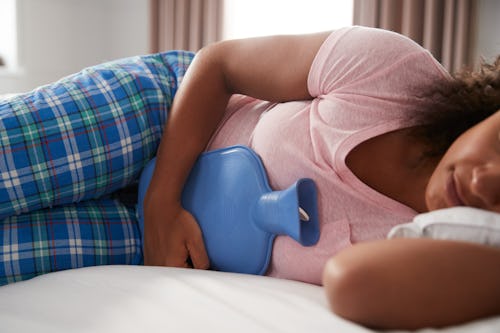
Using a heating pad — or a hot water bottle — during pregnancy is just fine as long as you’re using it safely (see below). “This old-fashioned yet effective home remedy allows the warm water to soothe and relax the muscles of the uterus and may improve blood flow to the effective area,” Dr. Sherry Ross, M.D., OB/GYN, women’s health expert, and author of She-ology: The Definitive Guide to Women’s Intimate Health, tells Romper.

Cramping

What's the deal with those cramps, anyway? Aren’t your days of period cramps supposed to be over for the next nine months? Ross says it’s completely normal and quite common. “Cramping is more noticeable in the lower abdomen since the uterus expands, further stretching the ligaments and muscles located in this area,” she says. In the early stages of pregnancy, that cramping you’re feeling could be the embryo implanting into your uterus. Additional causes of cramping might include gas, bloating, and pregnancy sex.

Back Pain

Cramping isn’t the only thing that might steer you toward using a heating pad while pregnant. The “most common reason for heating pad use during pregnancy is for back pain,” Dr. Kecia Gaither, M.D., double board-certified OB/GYN, maternal fetal medicine specialist, and director of perinatal services at NYC Health and Hospitals in the Bronx, tells Romper. “Other uses include joint pain [or] sore muscles.”

Will It Affect The Baby?

It only makes sense you won’t just be thinking about your safety while using a heating pad, but also your baby’s. After all, when you increase your body temperature, you’re also heating theirs. Fortunately, if you use a heating pad at the right temperature and for a safe amount of time, you should be in good shape.

“The protective coating of the water bottle prevents burning of the skin and any harm that could affect the baby,” Ross says. And the protective coating around an electric heating pad should provide the same protection.

How To Use A Heating Pad Safely

As for the safety of you and the baby, Gaither tells Romper that the heating pad should generally be used below 100 degrees Fahrenheit and only for short increments of 10 minutes or less. “It’s safe to use heating pads as long as it’s not for an extended period of time [and doesn’t] raise the core body temperature,” Gaither says. Since the heat is localized to one area of the body, your temperature won’t go dangerously high like it could in a hot tub.

This is especially important during early pregnancy: It’s “generally advised not to use [heating pads] on the abdomen for a prolonged period of time during the first trimester,” Gaither adds, as it could potentially risk miscarriage or birth abnormalities.

If you’re concerned, you can always wrap a towel around your heating pad while you use it. Or, Ross recommends some other remedies to help with pregnancy cramping and similar aches. “Rest and hydration are also effective at relieving mild cramps associated with pregnancy,” she says. “Drinking water, warm or hot, helps relax the uterine muscles.” Looks like it’s time to turn on that kettle for some warm tea!

When To Stop Using A Heating Pad

Ross notes that if you’re having diarrhea, fever, nausea, vomiting, a fast heartbeat, “worsening pain,” or vaginal bleeding, you should definitely stop using the heating pad and call your healthcare provider. In addition, cramping with shoulder or neck pain warrants a call — potentially a sign of ectopic pregnancy — as well as pain when you urinate, which could be a sign of a urinary tract infection (UTI).

Pregnancy cramps and aches are the worst, but they typically come with the territory. Thankfully, applying a heating pad or hot water bottle is a helpful way to ease those pains — as long as you keep in mind how to use it safely. Pair it with a cup of warm tea to bring on the full soothing effect.

Studies referenced:

Duong, H. T., Shahrukh Hashmi, S., Ramadhani, T., Canfield, M. A., Scheuerle, A., Kim Waller, D., & National Birth Defects Prevention Study (2011). Maternal use of hot tub and major structural birth defects. Birth defects research. Part A, Clinical and molecular teratology, 91(9), 836–841. https://doi.org/10.1002/bdra.20831

George, J. W., Skaggs, C. D., Thompson, P. A., Nelson, D. M., Gavard, J. A., & Gross, G. A. (2013). A randomized controlled trial comparing a multimodal intervention and standard obstetrics care for low back and pelvic pain in pregnancy. American journal of obstetrics and gynecology, 208(4), 295.e1–295.e2957. https://doi.org/10.1016/j.ajog.2012.10.869

Experts:

Dr. Sherry Ross, OB/GYN, women’s health expert, and author of She-ology: The Definitive Guide to Women’s Intimate Health

Dr. Kecia Gaither, double board-certified in OB/GYN and maternal fetal medicine and director of Perinatal Services at NYC Health and Hospitals in the Bronx