This is slide 1 description. Go to Edit HTML and replace these sentences with your own words. This is a Blogger template by Lasantha - PremiumBloggerTemplates.com...
This is Slide 2 Title
This is slide 2 description. Go to Edit HTML and replace these sentences with your own words. This is a Blogger template by Lasantha - PremiumBloggerTemplates.com...
This is Slide 3 Title
This is slide 3 description. Go to Edit HTML and replace these sentences with your own words. This is a Blogger template by Lasantha - PremiumBloggerTemplates.com...
When Ali Wong won the Golden Globe for Best Performance by a Female Actor in a Limited Series, Anthology Series or a Motion Picture Made for Television for her role in Beef, she was sure to thank all of the people who helped make that special moment happen. Including her ex-husband Justin Hakuta, who got a special shout-out for supporting her as a working mom.
Wong and Hakuta were married for eight years before announcing their split back in the spring of 2022. They share two daughters, 8-year-old Mari and 6-year-old Nikki, who they continue to co-parent together. On Sunday night, Wong shared a special message with Hakuta after winning her Golden Globe, saying, “I really need to thank the father of my children and my best friend, Justin, for all of your love and support. It’s because of you that I’m able to be a working mother.”
It was a beautiful shout-out from Wong during her historic win. She was the first Asian American to win a Golden Globe in this category, and wanted to make sure her ex-husband understood his role in helping to make that possible.
This is not the first time Wong has praised her ex-husband. In a 2023 feature in The Hollywood Reporter, she called Hakuta her “best friend” and came to the interview following a pickle ball game with Hakuta. “We’re really, really close; we’re best friends,” she told The Hollywood Reporter at the time. “We’ve been through so much together. It’s a very unconventional divorce.” He even joined her on tour this summer along with their kids, where she included stand-up routines about their divorce. “I’m still workshopping it, but the bones are there and it came to me very fast. This is the first hour I’m doing since I started where I’m single. I think we’re going to call it the Single Lady tour,” she told THR at the time.
Wong has rather famously always made her family life the stars of her comedy specials like Hard Knock Wife on Netflix, so it’s really beautiful to see her take a moment to thank her ex-husband for being a supportive co-parent and giving her the space to create in her work life.
Considering how much we all loved Beef, we should probably be thanking him too.
We had some child-free friends over for dinner the other night. My husband had done most of the cooking during nap time, so we could be social. We persuaded my 2-year-old, who likes to imagine himself at the center of a very tame crisis, that he needed to gather all the cloth napkins in the house and put them at the feet of our guests, on the living room floor.
“They’re in the KITCHEN,” he screamed. “I’m on my way!”
And then we were just four adults, having alcohol and cheese and talking. The conversation became about parenthood in the abstract way it sometimes does between people who just had kids and those who are thinking about having them. Like, what is your life like? I found myself swearing that I had a full and effortless social life.
Really? My friend was skeptical. He never sees his friends with kids anymore.
The 2-year-old added a terry cloth mop cover to the pile of napkins. “We need some more,” he said, thundering away from us. “Jet speed!”
It was true, I admitted, that I don’t manage to make social plans much anymore. Monthly, maybe. But what I felt the need to try to convey, and still feel the need to publicize, as a representative of Those Who Have Dropped Off The Map, is that I don’t need to make as many plans anymore, because I have the playground. And the pool and the kids’ room at the library. The coffee shop that has high chairs and this one brewery that maintains — and the hospitality of this can move me to tears — a big bucket of dirty, old toy trucks.
Kid-friendly spaces are few and far between. My world is smaller than before I became a parent, but it has become passively social in a way that I associate with less anxious, less lonely times. Parents are all on roughly the same schedule (an early one), and children respond well to routines. Faces become familiar very quickly.
There was a period this summer when we were the first ones at the playground every Saturday, closely followed by another family with a kid the same age. We became inclined to go, knowing that they might be there, and soon an organic, zero-pressure standing hang was formed. The couple had interesting jobs and a funny running narrative about each other’s parents. We became friends to the point where I thought, oh I should text them this, before I remembered I didn’t have their numbers.
The playground had become our vaunted “third place” — neither home nor work — that I longed for in my 20s. Where I’m likely to run into an acquaintance but, if I don’t, it’s not weird to sit and read a book, or pretend to read a book and eavesdrop. From a bench on the opposite end of the tot lot, I’ve been listening to one woman plan her entire wedding over the phone while her infant sits on the sandy turf, one pudgy hand resting on a ride-on caterpillar. If I failed to have such a spot earlier in my life, it’s not because I wasn’t a parent, but because I failed to commit to anything the way my son has committed to the swings. And perhaps because I expected too much from third places and the people you meet there.
The primary social value of other parents is that we’re in the same place at the same time, in the most literal sense.
As far as third places go, the playground is not particularly comfortable. The benches are cold. But it’s free, and it never closes. I would love it if the playground had coffee or beer, but I have come to appreciate the subtler mood-elevating effects of vitamin D and low-stakes social interaction. Trading opinions with a stranger about Netflix and restaurants and nearby hikes just feels better than looking at Twitter, no matter how little intel I take away. There’s one woman I see at the playground and our whole relationship is we compare our relative locations on the waiting list for toddler gymnastics. (As of this writing, her son is in and mine is out.)
Even on the days when I don’t feel like small talk, it is stimulating, on an almost subconscious level, to be dumped into a new pond of people. At the playground, one can’t help but notice that the dad pushing the swings has incredible triceps, or that a mom has a seemingly endless supply of top-notch coats. I like listening to people grandparent in languages other than English, and I love how newer moms look at me like I’m a different species, even though I still feel like I am one of them. It’s moving to watch someone else’s kid sprout up, become an older sister, graduate to the big-kid playground, even if you never learn their name.
People talk about mom friends as if it was the deep, existential aspects of parenthood that bond us with other people undergoing the same transformation. Or as if our new interest in sleep training, day care, and phonics was so powerful that we only wanted to socialize with other people who share it. But my experience has been that the primary social value of other parents is that we’re in the same place at the same time, in the most literal sense.
The closest analogue to the playground that I can think of is a college dorm on a Friday night. The quality of the company may vary, but kid-friendly spaces reliably take me from being alone to hanging out, no invitation necessary. At the playground, nobody has to clean up, and it’s no big offense if you bail. I think the kids are better there, too. Mine would not even let me loan a neighbor kid one of his sippy cups at home, but he can weirdly handle taking turns with the communal toys in the sand pit. I also don’t have to worry about anybody’s drywall when he runs full-tilt pushing a toy meant for an infant learning to walk.
Recently, I realized that you can just text a bunch of people, say you’re ordering pizzas to the playground, and ask if anyone wants in. That’s dinner, gross motor play, and adult conversation, all checked off, without washing a single dish.
Well, we could do that, but my local playground has one major flaw, which is that it does not have any lights. Between the cold and the dark, it’s hard to find playground hours this time of year. We’re home a lot, having predawn foot races between the kitchen and front door. It’s been a good season for more intentional, deeper hangs: Getting to know playground-friends better, finding out if they might become friend-friends, and reconnecting with the people who have more interesting things to do than head out for the park at 9 a.m. with a slide-cleaning squeegee and bag of Pirate’s Booty.
But I am counting down to our glorious return. When I accidentally drove past the playground the other day, the 2-year-old sobbing “my playground, my playground” from the pitch-black back seat, I remembered the first warm day last year. We decided to walk to the playground, and everybody had the same idea. The place was packed. Standing room only, with a half-dozen separate adult conversations happening in different corners. There were people we saw all over and faces we had never seen before. Our friends were there, talking to other people we knew, though we didn’t know they knew each other. A cool dad we had met once was talking about the still-visible moon with his daughter, a phase of parenting that seemed impossibly far off to us. A slightly older crew of parents was drinking cocktails out of travel mugs, keeping an eye on their preschoolers while bouncing their infants. We had a distinctly freshman feeling, that more and better forms of fun awaited us.
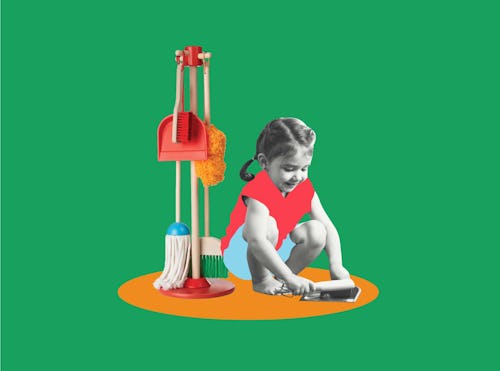
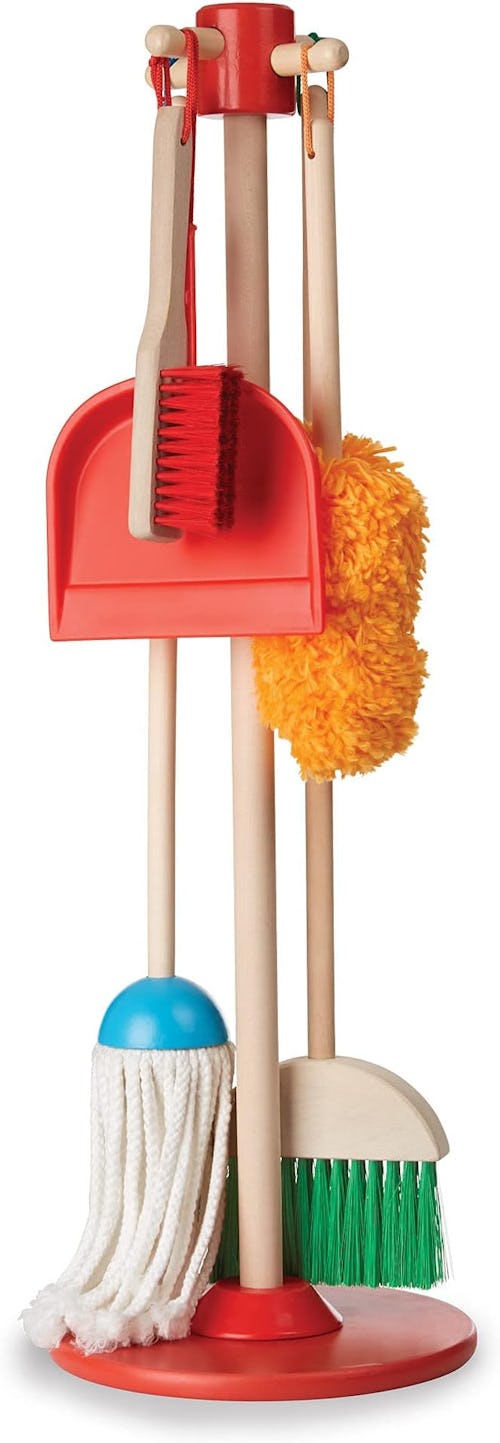
Parents know how much toddlers love to play pretend clean. We see it in their own homes as our little ones waddle around from room to room, sweeping up imaginary crumbs, mopping floors that could use an actual scrub-down, and wiping down any surface they can reach with whatever fabric they can get their hands on, be it an actual cleaning cloth or a dirty sock from the hamper. The toy industry is well aware of this phenomenon as well. We’ve seen a surge of cleaning-themed toys hit the market in the past few years, and there’s one product in particular that feels like a rite of passage into toddlerhood: Melissa and Doug’s Dust! Sweep! Mop! set. As soon as your baby outgrows infancy, there’s a high chance this six-piece wooden toy set will make its way into your home. But what is it about playing “cleaning” (different from clean-up) that is so thrilling for young kids?
“Cleaning seems to take up even more time than other housework imitative behaviors that toddlers like to engage in,” says Laura Phillips, neuropsychologist and senior director within the Learning and Development Center at the Child Mind Institute. “It's one of the earlier forms of pretend play that we see toddlers engage in. And there are developmental reasons — cognitive, social, and emotional — that drive that play,” she says.
Here’s what experts have to say about the appeal of cleaning to toddlers, how it benefits them developmentally, and how parents can make this type of pretend play the most enriching for their child.
Why Toddlers Love To Clean
Reason 1: It’s in their nature to imitate
Playing copycat is an integral part of development. “The most meaningful, significant, or critical reason why toddlers engage in so much cleaning and other housework behaviors is because kids just naturally are imitators. It's how they learn,” explains Phillips. “We're social beings. We learn foundational linguistic and motor skills [like speaking and jumping through observing other people do it,” she says.
This did not go unnoticed by the masterminds behind Melissa & Doug’s toys. In fact, the product first came to be after watching toddlers in their element — what items were they drawn to and how were they interacting with them? “We noticed that kids would often play with a dustpan and broom in preschools,” says Sofia Dumery, senior vice president of design at Melissa & Doug. And from there, they decided that “cleaning could be an exciting area to examine.”
Reason 2: It makes them feel good
— kate_sept2004/E+/Getty Images
Both Phillips and Dumery agree that there is a sense of accomplishment and self-worth stirring in young children when they engage in cleaning, and this is likely due to the praise they receive when they perform these acts. “It's very reinforcing and that's feeding into their own sense of agency and sense that they can accomplish tasks,” Phillips says.
And perhaps there’s something about playing with purposeful items, as opposed to toys that are simply designed for entertainment, that accelerates their sense of independence. “Realistic, hands-on toys let kids explore the world around them, and help them connect with others,” explains Dumery. “Our research in pediatric development showed that kids undergo a huge transition between ages 2 to 3 when they start to explore their world and develop a sense of autonomy. Taking on grown-up roles and responsibilities (like pretending to do chores) and imitating the behaviors of their caregivers allow kids to model independence, which builds self-esteem and confidence.”
Reason 3: The accessibility
One theory why toddlers are so drawn to cleaning (more than other imitative tasks they could be performing) is that there’s a lot of cleaning naturally actively happening around them and thus have more opportunities to observe it, reflects Phillips. Think about it: caregivers are generally most paranoid about germs the younger a child is, constantly tidying, mopping, and wiping surfaces. It makes sense that if babies and toddlers have an innate sense to imitate the people around them, once they are physically able to, they will want to.
Wiping and sweeping is also a relatively safe act to imitate, Phillips surmises, as long as actual cleaning products aren’t within reach. Most likely they’ll pick up a sock or some other small, soft textile, and try to wipe down the fridge, cabinet door, or play table.
A Brief History On The Toy
Melissa and Doug’s highly recognizable Dust! Sweep! Mop! set celebrates its 10th anniversary this year, and in the company’s 30-year history, it’s one of their top five bestselling toys of. all. time. Grown-ups love it and buy it because it’s a unique toy from a quality brand with a relatively small footprint. And let’s be honest — it’s kind of hilarious to give your 2-year-old a mop and broom set that’s literally ergonomically designed for them.
Here is how Dumery describes the very intentional design elements of Dust! Sweep! Mop!: “The bristles are pliable enough to actually pick up dirt, but aren’t scratchy, the dustpan snaps easily to the brush, the mop doesn’t damage the floor, and the duster is super soft yet durable. The fact that it comes with a sturdy, wooden storage stand is crucial; it has a small, yet stable, footprint so it can easily go anywhere and the stand encourages kids to clean up after themselves.
Developmental Benefits Of Playing Pretend Cleaning
Letting your child pretend clean to their heart’s content is all fun and games until you realize there are serious developmental benefits behind this type of play — it just might become the activity you want them to engage in the most. “As brains develop, they drive certain behaviors naturally that then help kids to acquire new skills,” says Phillips. And with regard to playing cleaning, she says “there's tremendous cognitive benefit to allowing space for that type of play: language, motor, creativity, flexible thinking, problem-solving, and also that social emotional piece of developing empathy.”
Linguistic
Essentially, imitation is the foundation for language and communication, explains Phillips, giving us a glimpse into what’s happening in a toddler’s brain when imitating: “There's actually neural circuitry (mirror neurons in the brain), that drive imitative behavior because of how it supports the development of language and communication. Both verbal and nonverbal forms of communication really starts to be developed through imitation and in the context of a relationship where there's a lot of back and forth. And it’s reinforced through the parent responding to what really is first in imitative behavior.” An example of communication via imitation is when a baby babbles and a parent babbles back at them.
Social
To a newborn, they and their caregivers are one entity — it’s not until they move through infancy and into toddlerhood that children increasingly see themselves as beings separate from their caregivers, Phillips explains. Once this realization starts to manifest, it’s then that they start to “observe other people's behaviors and then try on those behaviors,” she says. This is what lays the foundation for developing empathy.
“From a social emotional perspective, that type of imitative play is really critical for developing empathy in a society where we really need to care for one another,” says Phillips, as it teaches them how to function as part of a group, and you really see this in a classroom or day care setting: children observing and mimicking the behaviors of their peers (like hanging up their coats in their cubby).
Physical
— Natalia Lebedinskaia/Moment/Getty Images
The most obvious benefit of this type of play is probably the fine and motor skills benefits. “When you're sweeping, you're moving your body in a different way than you do naturally. So, there's also a lot of physical development,” says Phillips. Same for dusting, using a spray bottle (which happens to be something that my toddler actually does during occupational therapy sessions) — each of these actions utilize and exercise different muscle groups to build strength and coordination.
Cognitive
Pretend play in general helps children strengthen problem-solving, creativity, and flexible-thinking skills, says Phillips. You’ll see it in the way they resolve issues (either real or imaginative) that arise while they play. Let’s say there’s a spill on the table and an actual rag isn’t available — they might run to the nearest hamper and grab a sock to wipe up the spill. This is an example of them identifying and addressing a problem using the resources available to them.
How To Make The Most Of Playtime To Benefit Your Child
Serve and return, or talking through whatever they’re experiencing, is the best way to shape language and communication, says Philips. “What kids need in toddlerhood is language and a ton of it. And specifically from a live human being,” she says.
Dumery dives further into why it’s so important for little ones to interact with people as opposed to electronic toys when it comes to language development: “American Academy of Pediatrics (AAP) studies have shown traditional toys are better than electronic toys for children’s language development because, when toys talk, parents talk less, and as a result, kids vocalize less.”
Also important, and probably less intuitive, is to narrate and label what your child is doing to give them the vocabulary for what they’re doing as opposed to asking them what they’re doing, which interrupts their play and actually can put pressure on them. “When kids are cleaning, parents can then narrate like, ‘Oh, look, you're sweeping the floor,’ because giving them words for what they're doing is helping with language development. It also helps kids just knowing that their parents see them is incredibly important for self-concept,” she says.
So what’s wrong with asking questions? “Parents have this urge to ask questions. They'll say, ‘What are you doing?’ Or ‘What are you building? What color are you going to choose next?’ That actually puts pressure on kids to feel like they have to meet a parent expectation about what they're building or what color,” she says.
All in all, any form of interacting and communicating with your young child teaches them so much more than just a bank of vocabulary terms. It’s so true when they say that toddlers are parrots and children are sponges — they just want to soak up and copy everything you do, and if that means they’re going to want to help you wipe down the tabletop after every meal, well, so be it.
Laura Phillips, Psy.D., ABPdN, board certified in pediatric neuropsychology; senior neuropsychologist, senior director, Learning and Development Center at The Child Mind Institute
Gypsy Rose Blanchard’s life has not been easy. The now 32-year-old spent most of her life as a victim of Munchausen syndrome by proxy, with her mother Dee Dee Blanchard forcing her to pretend to be a sick child suffering from serious illnesses like leukemia and muscular dystrophy well into her 20s. Her mother was insistent that Gypsy Rose hide the fact that she was actually an adult woman instead of the wheelchair-bound, terminally ill child she presented to the rest of the world. Dee Dee was so committed to this fiction that Gypsy Rose says her mother made her wear diapers when she was on her period, instead of teaching her use menstrual products.
Gypsy Rose was recently released early from prison after being convicted for her role in the 2015 murder of her mother that she conspired with then-boyfriend Nicholas Godejohn, and she has been sharing some tragic details of what her life looked like in the years leading up to that horrible event. In the new Lifetime docuseries The Prison Confessions of Gypsy Rose Blanchard, premiering Jan. 5, the young woman shares that her mother made her wear diapers when she was on her period, according to People. In fact, Gypsy Rose didn’t learn how to use a tampon until she was sent to prison in her 20s.
“It was not your typical, ‘OK, so I’m going to take you to a store and we’re going to get you a training bra, we’re going to get you pads and tampons,’” Gypsy Rose further explained in an interview with People. “There was none of that. So it was very abnormally learned, and unfortunately, I had to basically come to prison with the skills that [Dee Dee] taught me, which was not much.”
Her fellow inmates helped her learn these basic skills. “[In prison] I’m around women that have been around the block or two, and they have a lot of life experience,” she explained to People. “Maybe it’s not the best life experience, but I’ve been able to gain some positives from being around other inmates.”
Gypsy Rose has decided to share her experience now as she prepares for a new life outside of prison. She married Ryan Anderson in 2022 while she still in prison, and told Lifetime that she is ready to be “free of all these disturbing secrets.” She hopes to have children after her prison release, and hopefully telling her story will pave the way for a better future.
“I share my story to be a cautionary tale,” she said in an interview with Good Morning America. “So that the next person that might be in a situation like mine, they don't take the route that I did.”
You could argue that athletes are forged after countless hours of practice, by overcoming impossible odds and soldiering on through defeat. But it would seem that some athletes are born to run — if you’re asking Donna Kelce, that is. In the latest installment of Travis and Jason Kelce’s podcast, New Heights, the brothers cover all sorts of topics with their special guests, Mama and Papa Kelce, and Jason’s wife, Kylie. And their conversation took a hilarious turn when the family discussed the fact that Travis Kelce used to be “a leash kid.”
The topic arises when Travis mentions going to Cedar Point amusement park as kids, when he was around 1 or 2, and asks his mother to explain why she put him on a leash for the day. Jason Kelce notes that Travis’ stint on a leash came after Jason got lost at a county fair the year before, and was returned to his mother by a police officer.
“I was scared to death because you would just run off. I couldn’t catch you Trav, you were so fast. Plus, I couldn’t lift you,” Donna says. At this point, Travis cuts in to explain that his mom always picked a meet-up point when they’d arrive somewhere busy, a place they would all go if they got separated so they could find each other quickly. Little Travis took this to mean he could run off intentionally and just head back to the meeting spot when he was ready. No, son...
Mama Kelce goes on to say Travis started walking at 8 months old and tells him “you were just a terror.” Apparently his small size plus his early ability to walk made Travis able to “dip in and out of cars” and evade his parents. “I can’t have you dying, so that’s what we did,” Donna says.
All in all, Donna says Travis’s stint on the leash only lasted about six months, just until he could understand the dangers of darting off. It sounds like his no-fear attitude was the same as most toddlers’, but that coupled with his speed and size made it hard for his parents to keep up sometimes.
And listen, leash kids and their parents probably deal with a lot of judgment for it, but if your kid is a runner, a harness is honestly the best way to keep them safe when you’re out and about. Let the haters hate, because they’ve obviously never had to chase a toddler who sprints for a busy intersection like they drank turbo jet fuel with breakfast. And who knows — maybe your little sprinter will grow up to put those skills to good use as a professional athlete, just like T. Kelce himself.
The Curious Case of Natalia Grace shocked the world when it came out last year. It told the story of a family in Indiana, the Barnetts, who adopted a girl originally from Ukraine whom they purported to not be 6 years old as her birth certificate claimed, but an adult. More shockingly, in a twist mirroring the 2009 film The Orphan, they claimed this grown woman was trying to murder her new family. In 2012, they had her legally re-aged from 8 to 22 and placed her in a series of apartments on her own before moving out of the country. Now a follow-up series, The Curious Case of Natalia Grace: Natalia Speaks, examines this wild case from the perspective of the young woman herself who proved, in the first episode through DNA testing, that she is now in her early 20s. While much of the information covered in Natalia Speaks was revealed in the original docuseries, the new series dropped some real bombshells over the course of six episodes.
Content warning: This article includes descriptions of child abuse and sexual violence.
Natalia Grace’s age was determined by multiple doctors while she was living with the Barnetts.
Kristine and Michael Barnett have claimed that not only did they have genuine questions about Natalia’s age, but they had no trustworthy medical records to indicate that she was, in fact, 6 years old when they adopted her. And yet records show that no fewer than four doctors confirmed that Natalia was a child between 2010, when she was adopted by the Barnetts, and 2012, when the Barnetts had her age changed to 22.
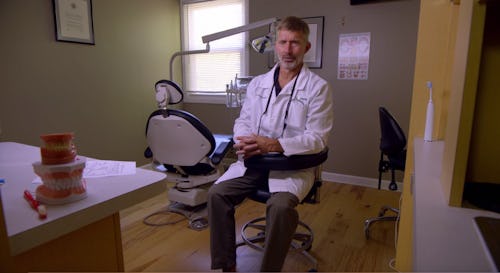
Natalia Speaks shows that within two weeks of her adoption, they had access to a report from an endocrinologist, Dr. Andrew Riggs, who put Natalia’s age at somewhere between 9 and 11. The estimate, while older than 6, still solidly places her in childhood. Moreover, Kristine brought Natalia to a family dentist, Dr. Tim Gossweiler, whose X-rays showed that Natalia not only still had 12 baby teeth in her mouth, but her adult teeth were visible beneath them. He determined her age to be between 6 and 9 years old, calling his ruling “indisputable” proof that she was a child.
This augments existing evidence, uncovered by BuzzFeed in 2019, that the Barnetts took Natalia to Peyton Manning Children’s Hospital in 2012 for a bone density test and a skeletal survey, both of which determined she was a child.
The Barnetts claimed Natalia was a closed adoption, but they emailed with her first adoptive family.
Michael Barnett has claimed that Natalia came to their family via a closed adoption, and yet in Natalia Speaks, Natalia claims to have seen the Barnetts and the Ciconnes go into a room together on her adoption day. This alone wouldn’t necessarily be a bombshell or smoking gun: Natalia was little when this happened and memory can be a funny thing. But...
The series also presents email exchanges between the Barnetts, the adoption agency, and Natalia’s former adopted family, the Ciconnes. So, based on the docuseries, not only was this not a truly closed adoption but it would seem the Barnetts had more information about Natalia when they adopted her than they said they did.
There appears to be motivation behind adopting Natalia.
Natalia Speaks highlights a theory as to what went awry between Natalia and the Barnetts and it essentially boils down to Kristine’s ambitions. Prior to adopting Natalia, Kristine had made a name for herself as a mom who nurtured her autistic eldest son, Jacob, and allowed him to reach his full potential as a math and science prodigy. Jacob enrolled in college at just 10 years old. He and Kristine were featured in a 2012 segment of 60 Minutes and were the subjects of numerous fawning newspaper and magazine articles. She received, according to Natalia Speaks, a $600,000 advance for a ghostwritten book The Spark: A Mother’s Story of Nurturing, Genius, and Autism.
In Natalia Speaks, subjects speculate that Natalia’s adoption was Kristine’s attempt to not only enhance her image, but to recreate the success she had with Jacob with Natalia. Kristine, some believe, wanted to reveal Natalia to be powerfully talented and gifted, but Natalia’s educators from her elementary school revealed that the girl performed at grade level. It wasn’t long before Kristine pulled Natalia from the school to educate her at home. While Kristine had alleged that the school complained about Natalia’s bad behavior, specifically hurting other children with her wheelchair, the school and Natalia’s teacher deny these allegations in the docuseries, stating that she was well-behaved and kind.
Moreover, this theory also suggests that saying Natalia was 22 was a calculated move: the documentary states that in Indiana, parents are materially responsible for their children through the age of 21. Saying Natalia was 22 would, under typical circumstances, exculpate the Barnetts from continued care. But because of Natalia’s particular form of disability, statutes dictated that since she required assistance in daily life, they would potentially remain responsible for her in some capacity for the rest of her life.
Natalia alleges profound abuse by Kristine Barnett.
While Michael Barnett detailed Kristine allegedly physically abusing Natalia while she was in her care, Natalia paints an even darker picture, alleging abuse ranging from beatings to humiliation to attempted murder. In addition to being hit with belts and “dropped” by her older brother (Natalia and Michael have both alleged that Kristine encouraged their sons to beat Natalia as a form of discipline), Natalia additionally alleges that Kristine pepper sprayed her twice (once with no provocation whatsoever); forced her to dress up like a gnome and stand in a fixed pose for hours; forced her to use a tampon at 7 years old, despite not having a period, and then pointing to ensuing bleeding to “prove” that she was in fact menstruating; and intentionally giving her more medication than she needed in, Natalia believes, an effort to overdose her.
Though Kristine declined participation in both The Curious Case of Natalia Grace and Natalia Speaks, she refuted allegations of abuse and mistreatment in a lengthy post on Facebook. “Natalia was a very much loved and cared for member of my family. She was not abused by anyone in my family,” her statement reads in part. She also called the docuseries “highly sensationalized.”
Natalia’s life in Ukraine was traumatic and may have involved sexual abuse.
Little is known about Natalia’s life prior to coming to live with the Barnetts, including her earliest childhood in Ukraine. But in the series, Natalia recalls some hazy memories from her time there, including being “chased” by someone wearing a scary green mask (a former FBI expert suggests this might have been a terrible but effective tactic for understaffed orphanages to keep the children in line); being drugged via injection; having her face covered and awaking to find herself in the presence of a man she didn’t know; and possibly even having a foster family. Archival footage of an interview between Natalia and the FBI’s Child Crimes investigator in 2014 shows Natalia describing sexual assault while she was still in Ukraine, when she could not have been older than 5.
Natalia was officially adopted by the Mans family, whom she has lived with since 2013.
While Natalia is legally 34 today (her age change has not been reversed despite copious medical evidence that she is in her early 20s), and is by any measure an adult today, she was formally adopted by Cynthia and Antwon Mans, who she refers to has her mom and dad on June 1, 2023. Her name is now Natalyah Grace Renee Mans. (Renee is also Cynthia’s middle name and, fittingly means “rebirth.”)
Natalia Speaks hints at trouble between Natalyah and the Mans family in the last moments of the series.
While the documentary ends on a positive note, the epilogue of the series shares a “shocking” phone call they received two weeks ago, six months after Natalyah’s adoption from the Manses. While we don’t get the conversation in its entirety, snippets indicate some sort of problem facing the family.
“Something ain’t right with Natalyah,” Antwon can be heard saying. “This girl is tweaking ... I feel like she’s the enemy in the house ... and she said to us we have held her hostage ... Made us look like we’re the enemy.”
“Natalyah is stabbing her family in the back over a complete lie,” Cynthia adds.
“She’s done other things too,” Antwon continues in this partial conversation, “But this was a new low ... Natalyah does not have emotions for nothing but herself ... We’re done. We’re done with her.”
Could this be a case of salacious editing? Has there been a falling out between Natalyah and the pair she’s called her parents for a decade? Whatever the answer, it seems this is less the next chapter in the young woman’s life, but a new story.
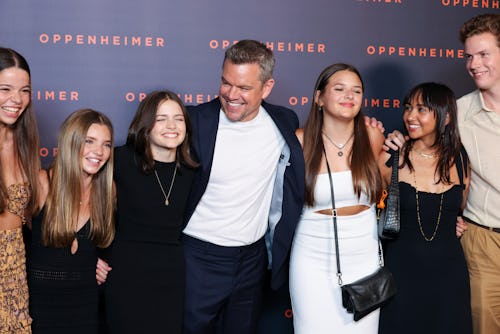
Matt Damon has received accolades and awards for so many of his roles, most recently for his parts in Christopher Nolan’s Oppenheimer and Ben Affleck’s sports drama Air. Which is absolutely amazing, of course, and could well have given him a bit of an ego if he wasn’t careful. Or if he didn’t have his wife and four daughters to keep him super grounded in reality. Here’s what else you need to know about Damon’s family.
Matt Damon met his wife Luciana Barroso when she was bartending in 2003.
Damon was in Miami filming Stuck With You in 2003 when he met Argentinian-born bartender Luciana Barroso. He told Ellen DeGeneres in an interview that it was love at first sight for him. “Literally saw her across a crowded room, literally,” he said. Barosso remembered it differently in a 2018 interview with Vogue Australia. She said that Damon and some of the film crew came in for a drink, and her future husband came behind the bar to get a break from the crowd. “He had started getting recognized and asked for pictures and autographs, and then it got kind of aggressive because people are drinking and stuff,” she explained at the time. “So he came and hid behind the bar … [wanting to] just hang out back there and have a drink. He says, ‘Oh, I saw you and I really wanted to talk to you.’” She let him stay behind the bar, but put him to work serving drinks. They went on to marry in 2005.
Luciana was a single mom when she first met Matt Damon.
When Damon first met Luciana, she was already mom to 4-year-old daughter Alexia. Something she told Vogue Australia meant the world to Damon. “He said, ‘I love that you’re a mum and that’s your priority.’ Some guys might have been different, they might think it’s complicated, but for him it wasn’t. When you meet somebody that you have a connection with, that’s just the person that you have a connection with, all the other stuff — the movie-star part — wasn’t really a factor. It was just Matt, to me he’s just Matt.”
Their daughter Alexia is 24.
When Damon married Luciana in 2005, he instantly became a stepdad to her daughter Alexia. “Suddenly, it wasn’t just my wife. It was her 4-year-old little girl,” he told Hello! Canada in 2010, per People. “There was never a choice. It was just the way it was, and I was happy for that.” He has maintainted a close relationship with Alexia, even working with her when she had a small cameo in the 2009 film We Bought A Zoo.
Their daughter Isabella is 17.
Matt and Luciana Damon welcomed daughter Isabella in 2006, and becoming a dad to a newborn for the first time really changed his work. The Bourne Ultimatum star told The Daily Express that the director of the film told him he looked “terrible” at the time. “I told him, ‘I’m sorry. I’m awake all night with the baby,’ to which he said, ‘No, it’s really good. She came along just at the right time — she’s really helping your performance.’”
Isabella has become one of her dad’s most hilarious film critics, he admitted in a 2022 CBS Sunday Morning interview when asked if young people watched Good Will Hunting. “Fewer and fewer, you know, younger people don’t know it as much,” he explained, then mentioning one younger person in particular. “You know, my 15-year-old refuses to see it. She doesn’t want to see any movies that I’m in that she thinks might be good.”
Their daughter Gia is 14.
Gia Damon was born in 2008 in Miami, and right away she was able to reap the rewards of having a dad in the entertainment business. She visited him on the New Mexico set of True Grit in 2010, where the proud dad told she and sister Isabella took pictures with horses. And Gia even had the chance to go to Africa to meet Nelson Mandela when her dad was filming Invictus. “Lucy and I didn’t even talk to him, we just let him hang out with the kids. He bounced them on his knee,” Damon told People of the meeting. “Isabella and Gia couldn’t take their eyes off him. They just were looking at each other, completely locked on each other the entire time.”
Their daughter Stella is 13.
The arrival of Damon’s youngest daughter Stella in 2010 made them a family of six, and he admitted to People at the time, “It’s been pretty crazy. The baby came a couple of weeks early. It’s our fourth, so we’ve done it before — but it’s a whole new dynamic.” Becoming a dad of four daughters has been pivotal for Damon, who had all of their names tattooed on his arm in 2019 and once even let them dye his hair red to keep them entertained during the pandemic. “I had let the kids dye my hair red. It was their art project basically, and it was clear that we weren’t going back to work,” Damon told his friend Ben Affleck on The Tonight Show in 2021. “Then they decide that I needed a mohawk, so they mohawked me.”