Redirecting you to our exclusive offer…

If you are not redirected automatically, click here.

Thanks for visiting! Your offer will open shortly.

  • This is Slide 1 Title

    This is slide 1 description. Go to Edit HTML and replace these sentences with your own words. This is a Blogger template by Lasantha - PremiumBloggerTemplates.com...

  • This is Slide 2 Title

    This is slide 2 description. Go to Edit HTML and replace these sentences with your own words. This is a Blogger template by Lasantha - PremiumBloggerTemplates.com...

  • This is Slide 3 Title

    This is slide 3 description. Go to Edit HTML and replace these sentences with your own words. This is a Blogger template by Lasantha - PremiumBloggerTemplates.com...

Wednesday, August 7, 2024

Discovering Relapsing MS: A 7 Question Quiz To Learn More


Imagine if simple tasks like getting dressed, making a meal, or even walking were a challenge. Many of us take these actions for granted, but this is the reality for the one million Americans who live with multiple sclerosis (MS).¹ It can be especially hard for those living with relapsing MS (RMS) — the most common type of MS — since they can experience periods of relapses, or symptom “attacks,” and remissions, which is when symptoms subside or even completely disappear.² ³ With the most common age of onset being 20 to 40 years old, it’s important to know about the different types of MS, recognize signs and symptoms, and explore the available treatment options for this autoimmune disease that affects the central nervous system.³

To help educate and empower individuals about RMS, we tapped Dr. Sharon Stoll, a board-certified neurologist and neuro-immunologist who works tirelessly to help individuals diagnosed with MS and their loved ones understand this chronic condition.

No matter what someone’s initial thoughts are upon receiving an MS diagnosis, Stoll recommends keeping an open mind and becoming their own advocate — even though doing research on their own can be scary and overwhelming.

“The MS space changes so quickly, and something that may have been true a few months ago may be outdated by the time a patient is seeing me,” Stoll explains. “I encourage patients not to rule anything out before speaking with their healthcare provider.”

So, what exactly is RMS? Take this quick seven question quiz to learn more.

To learn even more, visit ReframingMS.com to download a 3-step guide that outlines a process for reflecting, reframing, and reaching out, so that people living with relapsing MS can voice their needs and reach for what’s possible, wherever they are in their journey.

Important Safety Information

Who should not take KESIMPTA?

Do NOT take KESIMPTA if you:

- have an active hepatitis B virus (HBV) infection.

- have had an allergic reaction to ofatumumab or life-threatening injection-related reaction to KESIMPTA.

What is the most important information I should know about KESIMPTA?

KESIMPTA can cause serious side effects such as:

- Infections. Serious infections, which can be life-threatening or cause death, can happen during treatment with KESIMPTA. If you have an active infection, your health care provider (HCP) should delay your treatment with KESIMPTA until your infection is gone. KESIMPTA taken before or after other medicines that weaken the immune system may increase your risk of getting infections. Tell your HCP right away if you have any infections or get any symptoms including painful and frequent urination, nasal congestion, runny nose, sore throat, fever, chills, cough, or body aches.

- HBV reactivation. If you have ever had HBV infection, it may become active again during or after treatment with KESIMPTA (reactivation). If this happens, it may cause serious liver problems including liver failure or death. Before starting KESIMPTA, your HCP will do a blood test to check for HBV. They will also continue to monitor you during and after treatment with KESIMPTA for HBV. Tell your HCP right away if you get worsening tiredness or yellowing of your skin or the white part of your eyes.

- Progressive Multifocal Leukoencephalopathy (PML). PML may happen with KESIMPTA. PML is a rare, serious brain infection caused by a virus that may get worse over days or weeks. PML can result in death or severe disability. Tell your HCP right away if you have any new or worsening neurologic signs or symptoms. These may include weakness on one side of your body, loss of coordination in arms and legs, vision problems, changes in thinking and memory, which may lead to confusion and personality changes.

- Weakened immune system. KESIMPTA taken before or after other medicines that weaken the immune system could increase your risk of getting infections.

Before you take KESIMPTA, tell your HCP about all your medical conditions, including if you:

- Have or think you have an infection including HBV or PML.

- Have ever taken, currently take, or plan to take medicines that affect your immune system. These medicines could increase your risk of getting an infection.

- Have had a recent vaccination or are scheduled to receive any vaccinations.

  • You should receive any required ‘live’ or ‘live-attenuated’ vaccines at least 4 weeks before you start treatment with KESIMPTA. You should not receive ‘live’ or ‘live-attenuated’ vaccines while you are being treated with KESIMPTA and until your HCP tells you that your immune system is no longer weakened.
  • Whenever possible, you should receive any ‘non-live’ vaccines at least 2 weeks before you start treatment with KESIMPTA.
  • Talk to your HCP about vaccinations for your baby if you used KESIMPTA during your pregnancy.

- Are pregnant, think that you might be pregnant, or plan to become pregnant. It is not known if KESIMPTA will harm your unborn baby. Females who can become pregnant should use birth control (contraception) during treatment with KESIMPTA and for 6 months after your last treatment. Talk with your HCP about what birth control method is right for you during this time.

- Are breastfeeding or plan to breastfeed. It is not known if KESIMPTA passes into your breast milk. Talk to your HCP about the best way to feed your baby if you take KESIMPTA.

Tell your HCP about all the medicines you take, including prescription and over-the-counter medicines, vitamins, and herbal supplements.

How should I use KESIMPTA?

See the detailed Instructions for Use that comes with KESIMPTA for information about how to prepare and inject a dose of KESIMPTA and how to properly throw away (dispose of) used KESIMPTA Sensoready pens or prefilled syringes.

- Use KESIMPTA exactly as your HCP tells you to use it.

- Your HCP will show you how to prepare and inject KESIMPTA the right way before you use it for the first time.

- Do not inject into areas where the skin is tender, bruised, red, scaly or hard. Avoid areas with moles, scars, or stretch marks.

KESIMPTA may cause serious side effects including:

- Injection-related reactions. Injection-related reactions are a common side effect of KESIMPTA. Injecting KESIMPTA can cause injection-related reactions that can happen within 24 hours (1 day) following the first injections and with later injections. There are two kinds of reactions:

  • at or near the injection site: redness of the skin, swelling, itching, and pain. Talk to your HCP if you have any of these signs and symptoms.
  • that may happen when certain substances are released in your body: fever, headache, pain in the muscles, chills, tiredness, rash, hives, trouble breathing, swelling of the face, eyelids, lips, mouth, tongue and throat, and feeling faint, or chest tightness. Contact your HCP right away if you experience any of these signs and symptoms, especially if they become worse or you have new severe signs of reactions after subsequent injections. It could be a sign of an allergic reaction, which can be serious.

- Low immunoglobulins. KESIMPTA may cause a decrease in some types of antibodies. Your HCP will do blood tests to check your blood immunoglobulin levels.

The most common side effects of KESIMPTA include:

- Upper respiratory tract infection, with symptoms such as sore throat and runny nose, and headache.

- Headache.

You are encouraged to report negative side effects of prescription drugs to the FDA. Visit www.fda.gov/medwatch, or call 1-800-FDA-1088.

Please see full Prescribing Information including Medication Guide.

Indication

What is KESIMPTA (ofatumumab) injection?

KESIMPTA is a prescription medicine used to treat adults with relapsing forms of multiple sclerosis (MS) including clinically isolated syndrome (CIS), relapsing-remitting disease, and active secondary progressive disease.

It is not known if KESIMPTA is safe or effective in children.

References

  1. Multiple Sclerosis International Federation. Atlas of MS 3rd Edition. Part 1: Mapping multiple sclerosis around the world. Accessed July 28, 2023.
  2. National Multiple Sclerosis Society. MS signs & symptoms. Accessed July 28, 2023.
  3. Hunter SF. Overview and Diagnosis of Multiple Sclerosis. Am J Managed Care. 2016;22:S141-S150.
  4. Olek, MJ. Multiple sclerosis. Annals of internal medicine. 2021;174(6):ITC81-ITC96.
  5. Kesimpta Prescribing Information. East Hanover, NJ: Novartis Pharmaceuticals Corp; April 2024.

6/24

424273


I Loved Being Homeschooled, But I'll Never Do It For My Kid


It snowed on my first day of home education. I was 10, it was 1994. I caught a snowflake on my sleeve, perfectly hexagonal, with all the points intact. We got out a microscope, and Mum taught me about the Fibonacci sequence and fractals, and how Johannes Kepler caught a snowflake on his sleeve in the 1600s and analyzed its shape, wondering why it had six sides, like a honeycomb. Via this snowflake, we could study history, mathematics, physics, and philosophy. A snowflake is shaped by its experiences, its journey, and no two are alike. No two children are alike either, my mum said, so why put them all into one education system?

For our next assignment, she had me look in the mirror and say, “I love you,” but I couldn’t do it, I cried. I had begun to hate myself, to barely believe I existed. Schools had impacted my mum’s confidence, too. In fact, before deciding to home educate, she had to leave her teaching job in a school due to stress. But at home we weren’t defined by how the other kids and teachers saw us, and we didn’t have to fit into other people’s ideas of how a day should be structured.

We didn’t study much geography, or biology, or learn about British imperialism and colonization and antiracism — my mum’s gaps became mine. Sexuality and gender never came up, but we did at least learn about (white, middle-class) feminism. To be fair, the school system was worse on many fronts. People always asked if I was lonely and I’d respond that I didn’t know what loneliness was because I’d never known what it is to have friends. (Yes, I was a dramatic child.)

Children in schools don’t spend much time learning the best ways in which they think, but at home we could. We experimented with working short hours, learning through reading, practicing languages on a walk, writing poems outside. Without a TV and before social media, there wasn’t much chance for escape, but we created an environment and rhythm that my mum and I both felt safe in, that had quiet spaces and soothing activities built into them. We had no language for neurodivergence or for understanding sensory overwhelm, but I called the days when I couldn’t handle anything “whoops days.”

After a few years, I tried another school, and in some ways it was good — I made friends, for one — but I left after a year. My parents would say it was because I wasn’t learning much, but for me it was the atmosphere, the number of people, and the subjects I didn’t care about. I called it “brain-devouring school” (still dramatic). And so my mum and I became everything to each other. She was my teacher and my best friend as well as my mother. She confided in me, said I was the only one she could talk to. I became calm, detached, I listened and advised, I felt mature. I didn’t tell her how desperate and lonely I was feeling, because I didn’t want to upset her.

The main reason why I wouldn’t home educate my child is that I’m not willing to give him so much of my time.

I have a child of my own now, he is 5 and almost finishing his first year of school. I am not as economically privileged as my parents. As a single parent renting in London, I have to work more hours than school covers. But the main reason why I wouldn’t home educate my child is that I’m not willing to give him so much of my time. Plus, he doesn’t let me teach him anything. He likes to test my knowledge; he doesn’t like it the other way around. “How many legs do scorpions have?” he asks. I tell him I don’t know. “Eight,” my child says, “because they are arachnids.” Then he calls on Alexa to confirm. His current catchphrase is: “Mummy you’re wrong, I’m right; you know nothing, I know everything.”

I’m not able to control my child’s time to the extent my parents controlled mine, and I wouldn’t dare ban screens. That would make things too tough for both of us. He isn’t having as creative a childhood as I had. He doesn’t get bored. When we are bored, we are intensely aware of our minds and bodies, and the need to engage them. My parents held their nerve, and perhaps I wouldn’t be the writer I am today without their determination and my childhood loneliness and boredom.

It’s clear that the school system as it exists now for my son is, while lacking in creativity and play, better adapted to neurodivergence and better informed on mental health. After school yesterday, I was very stressed and upset. I couldn’t pay attention to my child, and he decided to flood the bathroom. I got angry with him. Then I realized I was being unfair and told him what had happened with my work and why I was struggling.

He said, “Mummy, maybe they didn’t understand you,” which was a good observation — he gets very upset when other people don’t understand him and what he needs. Then he said, “It’s not your fault.”

“Thank you,” I told him. “That’s helpful actually. Sorry for shouting.”

“Mummy,” he said, as I wrapped him in a towel, “I think being stressed is making you be not very good to me.”

“You’re right,” I told him. “I don’t know how to calm down.”

“You need to take three deep breaths and count to eight.” By this point he was clambering up the armchair in his bedroom, climbing to the top, naked. He demonstrated, taking his time, counting, in fact he got up to 12. “Now you do it,” he said. I took in the breath. I didn’t count out loud. “You need to count,” he said. He talked me through the three breaths. Then he said I need to do some square breathing. He drew a square for me in the air and told me to breathe in and out at the different sides of it. He was precise in his gestures. He looked down on me like a benevolent guru.

After all of this, I felt much better. I thanked him. I appreciated his help and it was sweet, but I did think back to a comment someone made to me when I was pregnant and my relationship with his other mother was ending: “Tell your baby it’s not his job to comfort Mummy when she’s upset.”

As a single parent, it’s tempting to feel like it’s my child and me against the world. People often say to me, ‘You’ll never need anyone else.’ His knowledge of snakes is impressive, yes, but I still need adult conversation.

The next time he got overwhelmed, I reminded him of square breathing and tried to talk him through it, but it didn’t help. A little while ago, he had a tantrum while his friend was visiting, and after being screamed at, I left him crying and shouting in my bedroom. The next morning he crept into my bed and told me he had decided he wasn’t going to have children himself, because it was too hard. I asked him to explain. He listed all the things that would be difficult: getting them dressed, feeding them (agreed — he’s in a particularly fussy phase), and then he added “tantrums.” I asked what he would do when his child had a tantrum.

“I wouldn’t leave them,” he said.

“Oh,” I said, “would you cuddle them?”

“No, but maybe I’d give them a soft toy like Rattle to cuddle.” (Rattle is giant soft toy snake). He continued with detailed instructions on what he would do, but concluded that it was very difficult. I told him it is difficult sometimes, but that parents don’t have to get it right all the time; for instance, I didn’t get it right when he had that tantrum, and I was sorry about that, but next time I’ll know what to do.

My mum was my everything to me — I comforted her when she was upset. By making learning part of living, part of home life, I have never distinguished between the different spaces, and I associate learning with love. I can now see the ways I’ve been drawn to partners who can also teach me and schedule our lives, until we become everything to each other, with no need for anyone else.

As a single parent, it’s tempting to feel like it’s my child and me against the world. People often say to me, “You’ll never need anyone else.” His knowledge of snakes is impressive, yes, but I still need adult conversation. I need friends and lovers, and I need time on my own. I have more friends at 40 than I ever did growing up. Did my mother need this, too?

In fact, I’ve found that as a single parent one of the first things I had to learn was to hand my child over to the other people in his life who love him. He needs his friends, his relationship with his other mum, her wife, family, and everyone else who takes care of him. I want him to count on me to be his parent, not his teacher. I don’t ever want to be best friends with my child.

Schools are not ideal, and neither is home education. The school system didn’t suit me, and neither did home education, or the conventional workplace, or the heteronormative nuclear family, or monogamy, or polyamory. It’s still worth imagining alternatives. That’s what home education taught me — that we can imagine alternatives.

Hannah Silva is the author of My Child, the Algorithm: An Alternatively Intelligent Book of Love. Out now with Soft Skull Press.


Monday, August 5, 2024

Should We Be Redshirting Boys For Kindergarten?


When our boys are little, micromanaging their influences can feel white-knuckle doable (if not practical). “I’m raising a tender little Ferdinand!” we say with bright eyes and new-parent idealism, determined to single-handedly shield them from the harms of traditional masculinity and buck the trends. As they get older, for most of us, it quickly becomes clear that the dominant culture has a way of seeping in. Before you know it, you spend half your time begging your son not to default to hitting and kicking on the playground every time he’s even slightly irritated by another kid. When you’re not reffing a wrestling match, you’re sobbing in the Nerf-gun aisle as you tell your son for the 15,000th time that you know that Aiden has 26 Nerf guns but different families have different rules and no, we’re not going to buy a gun (but honestly, you are this close to giving in because you see now that it’s all a losing battle). In the few precious moments when you are not playing culture war with your 4.5-year-old in the toy aisle of the grocery store, you are stressing about how your kid — who, despite the jarring physical outbursts, actually seems pretty sensitive and sweet — is going to handle sitting still all day in kindergarten. Will he be nurtured? Understood? Or just in trouble all the time? Will he be able to learn? Particularly if you’re white and higher income, this is the time you might find yourself in a stress-Googling spiral that will lead you to the idea that you should redshirt your boy.

Conversations about “redshirting” — a term borrowed from athletics that’s now often used in the context of academics to refer to starting kindergarten a year late — in certain parent circles, are a perfect microcosm of our general anxiety about boys. It doesn’t hurt that we usually first encounter redshirting right around the time we confront the hard reality that the insidious, omnipresent influence of our culture’s conflicting, confusing, and, yes, sometimes toxic messages about masculinity is simply a fact of life here now. We can try to insulate, prepare, and resist it in small, important, daily ways, but we see, eventually, that we can’t really protect our sons from it.

Therein lies the allure of redshirting. We can’t fix all of culture overnight, but we can try and put off our own sons’ exposure to it. We hear about redshirting, and we think to ourselves, That!

American parents are worried about their boys, and they may be right to worry. The headlines and statistics that bolster them can be scary: Men are lonelier than ever; the highest risk factor for suicide is being a man. Studies show that teenage boys’ mental health needs are chronically underserved, so much so that, in 2019, the American Psychological Association issued meticulously researched, official guidelines for practitioners working with boys and men. In it, the APA asserts that the pressure to conform to traditional masculinity “has been shown to limit males’ psychological development, constrain their behavior, result in gender role strain and gender role conflict, and negatively influence mental health and physical health. Indeed, boys and men are overrepresented in a variety of psychological and social problems.” Ruth Whippman’s recent book, BoyMom — which could have been subtitled “how not to raise an incel” — expresses exactly the multi-faceted anxieties that plague parents of young boys today.

Questions of nature versus nurture persist, but it’s hard to ignore the fact that parents hoping to raise mentally healthy boys in our culture may face an uphill battle. Redshirting sounds like a particularly easy solution when advocates like Richard V. Reeves, a senior fellow in governance studies at the Brookings Institute and president of the American Institute for Boys and Men, talk about it. In his 2022 book, Of Boys and Men, Reeves argues with soothing simplicity that there isn’t even a decision to be made: All boys should be redshirted. Boys mature more slowly, take longer to master impulse control, suffer from a “gender achievement gap,” and are currently less likely to go to college than girls. Give your son an extra year of social-emotional development and brain development, he says, and they’ll be more ready to succeed in kindergarten and beyond. You’ll see higher test scores, fewer behavioral issues. Plus, studies show that boys from lower-income households — currently the least likely to be redshirted — benefit the most from redshirting, so we really should make it universal.

Of course, it’s not that simple, argues Diane Whitmore Schanzenbach, an economist and professor of education and social policy at Northwestern University. She has frequently engaged in friendly academic debate with Reeves on the topic and authored the very study about lower-income boys and delayed kindergarten entry that Reeves includes in his arguments in favor of redshirting boys.

“We spend so much time worrying about those first couple of months in school, but that’s what kindergarten’s designed for; to help them get acclimated to school. A good kindergarten teacher knows how to do that. It’s developmentally appropriate to have a hard time controlling your hands sometimes.”

One of the first issues with any conversation about redshirting, she tells me, is that, most school districts across the country do not allow it. Perhaps because of this, or because most of us are counting the days until we can stop paying for preschool, the number of people who actually choose to hold back their their children an extra year is quite low, making the whole debate a bit of a tempest in a teapot: “If you look at the data amongst boys with summer-born birthdays, fewer than 1 in 5 is being redshirted,” Whitmore Schanzenbach says. As an economist, too, she adds that it’s worth noting that starting your academic career a year late also means joining the workforce a year later, which represents a year’s worth of lost potential income.

For all the buzz around redshirting — at least among parents of preschool boys with summer birthdays — only about 12 % of parents have reported holding back a child. Though that number is slowly going up, Whitmore Schanzenbach argues that it really shouldn’t be — Reeves and other advocates of redshirting have jumped to conclusions about the long-term benefit of redshirting. Some studies have even shown that any academic advantage that starting your kid later may offer will be the largest in kindergarten and diminishes every year, dwindling to a degree that is essentially not measurable by middle school.

Still, you know your kid best. If your district allows redshirting, and it’s something you’re considering, she urges parents to remember that your child is growing and changing rapidly. “When you’re making these decisions in the spring before the kindergarten year, you’ve got a pretty weak signal of what your kid’s going to be like in September,” she reminds. “As moms, part of our job is to worry, but sometimes we need to take a step back. We spend so much time worrying about those first couple of months in school, but that’s what kindergarten’s designed for; to help them get acclimated to school. A good kindergarten teacher knows how to do that. It’s developmentally appropriate to have a hard time controlling your hands sometimes.”

Parents should also consider the fact that being the oldest kid in class can come with its own challenges, she suggests. Choosing to have your summer birthday boy be the oldest in class may mean that they are more likely to be bored, and bored or disengaged kids can be just as likely to act out as younger kids who are still working on impulse control. This was the reason that Whitmore Schanzenbach herself did not redshirt her summer-birthday son.

When I reached out to my extended community of parent friends and acquaintances to see if I personally knew anyone who’d held their summer-born boys back a year, I was struck by a few things. First, that a lot of people who have done it do not particularly want other parents to know that they’ve done it. Second, that many people who do it — at least in my extended circles — are doing so because of neurodiversity, whether autism spectrum disorder or attention-deficit/hyperactivity disorder or other sensory challenges. And finally, I was struck by the fact that the parents who were up for sharing their experiences with me were all absolutely certain that it was the right choice for their family, one that they often had to really fight to be able to make and one they would make again in a heartbeat.

As opposed to asking “When should I jump into the system?” perhaps the question should be: “How can we fight to make it a better place for our child, whatever their age may be when they start?”

Considering the broader question of the way the pressures and cultural expectations around traditional masculinity may impact our kids’ behavior, and fears about our boys’ ability to perform in an academic environment in the context of these pressures, Christopher Reigeluth, Ph.D., clinical psychologist at Oregon Health & Science University and author of the The Masculinity Workbook for Teens, says that while redshirting may be right for a few kids, for most parents who are worried about their boys, the question of when to start kindergarten is beside the point. Rather than your child’s age, his ultimate success or failure will depend on the schools’ ability to meet their needs, he says. As opposed to asking “When should I jump into the system?” perhaps the question should be: “How can we fight to make it a better place for our child, whatever their age may be when they start?”

As for parental anxieties about boys in particular, Reigeluth stresses that research has shown that “schools are the chief socializers of boys,” but that doesn’t mean that parents are powerless once their child starts school. Whenever your boy starts school, he says, just having a clear-eyed understanding of the ideas about masculinity that your boy will encounter there is one way parents can help their boy navigate it all. “They’re going to start to get messages to repress vulnerable emotions, to keep sensitive things to themselves, to get more teachings about the importance of power and aggression right from the start,” Reigeluth explains. Parents can play an essential role in helping insulate our sons from the impact that these messages have on their well-being. Bearing in mind, he says, that “masculinity is a flexible, fluid thing,” parents can counter harmful messages about masculinity by giving boys permission and encouragement to be vulnerable and by modeling healthy habits, like talking about feelings and communicating openly. Redshirting may not be the cure-all we wish we had for our kids, and particularly our boys, but Reigeluth agrees that our boys need and deserve a more supportive culture, both inside and outside of the classroom. Parents, researchers, and clinicians who hope to find a way to make boyhood healthier for the next generation agree on one thing, Reigeluth says: “The stakes are high.”


Sunday, August 4, 2024

This All-Inclusive Resort In Puerto Vallarta Has Something For Everyone


They say going on vacation with kids is just parenting in a different location. How do you manage to keep your little ones happy and entertained while you, the one footing the bill, sip on a poolside paloma, relax in the sun, and enjoy all the things we love about traveling? If you’re deep in vacation research mode to find a location that ticks all of those boxes, Hilton’s all-inclusive property in Puerto Vallarta, Mexico is a stunning option to consider.

I was recently invited, along with a group of editors and writers, to check out all the resort has to offer. Until 2021, the Hilton Vallarta Riviera All-Inclusive Resort was an adults-only property, so it might not have been on your radar. But whether you’re traveling as a family or a couple, there’s plenty to do, see, eat, drink, and experience. And if you want to do absolutely nothing and simply be pampered with room service and massages, that’s also doable. So make sure those passports are valid and here’s what else you need to know.

Where is the Hilton Vallarta Riviera All-Inclusive Resort?

The Hilton Vallarta Riviera All-Inclusive resort is located on Mexico’s Pacific coast in Puerto Vallarta. The resort is a 40-minute drive from the airport, which takes you through the historic downtown area, Zona Romántica, where you’ll also get a glimpse of the Malecón. You’ll notice pretty quickly, like as soon as you get off the airplane, that Puerto Vallarata is a calmer, more laid-back destination in Mexico than the party scene in Cancún.

Transportation from the airport can be arranged by the resort and once you arrive you’ll be met by a bellman who will take your bags and grab you a cold margarita while you get checked in. You’ll get a simple wristband that serves as your room key and that’s all you’ll need for your stay.

The resort is surrounded by picturesque views, with the Pacific Ocean on one side and the Sierra Madre Mountains on the other. While there is more than enough to do at the resort, downtown is a short 10-minute drive away if you want to venture off the property for some sightseeing, street food, or souvenirs.

How much does it cost to stay there?

Rates start at $400 per night for two adults, but that price will vary depending on the time of year you’re traveling, the type of room you book, and if you’re traveling with children. For example, a standard oceanfront room located on the fourth, fifth, or sixth floor for two adults and one child in August 2024 will cost about $450 a night. All 444 rooms at the resort do come with an ocean view and private balcony, but rates will be more expensive for a room on a higher floor.

The resort caters to folks traveling with and without kids. One wing of the hotel is family-friendly and the other is for adults only, so you won’t have to worry that your kids jumping on the beds or their post-pool meltdown will disturb newlyweds on their honeymoon. And, hey, maybe your kids will make friends in the elevator!

That room rate includes your meals and drinks at the resort’s 12 restaurants and five bars, including 24-hour room service. There is plenty of Mexican food available, but you’ll also find sushi, Italian, steak, seafood, and more. I’m still thinking about the Aguachile dish from the resort’s Cocomar restaurant. You won’t be presented with a room charge or itemized bill, so be sure to bring cash if you want to tip your servers and bartenders.

What is there for kids and families to do?

Plenty. Like the separate wings for rooms, the hotel also has a designated pool just for adults (that one has the swim-up bar, just FYI, but there’s always a cabana boy nearby to take your drink order) and one that’s family-friendly. Both overlook the Bahia de Banderas and are not far from each other. Also nearby are two food trucks, which are perfect for a simple poolside meal when nobody is ready to dry off from swimming just yet. The freshly-made guacamole is a must.

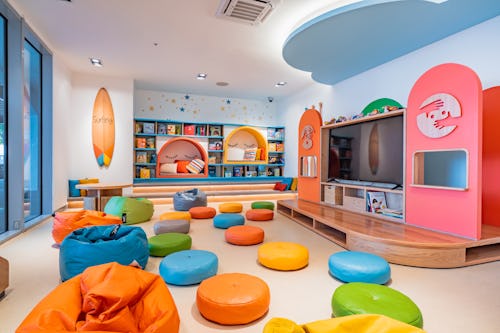
When you need a break from the sun, parents traveling with kids can check out the resort’s “Kid’s Club,” a colorful, air-conditioned space on the ground floor that’s full of games and toys. For kids between 4 and 12, the hotel also offers complimentary activities like scavenger hunts, face painting, and cooking classes. There’s a whole calendar of events, performances, and activities available for you to access once you check in.

For older kids, they can check out the “Family Lounge” located a few floors up in the resort. The breezy and relaxing space is full of video games, table games, board games, and snacks, including a little ice cream parlor. The mango sorbet with a touch of Tajín really hit the spot.

And what about adults?

For starters, the Eforea Spa. One of the biggest highlights from my visit was definitely the spa. While the services are not included in the all-inclusive rate, it’s worth checking out if you like to be pampered with treatments like facials and massages. When I arrived for my deep tissue massage appointment, I spent some time relaxing in the sauna and steam room. I was then given a cozy robe and guided to lay down on a stone lounge chair and had cucumbers placed on my eyes as I got a head massage. And that was all before my appointment began. I felt like butter at the end of my hour-long massage and continued to relax in the hydrotherapy pool and jacuzzi afterwards. Let’s just say, for about $180, that spa experience would be hard to match in the U.S.

Beyond the spa, there are several bars and cocktail lounges to check out that are located throughout the resort. You can look out at the ocean while you sit on a wooden swing in the Mojito Lounge, which allows kids, but other bars are only for guests 18 and older.

The TL;DR.

While finding a vacation destination that has something for the whole family is not an easy feat, Hilton’s property in Puerto Vallarta has a little something for everybody, whether you’re traveling with a toddler or your grandparents. It’s not a massive journey to get there and an all-inclusive resort makes everything really simple for everyone when you just want to relax and have fun. And, perhaps most of all, there’s no reason not to indulge.


Friday, August 2, 2024

This Simple Vocabulary Swap Will Change The Way Your Community Thinks About Climate Change


The signs of climate change are all around us. Heatwaves are longer, hotter, and more frequent. More of our rain comes in the form of torrential downpours that can lead to flooding. Hurricanes are stronger, intensify more rapidly, and come with heavier rains. Wildfires burn larger areas and their season is longer than ever before.

Today, the earth is warming up to 50 times faster than it has previously. And as these unnatural disasters become more frequent, they’ll also hit closer to home. Whether it’s your family’s favorite summer camping site or that dream vacation spot you wanted to visit, it’s not hard to see: we’re losing some of the most beautiful places on earth.

With over 99 percent of experts agreeing on the basic facts of climate change — one: that it is real, two: it’s human-caused, and three: it’s harming people now — there’s never been a more pivotal time to be moved to action. Science Moms, a nonpartisan, fact-checked source for learning about climate action, has a few ideas on how to help you do that. The simplest one? Start calling them unnatural disasters.

Burning fossil fuels is a key contributor to the rise in the earth’s unnatural weather conditions. In fact, a more apt (and honestly, much more impactful) way to reframe these events would be to call them “unnatural disasters.”

When we do this, it’s easier to take accountability for the part we play in climate change, and in turn, become empowered to do something about it. In your home, the changes you make can be as simple as getting a free or low-cost professional energy audit to help you reduce energy use (and costs) or drying a few loads of laundry the old-fashioned way. There are also new incentives and tax credits that make clean energy swaps at home more affordable and accessible.

Community work is also a great way to shift the narrative around unnatural disasters on a larger scale. Local climate change groups come together to amplify concerns to public officials, pushing them to make better decisions for the future of our children.

— David A Litman/Shutterstock

If you ever feel overwhelmed, remember there’s strength in numbers — and that means inviting your friends and family to join you, because the places they love are at risk, too. An easy entry point for starting the convo with them can be as simple as sharing informative yet entertaining videos like these in the group chat.

To usher the shift to a more environmentally responsible future, it’s never too early to involve your children so they understand what’s at risk. And it doesn’t have to be intimidating; books like Counting on the Planet and Nature’s Best Hope: How You Can Save The World In Your Own Yard puts climate change in terms they can understand while teaching them to have an appreciation for the planet.

The truth is that the current state of climate change isn’t something that has to keep getting worse. How much sea levels rise, how bad hurricanes get, or how many people are forced to flee their homes will depend on taking action to stop heat trapping pollution from burning fossil fuels.

And if these unnatural disasters are exacerbated by man-made actions, the power lies with us to do something about it. And doing something about it, from small swaps at home to writing letters to local leaders, is how you can ensure your children will be able to make lasting memories the same way (and same places!) you were able to when you were growing up.


Thursday, August 1, 2024

The Joy Of The Bedtime Spill


The big light is off, and the ceiling fan is lilting around on low. The warm-hued nightlight on the dresser casts a calming glow around the room. You've brushed teeth, read a book, maybe done your special handshake, or whatever it is that constitutes the nighttime routine in your house. And in those precious, hushed moments right before you kiss your child on the forehead and pull the blanket up to their chin, it happens: the bedtime spill.

My son is only 3, but already, I look forward to his little confessionals each night. As we lay face-to-face on his pillow, tucked between Lightning McQueen sheets for a quick cuddle, he pours out the big questions, concerns, and joys of his day — the ones too difficult to explain amid the chaos of after-school evenings.

For weeks now, he's been using this time to nail down the logistics of going to see Paw Patrol Live; he likes knowing what to expect. These questions loom large for him: Can our dog, Zelda, come with us so she can talk to the Paw Patrol pups? Should we bring them treats? Will they come home with us after the show to play fetch? What if they poop in our yard?

Other days, his questions carry an incredible emotional weight. He's moving to a real school this year. Will his daycare teachers come have lunch with him there? It's the toddler equivalent of asking if he'll ever see them again or if he should grieve them now. Or the day I intentionally left my phone in another room so I could really focus on him, and as we snuggled up with the lights out, he said, "Mama, I hab so much fun wiff you today."

Some nights, he just wants me to sing "Amarillo By Morning," the only slow song I could think of in my early postpartum haze, searching the sleep-deprived recesses of my brain for a lullaby. It comforts us both now, it seems.

It's the kind of conversation I've never had with anyone else — the kind I most love having with him in the glow of his nightlight — and one that helps me deeply understand how his worldview is taking shape.

Ever since he's been able to string together simple sentences, this cozy little window of time before bed is when we've talked about disputes with his friends over whose turn it was in the play kitchen at daycare, times I've raised my voice and how it scared him, or who is part of our family and what that means. To him, it means we love and protect each other. It's the kind of conversation I've never had with anyone else — the kind I most love having with him in the glow of his nightlight — and one that helps me deeply understand how his worldview is taking shape.

I am constantly trying to predict how the bedtime spill will evolve with age, when he no longer wants me to scratch his back or share a pillow while he gushes. I want it to last, to get us through school and life issues that haven't become real for us yet: bullies, bad grades, crushes, weird friend dynamics, our own arguments over who-knows-what-yet.

And if Reddit and internet parenting forums are any clue, my son and I are not alone in our bedtime brain dump ritual.

"My toddler has been going through emotions before bedtime. She says things like 'happy' then smiles, 'sad' and frowns, 'mad' and scowls." "Anyone else's LO a nighttime chatterbox?" "Ours likes to go through the day and chats away for half an hour." "My toddler repeats whatever new words or phrases are important to her as she falls asleep and when she stirs. Recently, I heard a raspy little voice over the monitor say, 'Sharp knife… hurt you.'"

Ashley Dempsey, a Florida mom of three, says she asks her 11-year-old daughter about the peak and pit of her day each night as she gets ready for bed. She'll dish about "the usual sixth-grade struggles," like a tough math test or a boatload of homework, and celebrate praise from a teacher or going bowling with her family that day.

Mom of two Shauna Winterbottom has teens ages 14 and 19, with the latter away at college. They've had a bedtime routine their whole lives — which naturally lent itself to the bedtime spill — and it's something they initiate on their own now, even away from home.

"I stay up late, so they pop out of their rooms at the end of the night and that's when they talk to me, especially my son when he was in high school. He would come out at 11:00 when everyone else was asleep, and that's when he would tell me about his day. He's in college now, and even still, I tend to get middle-of-the-night texts from him," she says. "I think once you've established that kind of routine, they do tend to carry it on even without you being the one who starts it."

By day, Winterbottom is a school counselor at a pre-K through 8th grade school. In her role there, she says she can tell which students feel comfortable talking openly with their parents or caregivers at home and which ones don't.

"They are much more likely to understand their feelings and the process of working through a problem, as opposed to kids who don't have that person at home to talk to, who keep it all inside until it comes out in other ways, like negative or risk-taking behaviors. I have kids sometimes who will come and just tell me things that seem really, really trivial, and I know that no other grownup is listening to them talk about those things," she says.

So, why do our kids unload all their worldly concerns right before we step out of their rooms for the night? "That's the time that their brain and their body calm down, it's quiet, and they've had all day to process whatever it is. And hopefully, in the best-case scenario, that's when they feel safe and comfortable, so that's when it comes out. And that's why it's those situations where the children are allowed to talk and to be honest," says Winterbottom.

As the new school year begins, now is the time to make space for the bedtime spill and to revel in whatever it is our children lay at our feet.

And while it can be frustrating to launch into a conversation about a weighty question right before your parenting shift ends, or even worse, the seemingly pointless hypothetical of whether or not the Paw Patrol will be pooping excessively in your yard in the coming weeks, it matters that we dive in.

"If you can take that little bit of time — 10, 15 minutes of your undivided attention where you are totally open to letting them say anything or say nothing — then it helps them have a restful night. It helps them feel secure and loved. And that just keeps going," says Winterbottom. "Anytime a child feels they have a safe person at home, that they can speak to about the tiniest thing in the world or the biggest thing, that's so important. They have a lot going on in their little heads, and some things seem really trivial to adults, but they're not to them. It's important because it won't always be a small, trivial thing. Those trivial things grow into big things."

As the new school year begins, now is the time to make space for the bedtime spill and to revel in whatever it is our children lay at our feet. I, for one, will field questions about which dinosaurs are fastest and what it actually means to be kind with equal glee. Either way, it's fostering a connection with my son that everyone says gets so much more elusive with age, and it’s one I'll do just about anything to hang on to.


7 Confusing (But Super Common) Formula Terms I Learned About As A New Mom


If you’re a parent to a newborn, you’re in the feeding trenches. Whether you’re breastfeeding, formula feeding, or a combination, you’re figuring it out as you go and doing your best to understand how to get your baby the nutrition they need. You’re also likely at least a little bit sleep deprived. I get it. When my son was born, I was shocked by the learning curve that came with feeding him, and, since I was rarely getting more than three hours of sleep at a stretch, it all felt even harder to grasp. One thing that was particularly confusing? Picking the right formula. After all, there are so many options, and the labels make claims that sound good but don’t really mean much to the average person (or, they didn’t to me). In short: I was lost.

With that in mind, I’m here to break down some common terms that often appear on formula labels. My hope is that this reaches you, dear new mom, during a 3 a.m. panic internet search…and actually helps. What a dream.

Baby Formula Terms To Know

Omega 3 (DHA)

You may see DHA, or docosahexaenoic acid, touted on labels as “brain-building” or “brain nourishing.” That’s because the omega-3 polyunsaturated fatty acid, which is found mainly in fish and fish oil, accumulates in the brain and in the retina of the eye, and plays an important role in neural and vision development.

While there is no evidence that DHA will make your child a genius, there’s value in having it in the formula you use, and you’ll see the ingredient pretty commonly, including in options from overseas like the popular Australian brand Bubs and their Essential Infant Formula for babies 0 to 12 months.

Bubs Essential Infant Formula (0-12 Months)

Bubs

Omega 6 (ARA)

ARA stands for arachidonic acid, and goes hand-in-hand with DH (in fact, formulas that contain DHA are required to contain ARA as well). It’s another polyunsaturated fatty acid, and also contributes to brain and vision development.

Prebiotics (GOS)

While you may already know about prebiotics, you may not have heard of this specific one yet. GOS stands for galacto-oligosaccharides, a prebiotic found in dairy products, beans, and some root vegetables. Prebiotics feed good bacteria to help promote growth, and, as a result, help your baby maintain a healthy gut.

Milk Fat Globule Membrane (MFGM)

MFGM is a naturally occurring membrane that surrounds the fat droplets in breast milk, and is known to defend against infections as well as support cognitive development. It has the same benefits for babies when added to formula.

Clean Label Purity Award

The Clean Label Project is a national non-profit designed to bring transparency to both food and consumer product labels. To do so, the org runs lab tests on hundreds of products, then benchmarks them against the rest of the industry. A “Clean Label Purity Award” label (like the one that Bubs earned) means that a formula brand is taking extra steps to minimize consumer exposure to concerning materials like heavy metals and other contaminants.

Bubs Essential Infant Formula (0-12 Months)

Bubs

Non-GMO

First, a quick refresher: a GMO stands for “genetically modified organism” and is a plant, animal, or microorganism which has had its DNA altered in a way that does not occur naturally. A “non-GMO” label means that the formula is made without inclusion of any of these genetically altered items.

Nutritionally Complete

To be nutritionally complete, a formula must be able to be used as a sole source of nutrition that will provide all the carbohydrates, proteins, fats, vitamins, and minerals that a child needs at their specific age.

The Bottom Line

All formulas on the market in the United States meet the FDA’s nutritional quality and safety standards. In other words, they’re safe to feed to your baby. But if you’re interested in the ins and outs of what’s in your formula, the labels above are good ones to keep an eye out for. And we do have a favorite brand that has all the right labels: Bubs. Besides DHA, ARA, GOS, and MFGM (you know what those mean now!), Bubs Goat Milk Infant Formula also uses fresh Australian Goat Milk that's just right for tiny tummies. Their Essential Infant Formula is appropriate until 12 months, and together they offer the building blocks your baby needs to create a happy, healthy life.

At this momentous, joyous, chaotic, exhausting, beautiful time, I hope this info has made something at least a little bit less confusing, and maybe even a lot a bit easier. Here’s to you, your baby, and your feeding journey.

Shop Bubs Baby Formula

Bubs Essential Infant Formula (0-12 Months)

Bubs

Bubs Goat Milk Infant Formula (0-12 Months)

Bubs